












Far too often, the advice offered to junior scientists in my orbit boils down to one instruction: “Delete your social media account.”
The advice is easy to understand. On many platforms, scientists spend hours recirculating bad news: the fall of democracy, climate crises, and an escalating war on science. The pessimism is not unwarranted, but it has become a professional performance. In some corners of the internet, gloom has become a kind of social currency, delivered through recycled headlines, not-very-funny jokes, and the ambient despair of a crowdsourced depression factory.
Neurobiologist Stuart Firestein arrives with a more dangerous recommendation: optimism. His latest book, “It Could Be Otherwise: Science in the Age of Uncertainty,” forms the third part of a loose trilogy about the less orderly parts of science. Firestein’s first popular science book, “Ignorance: How It Drives Science,” published in 2012, examined how unanswered questions propel discovery. And three years later, “Failure: Why Science Is So Successful” considered error and failed experiments as ordinary features of research. Firestein’s decision to pursue optimism is a bold one, given the times we are in.
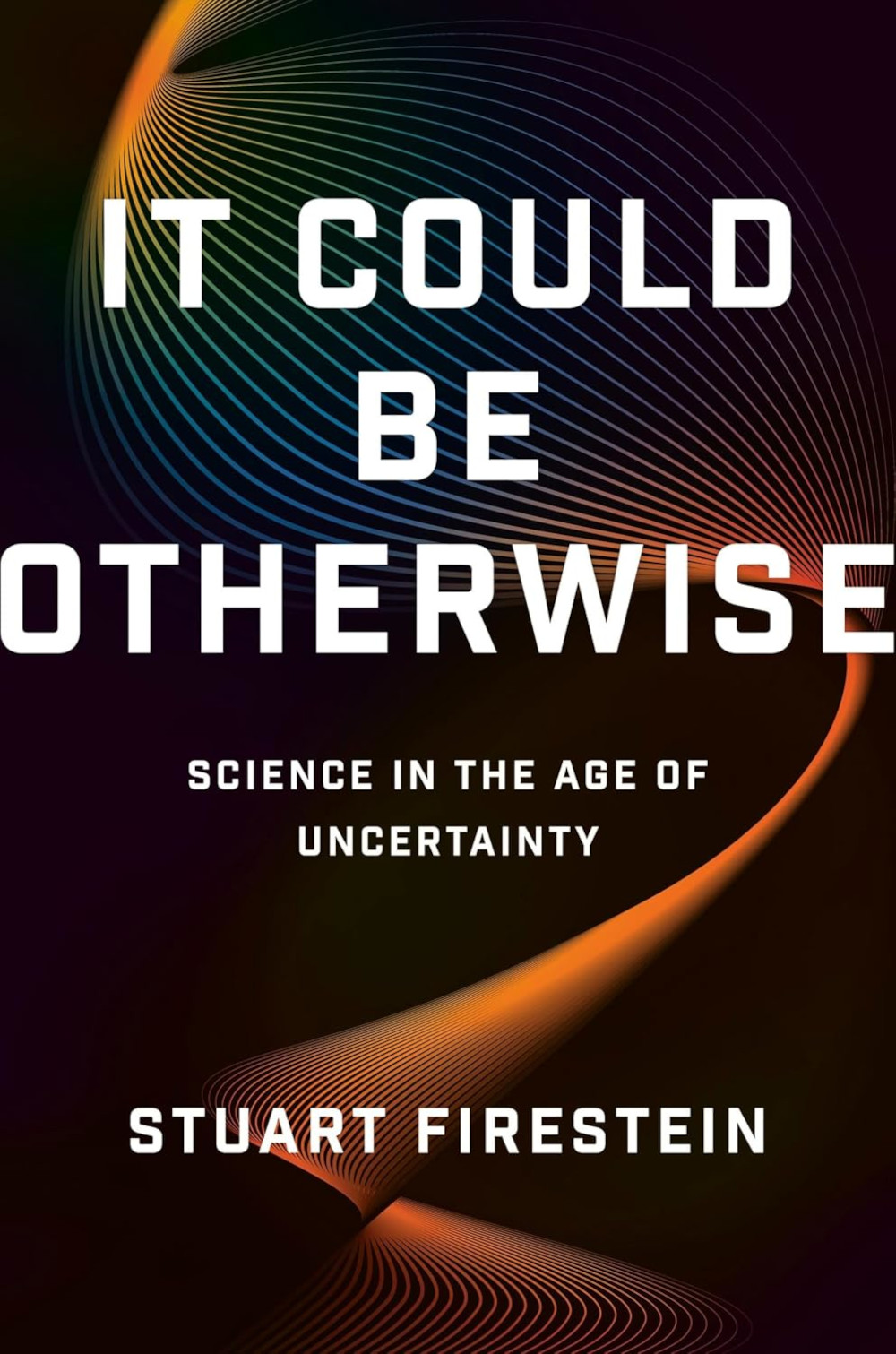
BOOK REVIEW — “It Could Be Otherwise: Science in the Age of Uncertainty,” by Stuart Firestein (Basic Books, 288 pages).
In today’s climate, we can associate optimism with the naïve positivity of tech overlords, who believe that anything is possible largely because they remain insulated from the immediate costs of their decisions. But Firestein means something much different. He offers us a powerful argument for why optimism is an appropriate disposition for the practitioner of science.
Firestein uses optimism as a philosophical position rather than a synonym for happiness. “I want to complicate the idea of optimism by claiming it as a philosophy, and not merely a matter of positive thinking,” he writes. That distinction allows Firestein to ask which scientific habits leave room for alternative futures and which treat the future as already settled. More than that, however, Firestein uses optimism as a locomotive for a rich tour of the history and philosophy of science.
The book’s central adversary is determinism — if every event is fixed by strict formalisms and universal laws, hope is a fruitless emotion in the face of outcomes that have already been decided. In this sense, it is an imagination-killing device, where natural systems are simple puzzles to be solved, rather than complex knots to be untangled.
From Firestein’s perspective, uncertainty leaves room for possibility, and possibility drives curiosity, imagination, and the agency to study the peculiarities of the natural world. Many of Firestein’s examples come from his home turf of biology. Mutation, contingency, historical dependence, and emergent organization all frustrate the fantasy that a living world can be fully reconstructed from a compact set of formalisms.
“I want to complicate the idea of optimism by claiming it as a philosophy, and not merely a matter of positive thinking.”
Firestein builds this case by walking us through the Scientific Revolution and its intellectual lineage. The book’s middle third includes the provocatively titled chapter “F— the Enlightenment.” He proposes readers should temper their reverence for the Enlightenment, or at least the version that promises a single, final explanation for nature. Given the exalted place of Baconian empiricism, Buffon’s natural history, and Lockean political thought in standard accounts of modern science, the criticism lands: “The Enlightenment was haunted by the twin villains of ultimate single solutions and determinism. Both kill optimism, and along with it the kind of science practiced since the seventeenth century.”
His criticism also comes from inside experimental neuroscience, a field that has often advanced by studying organisms at the level of genes, cells, circuits, and signals. Firestein knows the power of this perspective as well as anyone, and his familiarity with the terrain of deterministic, atomistic, reductionist thinking makes him an appropriate foil. Sure, the Enlightenment gave the world many great ideas. But it created the (mostly) false notion that there are simple solutions to complex problems.
Later chapters incorporate Darwinian evolution, probability, complexity science, and pluralism into his argument in favor of scientific optimism. It reads as both a guided tour and a cumulative argument, each subject offering a different reason to resist final answers. Evolutionary history foregrounds the power of contingency. And complexity science shows how collective behavior can exceed what a list of components would lead us to expect.
Get Our Newsletter

The book’s penultimate chapter, “Diffusion,” is where we meet Firestein the teacher and advocate for science education and literacy. It is not a policy decree, but rather highlights the manner that information can more efficiently diffuse between people, settings, and institutions.
He closes the book with a personal reflection that also serves as a guide for how to do the kind of multifaceted work that undermines determinism and fosters a clearer picture of the world that we aim to understand. He invokes the work of philosopher Isaiah Berlin, who proposed the sort of idea of pluralism that Firestein believes we should embrace. And his argument serves as both a call to scholarly arms and a rebuke of intransigence of modern natural scientists, who (in his eyes) have a limited view of the value of pluralism, and don’t often enough challenge deterministic leanings.
In an age when pessimism is what all the cool kids seem to embrace, “It Could Be Otherwise” is the book we need now. It was written by an eminent scientist, who dared to leave his scientific nest in the hope of teaching us how we arrived here, and how science can do better.
Firestein’s argument serves as both a call to scholarly arms and a rebuke of intransigence of modern natural scientists.
And one of Firestein’s most poignant recommendations for doing it better is a theme that runs throughout: Part of progress and optimism is in the far-reaching powers of science communication. He mentions this as part of the recipe for progress in a chapter titled “Making Progress Toward Optimism”: “A final component for producing progress as an idea is that it be public and widely known.”
Firestein wants a science that is not only smarter, but more integrative, and inclusive. And in some ways, the notion that we can take this world of complicated ideas that have existed for many centuries, and make them accessible to billions of people, is one of the most profoundly optimistic messages that we can embrace.
Disclosure: The author of this review and the author of the book are both affiliated with the Santa Fe Institute, an independent nonprofit research center for complex systems science.