












The English chemist and physicist Michael Faraday had a unique way of teaching the science of how water expands when it freezes — a famously counterintuitive phenomenon. During his Christmas lectures delivered at London’s Royal Institution in the winter of 1860–61, he placed two sealed, water-filled iron bottles into a mixture of ice and salt. He told his audience to expect a pop, then continued lecturing while the water froze. One bottle split open and the second burst, scattering the surrounding icy mixture. The audience learned that water expands as it freezes, and even an iron container couldn’t contain it.

Faraday, known for attaining scientific fame from humble beginnings, thought carefully about how to speak to, educate, and entertain an audience. In an 1813 letter to a friend, he lamented the stale manner in which many scholars spoke, advising against appearing “glued to the table or screwed on the floor.” He encouraged the live demonstration of experiments and recommended that lectures stay within one hour.
I believe that in our current era, the live presentation of science — whether it takes the form of public seminars or smaller gatherings among experts — deserves greater emphasis and attention. I argue this for two primary reasons: The importance of social position among scientists has corrupted our ability to identify scientific talent, and the rise of artificial intelligence in science increasingly complicates our notion of expertise. In such an environment, we must rely more on analog interactions, as they are harder to hack with well-connected professional networks or modern technology.
The live presentation includes public talks (of the sort that Faraday gave), dissertation defenses, job presentations, conference talks, and lectures similar to the ones we heard from teachers in high school or college. It is one of the few scientific products created by an author independently, without directly accessing a professional network. It is true that the work presented might be the result of large-scale collaboration or might have been amplified by a well-regarded network of scientists in that field: It’s easy to publish in a prestigious journal when you’re working with people who regularly publish in such journals. But the lone scientist, equipped with a microphone and little else, cannot rely on help from an army of hardworking trainees, a gifted biochemist collaborator, or an adviser who is a member of the National Academy of Sciences. At its core, it is just the speaker and the audience.
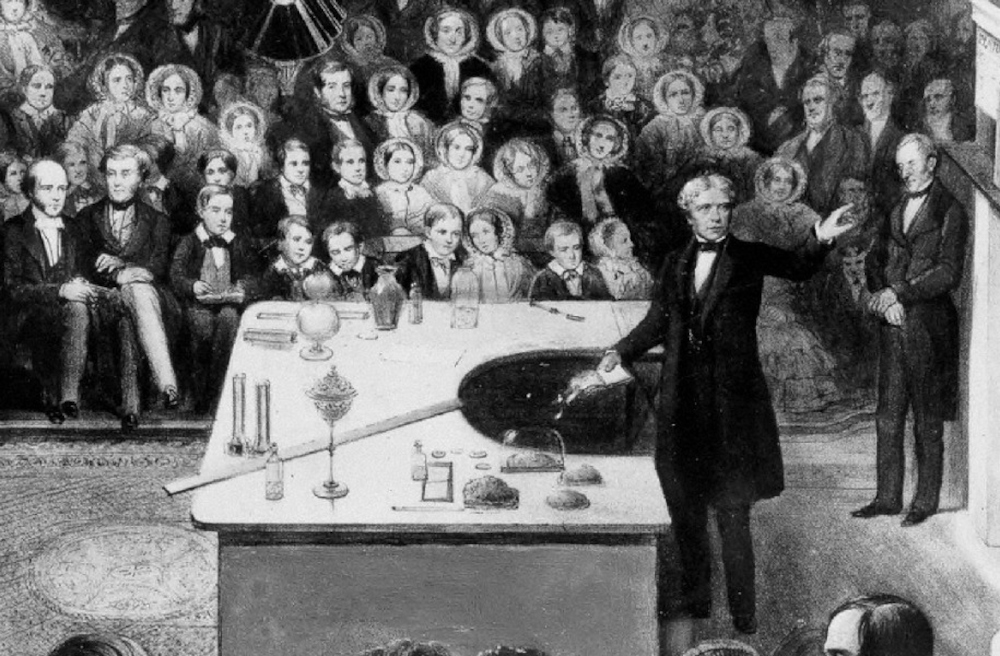
A lithograph by Alexander Blaikley depicts Michael Faraday delivering one of his public Christmas lectures in the 1850s.
Visual: Wikimedia Commons
This independence is key: Studies have highlighted the ways in which institutional affiliation, adjacency to influence, and other factors can shape scientific prestige and the professional rewards associated with it (in hiring and promotion, for example). These findings undermine our belief in a free and fair marketplace of talent and ideas — a key ingredient in science’s ability to solve complex problems and a likely source of the public’s belief in it.
But if elite social networks have muddied our picture of scientific contribution, then the explosion of AI has fully scrambled it. The conversations about the intersection of AI and scientific productivity are widespread, but most agree on one in particular: The large language models undergirding such tools have already subverted many parts of the scientific pipeline. For instance, researchers have developed an “AI Scientist” that can autonomously generate research ideas, write code, run computational experiments, and produce manuscripts.
Even if an AI scientist can perform these activities, the human scientist should still be able to package the results in a manner that can be verbally communicated to audiences. Surely, an AI scientist could answer spontaneous questions from audience members and interlocutors. But a live presentation — given by a real person in real time and witnessed by other real people — provides an opportunity to observe which humans know what they are talking about, and which are powerless without their professional peers or Claude agents.
However splashy the results, the performance of the presenting scientist — especially during the audience Q&A portion of the presentation — can capture their ability to deconstruct complex ideas, think on their feet, highlight their scholarly depth, and connect their work to that of others. Virtual presentations also qualify and would remove the requirement that all participants be physically present, provided the answers are the speaker’s own. (Of course, the virtual setting may allow one to lean on digital tools, thus removing some of the independence of the live presentation.)
Like a DJ, the presenter should reconfigure their work into a compelling and digestible set of stories about whatever corner of the natural world they work in.
There are also many reasons why we should be cynical of the live presentation. For one, it favors those who are capable of live speech — those with speech or hearing impairments can be at a distinct disadvantage, although captioning, interpreters, and speech-generating devices can help. But the ableism in science has long been a problem that requires a grander solution.
Furthermore, live presentations are generally easier for native speakers of English, the unofficial language of science around the world. Maybe paradoxically, technology can help to address this disparity: AI-assisted live translation can be a tool (even if it is imperfect) to help audience members understand the content of a presentation, regardless of the language it is spoken in. But there are other barriers here, as a sense of humor (often key in live presentations) and context cues can be lost in translation. Also, hinging our decisions on who is and who isn’t an expert based on singular presentations suffers from a sample size problem: To judge a scientist for one hour — as we do during the job interview process, for example — when their career contributions took many hundreds, feels like an insufficient way to gauge the full scope of the contributions of an individual scientist.
To this last point, I’d suggest that the live seminar is not a singular event at all. It is no less a singular object than the single scientific manuscript is. And we hire and award Nobel Prizes partly based on the latter. Like the scientific manuscript, the presentation is the product of deep thought, repetition, iteration, and intelligent curation. Part of my wish is that the presentation be elevated to a status equivalent to (or perhaps equal to) that of the scientific publication.
Get Our Newsletter

Think of it this way: Many successful professionals must complete examinations of some kind during their educational journey. Think of the presentation as a standardized examination, but better: The test taker (the speaker) curates the topic area and scope. Their evaluation or audience appreciation rests on their ability to deliver the content in an organized, accessible fashion and answer technical questions about the work.
In order for the live presentation to attain new eminence, we need to reconsider how the presentation is given and what its purpose is. Too many modern seminars simply summarize existing findings, leaving audience members to ask themselves why they showed up at all, as they simply could have read the presenter’s paper. Instead, the presentation should be akin to a mixtape: Like a DJ, the presenter should reconfigure their work (published or not) into a compelling and digestible set of stories about whatever corner of the natural world they work in.
It is no surprise that Faraday took a particular interest in how science was presented. His example suggests that the scientist functions better as a magician, who thrives on displaying magic for observers, than as a sorcerer, who is revered or feared for their powers. This is a lesson that is especially important in an age where we are reflecting on the social contract between science and the public.