








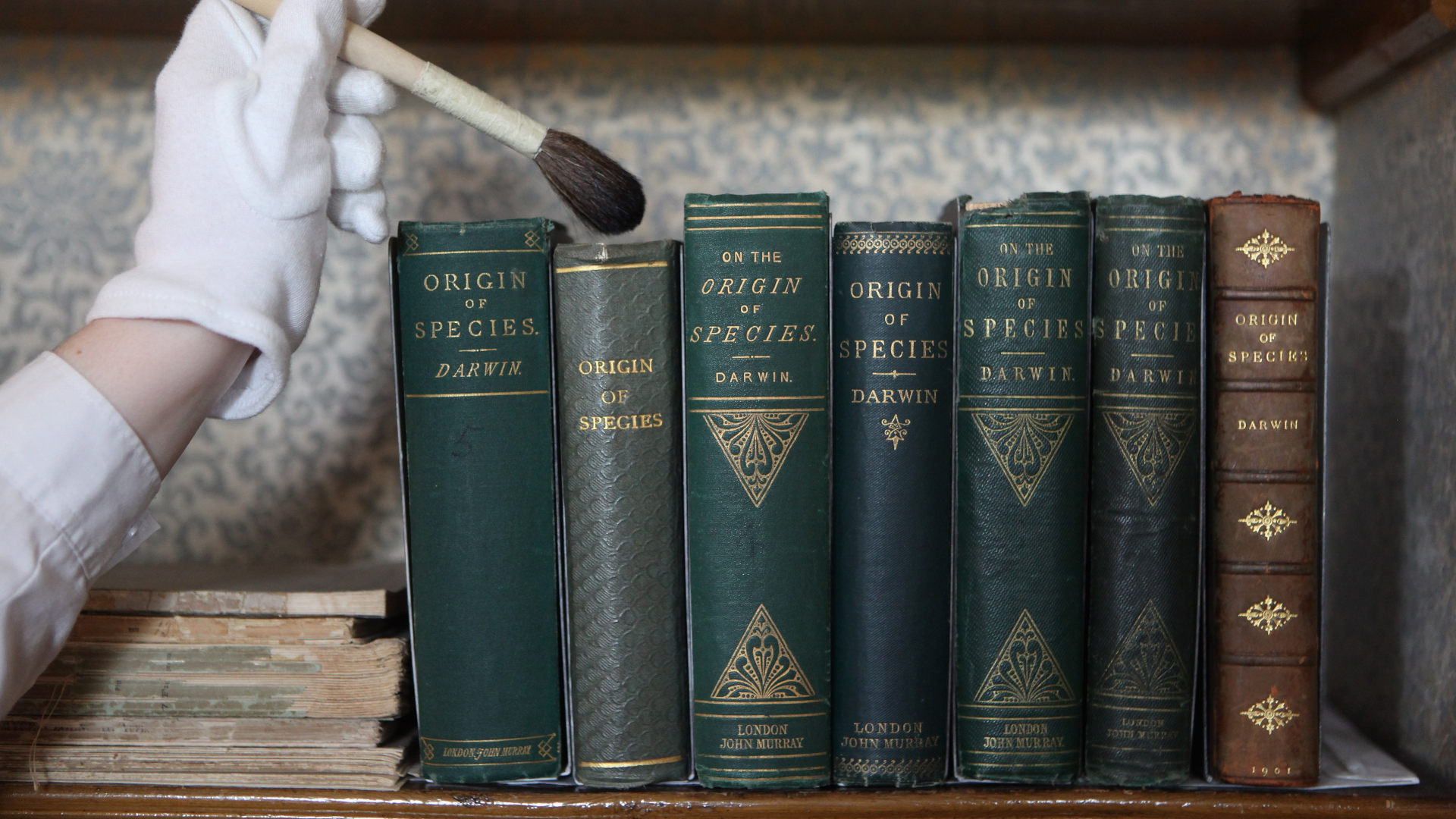


During the fall semester of 2025, I taught a graduate seminar entitled “Darwinian Thought and Society.” While teaching should always derive from generosity and a desire to share knowledge, my motivations were partly selfish. The course was an opportunity for me to re-engage with Darwin’s foundational ideas in the company of some of the brightest junior scientists that I’ve ever come across.

The conversations around the first book we read, Darwin’s 1859 “On the Origin of Species,” were mostly familiar ones. We often discussed his use of evidence and his voluminous knowledge of natural history. But other features stood out. For example, the manner in which the book delivered its theoretical argument is unlike what scientific opuses do today. The book contains no equations and only a single figure, a diagram often described as the world’s first phylogenetic tree. It contains no detailed experimental design. There are no statistical methods, or power calculations. Yet the ideas in it are among the most radical and dangerous in the Western canon. In 2026, science has been forced into a deep reflection phase with regard to its present and its future. Revisiting Darwin offers useful lessons for the terrain we now occupy.
One of the revelations from the course was something that I already knew but had not fully absorbed: that the most compelling aspect of Darwin’s work is the manner in which he arranged, staged, and presented the evidence. Darwin did not persuade with numbers, strict axioms, or formalisms. He built worlds for the reader to inhabit, such that our doubts collapse under the steady pressure of his observations, stitched together through turns-of-phrase. In this sense, “On the Origin of Species” — arguably the most important scientific treatise since Isaac Newton’s “The Mathematical Principles of Natural Philosophy” — can be responsibly described as a work of prose and science communication. And his broader corpus is a gift because it encourages conversation rather than fruitless provocation and allows us to discuss, with clarity, even his most controversial ideas.
Science has been forced into a deep reflection phase with regard to its present and its future. Revisiting Darwin offers useful lessons for the terrain we now occupy.
On the first day of class, I joked with students that I would play the role of their politically conservative uncle. That is, there would be no trigger warnings and none of the cushioning that has become standard in college courses that include exposure to ideas and readings with offensive language or content. I told them that we would read Darwin’s books as they were written and try to understand them, and if they didn’t like that, to enroll in a different course. The larger lesson was simple: To study a complex world, you must read difficult material and learn to interpret it with rigor and empathy.
I was priming the class for Darwin’s views on race and gender, ideas that complicate many of our largely positive opinions of him (mine included). Some of my selective memory, which demotes his problematic takes, has support: There is a literature on how progressive he was compared to scientists like his cousin Francis Galton, who coined the term “eugenics” in 1883. But reading Darwin’s 1871 book “The Descent of Man” in a classroom with several young women from around the world softened my rigid stance that the right response to backward takes is to simply get over them. I still believe that refusing to read or interpret such work is unscholarly. But I also came to admit something I had been too eager to brush aside: Even when we consider historical context, there is still something painful about reading a giant of science describe human differences in the language of hierarchy, rank, and levels of civilization.
More generally, the experience taught me that science education is not merely the transfer of correct ideas from one generation to the next. It is also an apprenticeship in judgment. It is where students learn how to handle brilliance contaminated by prejudice, how to read carefully without worship, and how to separate historical importance from moral innocence. We do not protect science by pretending its heroes were unassailable. We protect it by showing that truth-seeking is a long walk on rugged terrain.
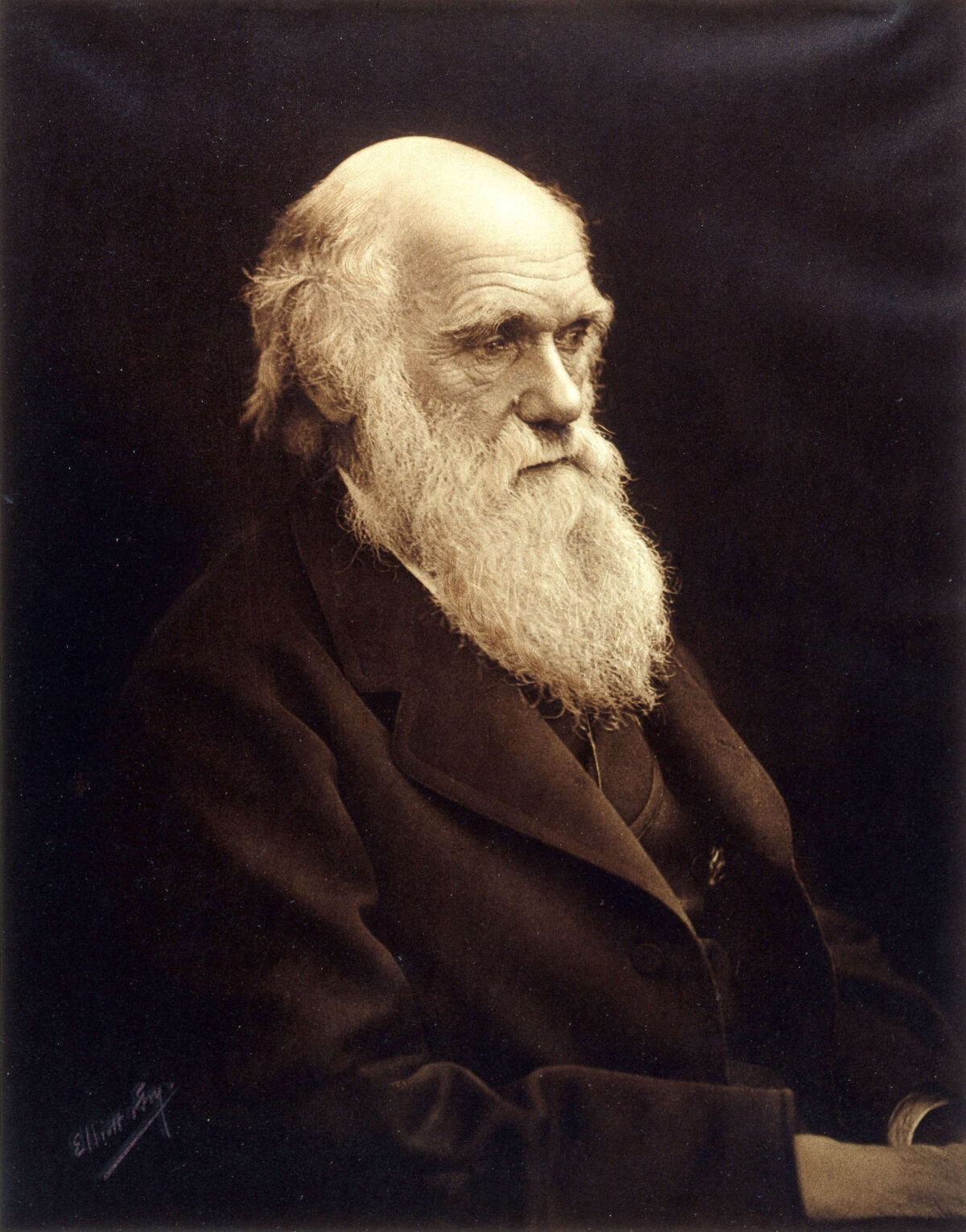
Portrait photograph of Charles Darwin. The most compelling aspect of Darwin’s work, argues C. Brandon Ogbunu, is the manner in which he arranged, staged, and presented evidence.
Visual: Wellcome Collection
In casual conversations, groups of friends and I have conducted the thought experiment of what Darwin would be like if he were around today. Usually, our results highlight some of his peculiarities: He was a naturalist but only received formal education in medicine (studies that he did not complete) and theology. He was wealthy and well connected, but was not an exceptional student, and famously lacked the mathematical proclivities of some of his contemporaries. But there is a more provocative dimension to the thought-exercise. I contend that 2026’s Darwin would carry the same savant-like obsession with nature but would apply it to the most complex social questions of today. His interests would surely transcend natural history and theories of evolution. He would care about the misinformation crisis, climate science, and have opinions about how to live in a world being upended by artificial intelligence and threats to democracy. He did not care much for disciplinary boundaries in his own time, and he would not care for them now. His computer desktop would have dozens of folders, some with machine-learning papers, others full of ornithology monographs. And he’d read them all.
What I’m offering may sound obvious to some, but the multiplicity that I discovered in Darwin is far from what I see encouraged in the scientists of today. In my view, scientific progress can be summarized as a race for prizes and the ability to gamify metrics, just as much as any other ambition. We build reputations in idea spaces often dominated by factions. We are penalized for pivoting into new areas of inquiry. We flood the market with ideas, hoping one of them catches fire. Surely, a love for the natural world lives in there somewhere, but the incentive structure has turned many of us into human large-language models, where we sometimes do not care about what we are measuring or why, as long as it lands in the pages of a prestigious journal. In this respect at least, I can’t help but lament at how far we have fallen from the days of Darwin, even if science has improved in many aspects (for example, it is far more diverse and inclusive than in his day). For Darwin at least, science was a conversation between humans and nature, more than it was an industry. I wish that were true today, for all of us.
Because I offer critiques of the science status quo, I am often characterized as something of a cowboy (charitably) or a gadfly (a label I resent). But what I aspire to be, more than anything, is an intellectual child of Charles Darwin. By this I do not mean a disciple of every belief he held, nor a romantic devotee of his era. I mean someone who believes that science is bigger than its rituals, that it should be hospitable to unusual minds, and that difficult truths must be faced directly.
THnk you for this thoughtful comment. I couldn’t agree more and appreciate you putting it into practice and print. I too would like support the the thoughts beyond the box- the phenomenological obeserver who sees beyond the particulars. Thank you for this piece.
I realized something similar to your awakening, when I was in grad school in psychology. Most of the academic research (this was the 60s & 70s) were very button holed within a very small area but I began to discover that those who made leaps in the field were people who used observation as the basis of their major contributions (e.g. William James, Freud, Piaget,etc). It was like the difference between a major architect and the engineers who worked out particular design problems. Deduction had taken over academia vs induction with a greater view of intertwined processes.