










How One Company Wants to Make Geoengineering Profitable
In July 2012, a renegade American businessman, Russ George, took a ship off the coast of British Columbia and dumped 100 tons of iron sulfate dust into the Pacific Ocean. He had unilaterally, and some suggest illegally, decided to trigger an algae bloom to absorb some carbon dioxide from the atmosphere — an attempt at geoengineering, a tech-based approach to combating climate change. It was a one-off, the largest known geoengineering experiment at the time, and a harbinger for more to come.
Now a startup called Stardust seeks something more ambitious: developing proprietary geoengineering technology that would help block sun rays from reaching the planet. Stardust formed in 2023 and is based in Israel, but incorporated in the United States.

Its approach is novel: Most geoengineering research today is led by scientists in the U.S. at universities and federal agencies, and the work they are doing is more or less accessible to public scrutiny. Stardust is at the forefront of an alternative path: One in which private companies drive the development, and perhaps deployment, of technologies that experts say could have profound consequences for the planet.
Geoengineering projects, even those led by climate scientists at major universities, have previously drawn the ire of environmentalists and other groups. Such a deliberate transformation of the atmosphere has never been done, and many uncertainties remain. If a geoengineering project went awry, for example, it could contribute to air pollution and ozone loss, or have dramatic effects on weather patterns, such as disrupting monsoons in populous South and East Asia.
But as global temperatures rise, public and scientific sentiments are shifting. If those temperature trends continue, governments or private entities may ultimately use geoengineering to alleviate or avoid the worst impacts of extreme weather, including deadly heat waves, firestorms, and hurricanes. And whoever deploys the technology will need to keep it up for decades while pent-up greenhouse gases gradually dissipate or are removed.
Few outsiders have gotten a glimpse of Stardust’s plans, and the company has not publicly released details about its technology, its business model, or exactly who works at its company. But the company appears to be positioning itself to develop and sell a proprietary geoengineering technology to governments that are considering making modifications to the global climate — acting like a kind of defense contractor for climate alteration.
Stardust is moving ahead amid few national and international rules and oversight, and a recent report by the company’s former climate governance consultant, Janos Pasztor, called for the company to increase its transparency, engagement, and communication with outsiders. The report provides rare insight into the so-far reticent company. But, so far, Pasztor told Undark, the company has not met all of his requests. Stardust still needs to implement his recommendations, and “be as transparent as possible, be available proactively to respond to questions people may have, and also to engage with other actors,” he said, because they do not, or not yet, have a “social license” for geoengineering activities.
Such a deliberate transformation of the atmosphere has never been done, and many uncertainties remain.
The company is led by CEO and cofounder Yanai Yedvab, a former deputy chief scientist at the Israel Atomic Energy Commission, which oversees the country’s clandestine nuclear program. Through Eli Zupnick, a communications officer hired by the company, Yedvab never accepted Undark’s many requests for an interview. But in an emailed statement to Undark sent via Zupnick, Yedvab wrote: “Stardust is a startup focused on researching and developing technologies that may potentially stop global warming in the short term.” The company, he continued, is “studying and developing a safe, responsible, and controllable solar radiation modification” and “our goal is to enable informed and responsible decision making of the international community and governments.”
Despite Stardust’s low profile, the company rejects being referred to as “secretive.” “Publishing all the products of our research without any exception is critical,” Yedvab wrote, adding that the company is “unwaveringly committed” to publishing results “as one of the measures to gain public trust.” Stardust has not published any of its research at this time, but Yedvab stressed they will do so once “scientific validation is concluded” on all of their results.
For decades, researchers have explored a variety of approaches to hacking the climate. Today, the most common approach is a type of solar geoengineering that involves flying high-altitude aircraft or balloons to release reflective particles in the high atmosphere, well above the flight paths of commercial planes. The technique, known as stratospheric aerosol injection, requires deploying tiny, carefully- chosen particles in precise amounts. In order to work well, the particles need to be periodically replenished.
Scientists have accumulated evidence for this approach by studying natural events that have flung small particles into the atmosphere. For instance, after an eruption of Mount Pinatubo in 1991, sulfur dioxide and hydrogen sulfide hung in the atmosphere and measurably cooled the planet for more than a year.

The 1991 eruption of Mount Pinatubo, seen from Clark Air Base in the Philippines. Sulfur dioxide and hydrogen sulfide emitted during the eruption measurably cooled the planet for more than a year.
Visual: Richard P. Hoblitt/USGS
Thanks to studies of that volcanic activity, some scientists argue that the environmental risks of deliberately strewing sulfates in the atmosphere are well understood. Although there are potential health risks from the approach, they say, they are small in comparison to the health risks from climate change. “We know that sulfuric acid air pollution causes mortality, and we roughly know how much. There’s more than a century of studies. We’re very unlikely to be wrong about that,” said David Keith, head of the Climate Systems Engineering initiative at the University of Chicago and an advocate of geoengineering research. In a new study, Keith and his colleagues argue that the health risks of sulfate particulates in the atmosphere are heavily outweighed by the potential impacts of not deploying geoengineering technologies.
Stardust plans a similar approach, but with a proprietary aerosol particle that’s less well understood, in Keith’s view. The company plans to distribute the particles through a machine mounted on an aircraft, according to Pasztor, a veteran climate diplomat and policy expert at the United Nations and elsewhere. According to Pasztor’s report, which he published on LinkedIn in September 2024, the company is engineering the particle and a prototype of the aircraft mount, as well as developing a system for modeling and monitoring the climatic effects. Over the coming year, Pasztor wrote, the company is planning on advancing those technologies and testing those particles in the stratosphere.
Yedvab confirmed that they are working on the technologies, saying in a statement to Undark that any such experiment would be done in a “contained, non-dispersive manner,” meaning that its particles would not be strewn over a wide area. It also committed to publishing information about any such outdoor geoengineering tests. Yedvab said that the company has not performed any such outdoor experiments yet, but it has done “a few outdoor aerial checks.” That meant that they have tested their dispersal system “under flight conditions,” but they haven’t yet scattered their aerosols in the atmosphere.
Get Our Newsletter

Those experimental particles do not appear to involve sulfates, meaning there is little data showing how well they might work. “It might be better in some respects, but on the other hand it’s going to be much harder to be confident about knowing what its risks are,” Keith said.
In his emailed statement, Yedvab confirmed the company is testing non-sulfate particles: “The ability to tailor particle properties to meet a broad set of requirements — safety, effectiveness, cost, and dispersibility — is a key advantage of our approach, giving it a distinct edge over sulfates and other candidate particles.”
As Stardust continues its research and development, it has drawn scrutiny, including from Pasztor. After retiring as a veteran climate diplomat, Pasztor agreed to work with Stardust in 2024 as an independent consultant. Rather than keep the remuneration for his work, he instead donated the entirety of it to the United Nations Relief and Works Agency for Palestine Refugees, or UNRWA, he told Undark.
The aim of Pasztor’s project was to highlight the need for clear international rules and oversight for geoengineering. He also wanted to make recommendations for Stardust — and for any other such geoengineering company — about how to ethically develop and deploy its technology.
Right now, there are no international rules or treaties that put obvious limits on this kind of work. As a result, an individual company or government can take dramatic gambles with the climate, in ways that could affect billions of lives, and it doesn’t have to get permission from anyone to do it.
According to Pasztor’s report, there should be rules that allow more people to be involved in that decision before it happens. Failing that, he said, Stardust should voluntarily tell the public what it’s doing and make sure it’s getting input from lots of different groups of people before it tinkers with the planetary thermostat.
“There’s one big area, transparency and outreach, to engage with the rest of the world, to the extent that the IP process allows,” he told Undark. Building trust through “a strategy of maximum transparency” should become a priority for them, he recommended in the report.
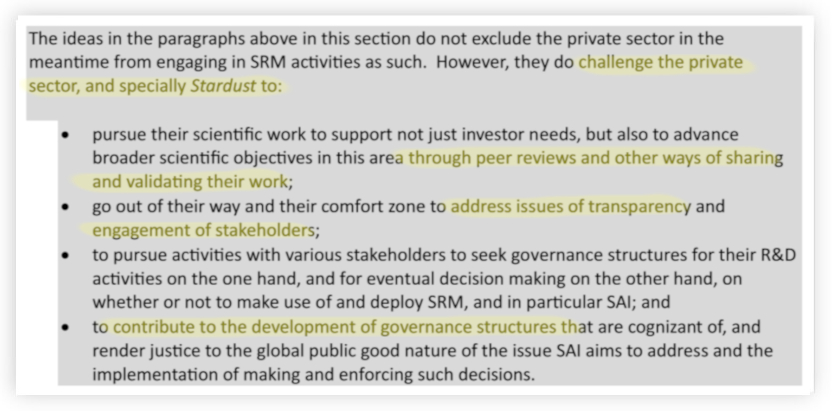
Stardust agreed to publish a public website, including providing a copy of Pasztor’s report, and to develop a voluntary code of conduct, he said. That would publicly lay out how they intend to conduct their research and development, including agreeing not to be involved in large-scale implementation, which would instead be under the purview of government agencies. Pasztor expected Stardust to publish this information last September or soon afterward .
For a while, though, no website appeared. “They were going to publish all of that on their website. Now they are delayed,” he said during a conversation in January. “Come on guys, this is getting embarrassing.”
In early February, while Undark was reporting this article, Stardust published a bare-bones website. The site links to Pasztor’s report and lists seven principles, including “prioritizing safety and scientific integrity,” publishing “unfavorable results as well as favorable ones,” and “supporting comprehensive regulation of this emerging field.”
“Come on guys, this is getting embarrassing.”
The site doesn’t describe who works for the company, but a statement provided to Undark by Zupnick noted that Stardust has 25 physicists, chemists, and engineers on the team and listed some of the company’s leadership: Yedvab, the CEO; chief product officer Amyad Spector, a physicist and a former employee of the Israeli government’s nuclear research program; and lead scientist Eli Waxman, an astrophysicist at the Weizmann Institute of Science who formerly served as Spector’s academic supervisor.
Stardust has not yet released a code of conduct, which the company described to Undark as “guiding principles” that “represent a set of voluntary commitments we have adopted in the absence of a dedicated regulatory framework.” In an email sent to Undark by Zupnick, Yedvab stressed that the company complies with all applicable governmental and international regulations.
Some groups, however, like the Center for International Environmental Law, say that Stardust’s efforts could violate the Convention on Biological Diversity’s de facto moratorium on geoengineering activities. “By developing and planning to commercialize solar geoengineering technology, Stardust is accelerating a reckless race and potentially violating agreements of the Convention on Biological Diversity,” said CIEL’s geoengineering campaign manager, Mary Church, in a statement in February. Any deployment of the technology, Church wrote, would likely “be controlled by a handful of major powers and corporations.”
Stardust’s prospective clients seem to be governments: As countries consider geoengineering, Stardust could be poised to sell them tools to meet those goals, several experts said. In an emailed answer to questions about its business model, Yedvab described the company’s approach as “founded on the premise” that solar geoengineering “will play a critical role in addressing global warming in the coming decades.”
The company’s portfolio of technologies, Yedvab added, “could be deployed following decisions by the U.S. government and international community.”
The company is attempting to patent its geoengineering technology. “We anticipate that as U.S.-led [geoengineering] research and development programs advance, the value of Stardust’s technological portfolio will grow accordingly,” Yedvab wrote. Pasztor’s report adds that if governments decide not to pursue geoengineering, investors “risk not receiving a return on their investment.”

The prospect of proprietary, privately held geoengineering technology worries some experts. Pasztor recommends that Stardust work with its investors to explore ways to give away their intellectual property, akin to how Volvo made its patented three-point seatbelt design freely available to other manufacturers 60 years ago. Alternatively, Stardust could work with governments to purchase the full rights to the IP, who can then make the technology freely available themselves.
In any case, Pasztor argues, Stardust can only proceed in an ethical manner if they do so with full transparency and independent oversight: “They are operating in a vacuum, in the sense that there is no social license to do what they are trying to do.”
Other experts have also questioned Stardust’s conduct so far. When it comes to principles of governance, like transparency and public engagement, “they’re not adhering to any of them,” said Shuchi Talati, founder of The Alliance for Just Deliberation on Solar Geoengineering, a Washington D.C.-based nonprofit. “Pasztor’s report is the only public thing we know about them,” she added. Stardust did not do any public consultation for its outdoor field tests, nor has it released any data or other information about them, Talati said. And that lack of transparency could come with consequences for the company, she argued, as Stardust’s approach may spark conspiracy theories about what a “secret Israeli company” is doing, and down the road, it will be much harder for people to trust Stardust.
“They are operating in a vacuum, in the sense that there is no social license to do what they are trying to do.”
A better approach, Talati argued in a paper published in January, is for Stardust to be communicative and build trust as early as possible, disclosing what it’s doing and with whom it’s engaging. The company’s funders, she argued, should disclose the scope of the work they’re funding as well.
People at Friends of the Earth, an environmental group that has long dismissed geoengineering as a “dangerous distraction,” echo Talati’s concerns and go further with their critiques of Stardust. “I don’t think it’s compatible to have venture capital funding and to be committed to scientific ideals,” said Benjamin Day, FOE’s senior campaigner on geoengineering. The problem, in his view, is that Stardust’s engineers have a vested interest in finding that stratospheric geoengineering can and should be done.
If governments choose to use geoengineering, they may become heavily dependent on Stardust if they’re ahead of the competition — of which there currently is none, Day said. “There’s no private market for geoengineering technologies. They’re only going to make money if it’s deployed by governments, and at that point they’re kind of trying to hold governments hostage with technology patents.”
If any geoengineering technology goes live, it will affect the whole world. The U.S. federal government is even developing an early warning system that could detect geoengineering in the stratosphere. Furthermore, deploying geoengineering means using and monitoring it for as long as a century, while any abrupt adjustment or end of that deployment could be disruptive, with “termination shock” triggering dangerous global warming within months.
Geoengineering research has long been entangled with national defense, said Kevin Surprise, a professor of environmental studies at Mount Holyoke College who studies the economics and geopolitics of geoengineering. Some of the first geoengineering papers in the late 1990s came from institutions with Pentagon ties, like Lawrence Livermore National Lab and the Hoover Institution. High-profile geoengineering meetings with the George W. Bush administration and the Council on Foreign Relations, as well as a mention in a Department of Defense report soon followed, and the CIA reportedly funded the first geoengineering report from the National Academies of Sciences, Engineering, and Medicine.
Because of the longstanding connections between geoengineering research and development, the military, and Silicon Valley, Surprise argues, Stardust shouldn’t be viewed as a rogue actor. “This isn’t out of the blue,” he said.
Researcher Duncan McLaren suspects the company is following a standard procurement model of the defense industry, where governments get technology from a few companies that develop it mostly in secret.
In Stardust’s case, they’ve received an estimated $15 million in venture capital funding, primarily from Awz Ventures, Canadian-Israeli VC firm, in addition to a small investment from SolarEdge, an Israeli energy company. Neither company responded to Undark’s requests for comment.
Stardust said that it receives no funding from the Israeli Defense Ministry, and made clear to Pasztor that it has no connection to the Israeli government. Awz’s partners and strategic advisers have strong ties to Israeli military and intelligence agencies, including former senior directors of agencies like the Mossad, Shin Bet, and Unit 8200, as well as of the CIA and FBI, according to its website. Awz also invests in AI-based surveillance and security tech in Israel, such as through the company Corsight, which has provided facial recognition tech for Israel’s war in Gaza.
Defense scholars and security experts don’t see geoengineering technology as a potential weapon, but they do view it as something a government might use for its advantage, and as something that would disrupt international relations, said Duncan McLaren, a researcher with the Institute for Responsible Carbon Removal at American University. McLaren suspects the company is following a standard procurement model of the defense industry, where governments get military technology from a few monopolistic companies like Boeing and Lockheed Martin that develop it mostly in secret.
“That tends to be a space in which public involvement in decisions is utterly sidelined,” McLaren said, and there is “the potential for this to be a highly undemocratic process of moving us down a slippery slope to solar geoengineering.” If humanity needed this technology, he added, “I definitely want it to be controlled democratically.”
Comments are automatically closed one year after article publication. Archived comments are below.
Why would this author and the publications editors practice such blatant and pernicious lying in thier opening paragraph? The truth is that native peoples founded project described and slow walked it through years of formal government review and approval processes and had passed with flying colors and even received massive government scientific, technical, and financial support. The ‘salmon restoration company’ clearly stated principal goal was to restore and bring back the fish! Wonders of wonders it truly worked resulting in the largest catches of replenished fish in all of history in the region, but of course as a project of native peoples, you know ignorant savages, recognition of their wisdom and leadership had to be maligned and dismissed, including by the author of this article and those running this venue. Why do these people stoop to such blatant racist attacks.