








Stereotypes die hard. If we’re asked to picture a scientist at work, it’s tempting to reach for an old stand-by: the astronomer at the eyepiece of an enormous telescope, or the chemist surrounded by test tubes. Even more entrenched, perhaps, is the notion that science advances by a chain of “aha” moments, sparking one earth-shattering breakthrough after another: Think of Einstein figuring out that E=mc2, perhaps, or Marie and Pierre Curie discovering radium.
In “Lost in Curiosity: Field Notes From Scientists’ Adventures Into the Unknown,” science writer Roberta Kwok sets out to smash those stereotypes, largely by taking us inside the everyday world of science and scientists, in all its painstaking monotony. Yes, breakthroughs may happen — but they are not, by any stretch, the norm. “‘Eureka!’ means ‘I have found it!’” Kwok writes early in the book, “but a more fitting motto for science might be ‘I can’t find it,’ ‘Where is it?’ or, most often, ‘What the hell is going on?”
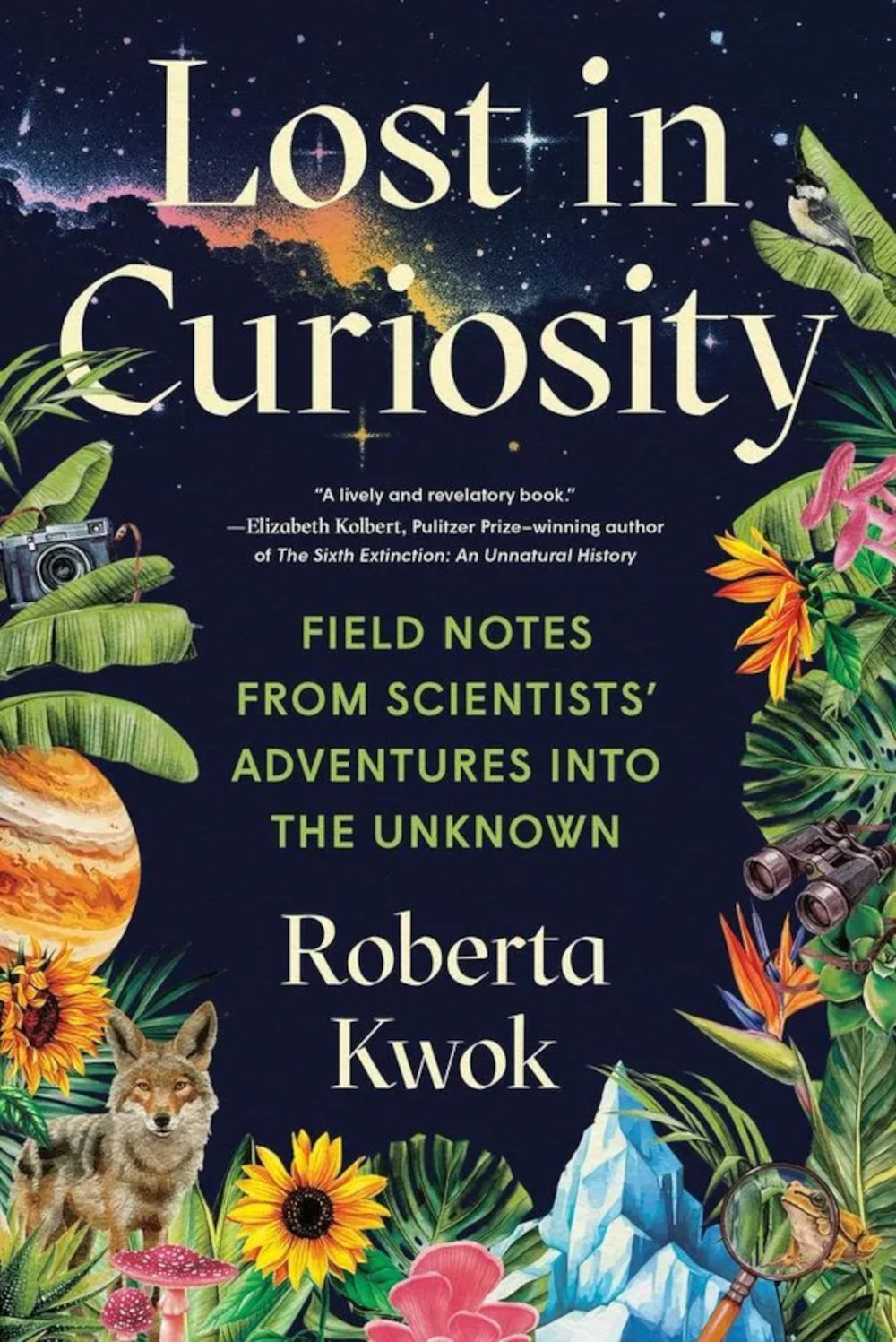
BOOK REVIEW — “Lost in Curiosity: Field Notes from Scientists’ Adventures into the Unknown,” by Roberta Kwok (Sourcebooks, 368 pages).
In some cases, just getting to where the science is supposed to be happening is a challenge. Early in the book, we follow along as Kwok learns about the work of Jessica Mejia, a postdoctoral researcher in glaciology at the University at Buffalo and one of a group of researchers planning an excursion to Helheim Glacier on Greenland, to study how water flows underneath thick sheets of ice.
There are no planes, trains, or buses that one can take to the team’s research site, located some 65 miles inland, nor any roads. Helicopter is the only way in or out, and the team has just learned that the helicopter would not be available when they need it. They’re also worried about the weather taking a turn, as it did back in 2018, when the team was stuck in town, waiting for conditions to improve so the chopper could fly. The previous year, a snowstorm forced them to stay in their tents for several days — and their current field work was delayed by the Covid-19 pandemic.
Helheim Glacier is more than just a massive block of ice. Kwok relates how researchers in 2011 struck water while drilling for an ice core — evidence of a giant aquifer hidden beneath the ice. Later measurements showed that Greenland’s aquifers cover an area about the size of Massachusetts. Knowing how the ice (and any water beneath it) behaves can provide insights into the effects of global warming, particularly the impact of sea level rise.
In some cases, just getting to where the science is supposed to be happening is a challenge.
Another chapter finds Kwok getting to know a poorly understood species known as the smooth guardian frog. The location — a rainforest in Borneo — again presents difficulties, though the real challenge here is trying to figure out why these tiny frogs do what they do. The females vocalize in response to a male frog’s call — which is unusual. Johana Goyes Vallejos, a Ph.D. student in ecology and evolutionary biology at the University of Connecticut, wonders if these frogs represent a case of sex-role reversal, in which females compete for males, with males taking on child-rearing duties. If that’s what was happening, it would be the first clear-cut case of such behaviour seen in frogs.
The idea that males rather than females might be caregivers gives Kwok a chance for a bit of humor: “As the mom of a then nine-year-old, I was dimly aware that being impressed by male frogs caring for their eggs was the equivalent of a well-meaning onlooker telling a man on a routine errand with his kids at the grocery store, ‘You’re such a good dad!’,” she writes. “Still, I couldn’t help but find something refreshing about behavior in other animals that flaunted our society’s default roles.”
The more Kwok discusses the issue with biologists, the more she comes to question her own assumptions: “Should sex-role reversal even be considered a thing? Should male and female sex roles be a thing? Why are we so obsessed with the differences between males and females anyway?”

Even if sex-role reversal is a good description of what Vallejos has observed, puzzles remain. At one point she sets up a video camera to record the little frogs having sex and is startled to discover that the females kept calling throughout the 90-minute mating process, even continuing after the female and male had parted. As the chapter closes, Vallejos — and Kwok — remain stumped.
A later chapter focuses on physics. Here the reader might expect heady discussions about dark matter or dark energy, but no: The researchers that draw Kwok’s attention are trying to understand what happens when you crumple up a piece of paper. You get creases, of course; but how many, and in what pattern — or are they random? They also want to know how the creases change, if the paper is crumpled over and over again.
Such research may seem like a waste of time and energy, but Kwok is sympathetic. She quotes a mathematician named Chris Rycroft: “‘Even though we know all these incredible things about subatomic particles and the center of the galaxy and things like that, these everyday phases of matter’ — like a crumpled sheet of paper — ‘hold mysteries we don’t really understand.’”
The “lone genius” myth is long past its best-before date, as is the notion that science is all about breakthroughs.
The science of paper-crumpling involves some difficult mathematics, but once again Kwok is game, even if the various symbols and equations often go over her head, as she readily admits. “Sometimes everyone would laugh at an esoteric joke or nod vigorously in agreement, having shared a lightbulb moment, and I’d pretend that I understood what had just happened,” she writes. “Still, there was something soothing about listening to them, like hearing people converse enthusiastically in Italian, enjoying the melodious sounds coming out of their mouths, and occasionally understanding a word like pizza or ravioli.”
As it turns out, what the researchers learn from paper crumpling offers insights into the wider cosmos. A Harvard Ph.D. student named Madelyn Leembruggen tells Kwok that tiny fluctuations in the density of dark matter can help drive star formation, perhaps paving the way for planets and people. “It’s been really cool to see those threads of the physics that unite the whole universe,” Leembruggen says.
The most distant object that Kwok considers is a moon orbiting a planet which in turn orbits a star far beyond our own solar system. (“Exomoons” orbiting “exoplanets,” in astronomy jargon.) She chats with Apurva Oza, a planetary astrophysicist at the Jet Propulsion Laboratory in La Cañada Flintridge, California, who explains why he believes some of these moons may be highly volcanic, spewing jets of lava and perhaps nearly tearing themselves apart. The catch is that no such moons have been directly observed, with scientists debating how to define them. For now, astronomers are pondering indirect evidence that may point to these objects really being out there — and such tenuous evidence is open to interpretation.
As with crumpled paper and tiny frogs, exomoons, assuming they exist, have more to tell researchers than one might imagine: Scientists believe that our own moon helped to stabilize the Earth’s axial tilt, keeping our climate relatively constant. So, if exomoons are common — which remains to be seen — it could boost our estimates of how prevalent life might be, beyond our own planet.
Get Our Newsletter

While Kwok has made an effort to weave these scientific stories together into an over-arching narrative, the individual chapters can be enjoyed in isolation. The reader needn’t remember anything about the Greenland glacier, for example, to get a kick out of learning that coyotes will eat just about anything, from snakes, rabbits, turtles, and goose eggs to earthworms, and baby rats. Or — as Kwok discovered by chatting with researchers who worked in Antarctica — that it’s apparently OK to eat a piece of fruitcake that’s been frozen since 1969.
After nine science-adventure chapters, several messages are loud and clear: First, science is messy; unless you’re a theorist, you’re likely to get your hands dirty. As well, the “lone genius” myth is long past its best-before date, as is the notion that science is all about breakthroughs.
Finally, we get a sense of the attributes that all of Kwok’s interlocutors seem to share boundless curiosity, and a deep passion for discovery — slow as that process of discovery may be.