






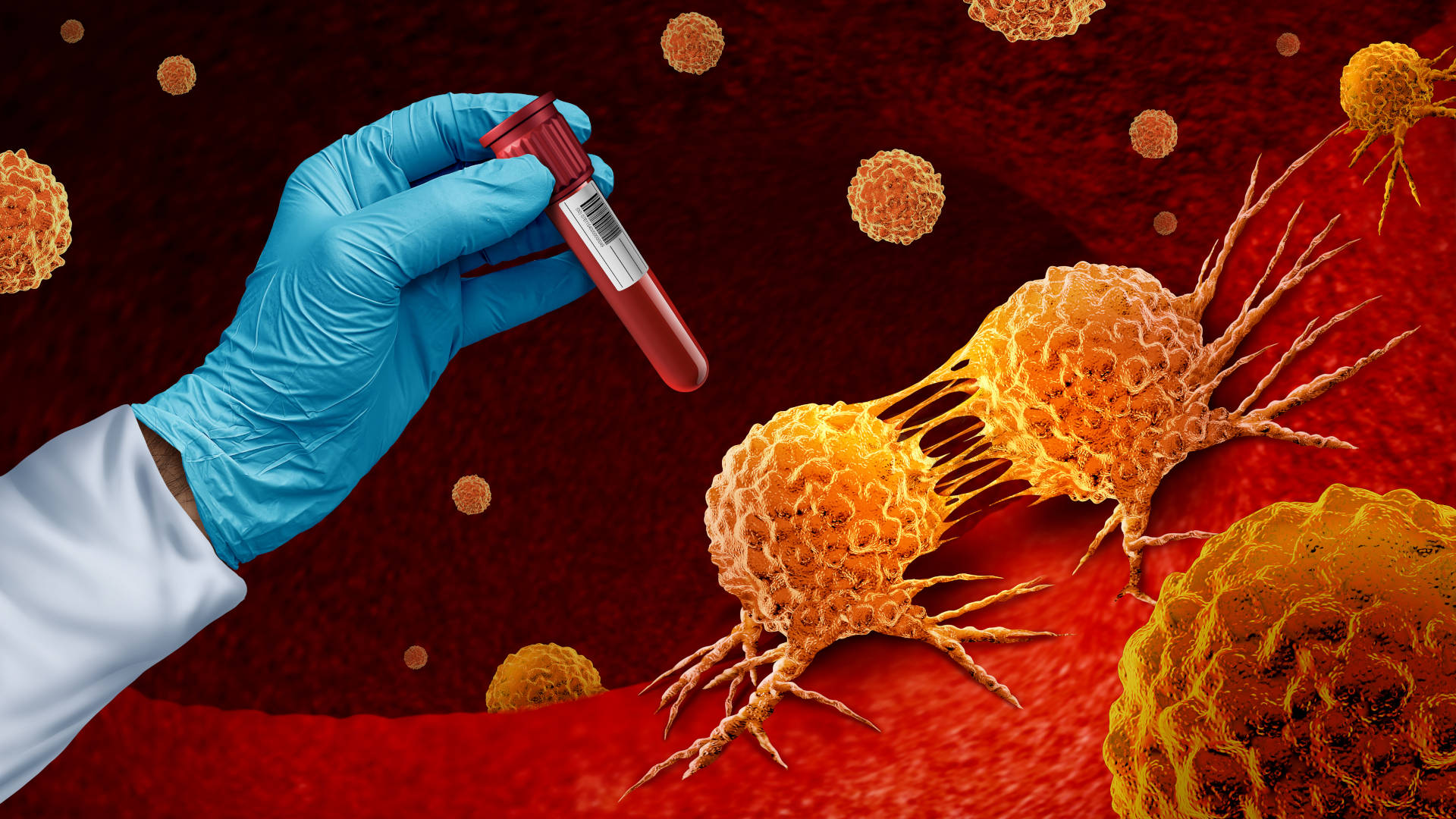


An emerging technology seeks to help revolutionize the world of cancer diagnosis: Multi-cancer early detection tests aim to spot signals for different types of cancer from a single blood draw or other body fluid sample. Also known as a specific type of liquid biopsy, MCED tests look for abnormalities that may indicate cancer, like circulating tumor DNA; some tests can indicate the likely origin of a cancer, while others may merely show that cancer could be present without identifying a probable type or location.
A key advantage of MCEDs, supporters say, is their potential to identify cancers at earlier, more treatable stages. As such, they may help save lives.

Industry tests show some promise: In simulation model research funded by Exact Sciences — a Wisconsin-based company that developed an MCED called Cancerguard — supplemental MCED testing led to an increase in Stage I, II, and III diagnoses (by 10, 20, and 34 percent, respectively). Stage IV diagnoses, meanwhile, decreased by nearly half. The authors — some of whom are listed as employees of Exact Sciences — suggested that this shows MCED testing could catch cancer before it’s at its most advanced stages, particularly for cancer types that lack routine screening.
But while some physicians say the tests are beneficial for people at high risk, some researchers have expressed concern that routine use by asymptomatic individuals without clear risk factors could lead to unnecessary tests and procedures. H. Gilbert Welch, for example, an internist and researcher affiliated with the Brigham and Women’s Hospital’s Center for Surgery and Public Health and a longtime expert on cancer screening, maintains that different types of screenings, including MCEDs, can detect indolent cancers that would rarely cause symptoms or death. In turn, this may result in unnecessary treatments, increased healthcare costs, and patient anxiety. An Australian researcher also points to breast and thyroid cancer as being overdiagnosed. (At least one simulation model, discussed below, suggests the risk for overdiagnosis to be relatively low though.)
MCEDs may also be less sensitive in detecting early-stage cancers, compared to other organ-specific cancer tests, which raises questions as to whether MCED screening actually results in patients living longer. Sensitivity rates — the rate at which a test accurately detects cancer — can be as low as around 20 percent, though they vary widely depending on cancer type and the specific test deployed.
Could more screening be turning mainly healthy people — sometimes called the “worried well” — into patients? It’s possible.
MCED tests, though, do have high specificity, or the ability of a test to correctly identify people without cancer. But when screening a large, mostly healthy population, even a highly specific test can generate numerous false positives. In turn, this can lead to what clinicians call a “diagnostic odyssey,” involving additional blood tests, scans, and biopsies to make a proper diagnosis. In one 2023 study, 62 percent of positive results were false where no cancer was found after an extensive workup.
Could more screening then be turning mainly healthy people — sometimes called the “worried well” — into patients? It’s possible. The late professor of medicine at the University of Pennsylvania, William Kissick, once wrote, “a healthy individual can be defined as someone who has been inadequately studied.” This aphorism jibes with the idea that the harder one looks for a disease, the more incidence one may find.
Multi-cancer early detection tests are not yet approved by the Food and Drug Administration, but they are commercially available to consumers who have a prescription from a qualified healthcare provider. The Galleri test is one prominent example. The product’s manufacturer, Grail, states the test can screen for more than 50 types of cancer at a list price of $949. And Grail says that it sold 185,000 tests in 2025. While most health insurers don’t currently cover the diagnostic, more could begin paying for it if the FDA authorizes its use. (In January, Grail applied for FDA approval.)

Exact Sciences’ Cancerguard is a similar MCED that’s also on the market in the U.S. And this year, California-based Guardant Health launched a multi-cancer detection test called Shield, not to be confused with the company’s colon cancer screening tool by the same name, in Asia but hasn’t yet done so in the U.S.
Contrary to some expert concerns, a recently posted model involving MCEDs, which has not yet been peer-reviewed — suggests that these tests have a relatively low risk of overdiagnosis. Researchers probed for possible indolent cancers that progress slowly and would normally remain undiagnosed without screening. They found that between 2 and 6 percent of all yearly screen-detected cancers with an MCED could be overdiagnoses, though the risk strongly increased with a person’s age.
But these findings came from a simulation; the study did not involve actual people. Currently, multiple studies to evaluate MCEDs that include trial participants are ongoing. REACH, for example, is a prospective study enrolling approximately 50,000 Medicare beneficiaries in the United States to assess whether adding Galleri to usual care affects early cancer detection and reduction of late-stage diagnoses. The study is sponsored by Grail.
The gold standard for evaluating cancer screening programs would be an independent randomized controlled clinical trial. A British National Health Service study of Galleri was the first of its kind involving an MCED. In the United Kingdom, prior to launching any new national multi-cancer screening program, clinical trials of this kind need to show that the use of MCEDs results in fewer cancer deaths owing to earlier diagnoses. However, Galleri didn’t meet the NHS trial’s primary endpoint, which was a reduction in diagnoses at later stages of cancer.
Nonetheless, the test manufacturer’s press release suggests results show “a favorable trend toward fewer stage III-IV cancers” for 12 types, including lung, pancreas, colorectal, and ovarian cancers.
“It is a very enticing prospect that you could just do one blood test and find all cancers.”
In an email to Undark, Welch posited that detecting tumor DNA “may well be clinically useful as a diagnostic test,” and could be helpful to physicians deciding, for example, whether a colon cancer patient who has already undergone surgery requires further treatment. But he maintains that the diagnostic shouldn’t be deployed as a “screening test in the general population.”
Andrew Vickers, a biostatistician at the Memorial Sloan Kettering Cancer Center, wrote in an email to Undark that “it is a very enticing prospect that you could just do one blood test and find all cancers” because it means you don’t have to test one cancer type at a time, such as a mammogram, colonoscopy, or lung CT scan. But Vickers warned, “we should not use tests unless they are proven to work.”
The issue with MCEDs, he added, is that they haven’t even been proven to find cancers with appropriate sensitivity and specificity, or to save lives. The recent failed test of Galleri demonstrates the problem at hand, Vickers wrote: “I have a big problem with companies advertising expensive unproven tests to the public.”
Support Undark Magazine
Undark is a non-profit, editorially independent magazine covering the complicated and often fractious intersection of science and society. If you would like to help support our journalism, please consider making a donation. All proceeds go directly to Undark’s editorial fund.
In response to such criticisms, a Grail spokesperson provided a response to Undark standing by the company’s product, noting its ability to screen for many different types of cancer, “including hard-to-detect cancers like pancreatic, ovarian and liver cancer, before they become symptomatic.”
Regarding the recent failed test, the response noted that while “there was not a reduction observed in the combined primary endpoint of Stage III/IV cancers, the trial generated strong evidence that the Galleri test can increase earlier cancer detection and reduce metastatic Stage IV disease at a population scale.”
Asked by Undark for a comment, Tom Beer, the chief medical officer for multi-cancer early detection at Abbott (which acquired Exact Sciences in March of this year) wrote:
“Cancerguard was intentionally designed with high specificity and a direct imaging-based diagnostic resolution pathway to help minimize unnecessary procedures while enabling earlier detection of cancers that currently go unscreened.” While Abbott respects the “debate around multi-cancer early detection, including questions about overdiagnosis and the responsible introduction of these technologies,” Beer noted that given “the scale of cancer mortality today, we believe it is both reasonable and responsible to continue advancing these technologies while rigorously studying their long-term impact.”
MCEDs haven’t even been proven to find cancers with appropriate sensitivity and specificity, or to save lives, Vickers wrote to Undark.
Steven Woloshin, a professor of health policy and clinical practice at the Dartmouth Geisel School of Medicine, emphasized that the public needs to know whether the benefits outweigh the harms. In this vein, he cited Muir Gray, a British physician and renowned public health expert, who stated “all screening programmes do harm; some do good as well, and, of these, some do more good than harm at reasonable cost.”
Ultimately, evaluating the clinical usefulness of MCEDs could take years. Accordingly, MCEDs may be years from being ready for widespread use. If so, it’s important for those contemplating their use in the meantime to consider both the potential benefit of early detection and the potential harms associated with possible overdiagnosis, false positives, and an unproven ability to save lives.