










Book Review: The Case for the AI-Powered Global Brain


Pierre Teilhard de Chardin, a controversial French paleontologist, priest, and theologian, died in April 1955, a few months before a group of eminent scientists — including, notably, Marvin Minsky and Claude Shannon — proposed a study of artificial intelligence at Dartmouth College on “the conjecture that every aspect of learning or any other feature of intelligence can in principle be so precisely described that a machine can be made to simulate it.”
It’s tempting to wonder what Teilhard would have made of the Dartmouth artificial intelligence workshop — considered to be a foundational event in the field — and more importantly of what’s unfolding in the field of AI today. Teilhard was famously a proponent of the idea of a “noosphere” (the ancient Greek nous is commonly translated as mind or intellect), as the next stage in the evolution of life on Earth, essentially our biosphere enveloped by a sphere of thought, comprising human brains aided by technology. But Teilhard hadn’t anticipated AIs with capabilities that outstripped individual human brains, writes Robert Wright in his recent book “The God Test: Artificial Intelligence and Our Coming Cosmic Reckoning.”
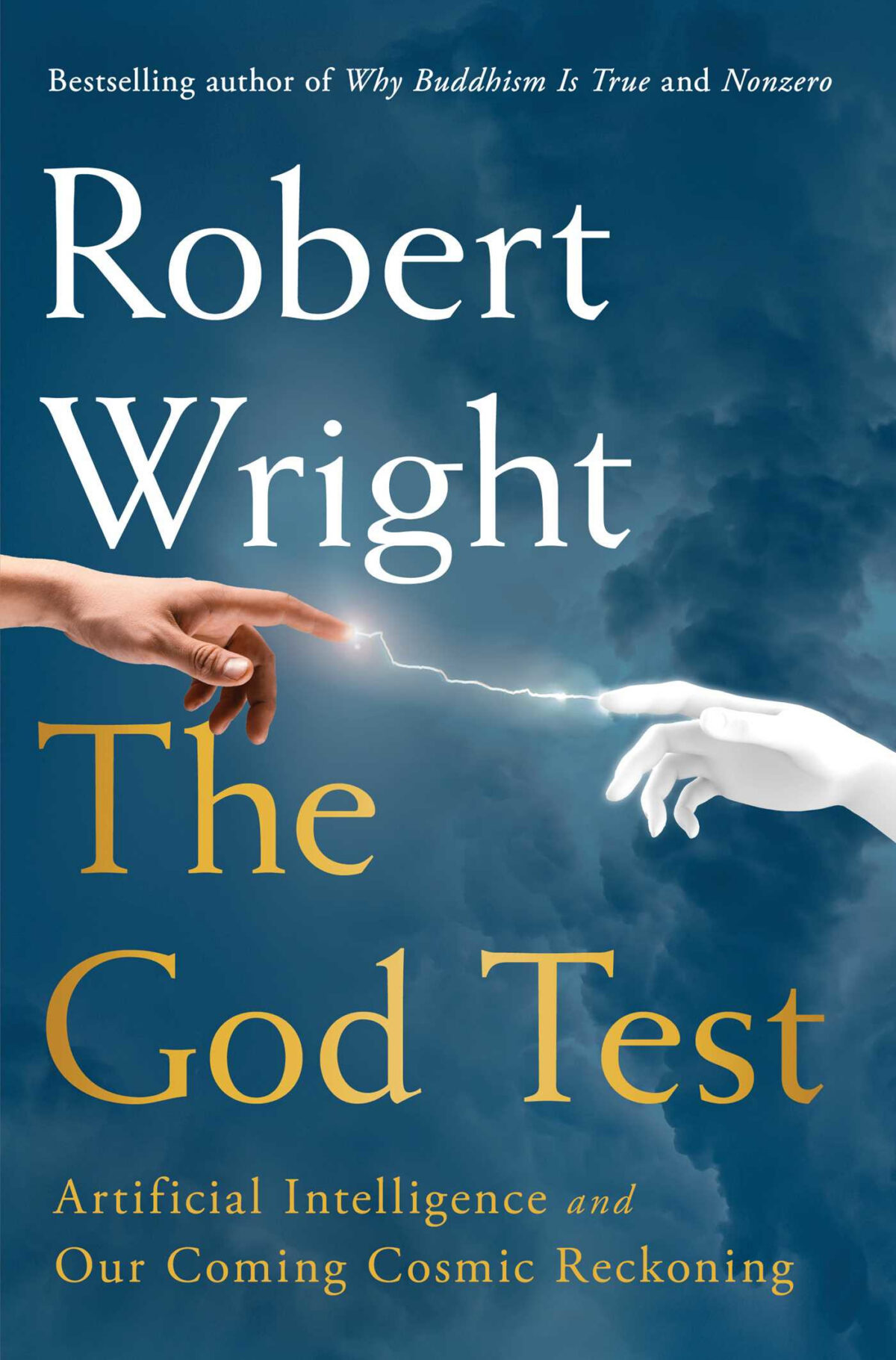
BOOK REVIEW — “The God Test: Artificial Intelligence and Our Coming Cosmic Reckoning,” by Robert Wright (Simon & Schuster, 352 pages).
Wright, the best-selling author of several books including the Pulitzer Prize finalist “The Evolution of God,” thinks that it’s time to merge AI with Teilhard’s idea of the noosphere. “We have to think seriously about a future in which there is something that increasingly resembles a global brain, and its neurons increasingly consist not just of human brains but of AIs,” he writes.
In Teilhard’s conception, Wright notes, the noosphere is an “inchoate planetary brain whose neurons are human brains.” But as the development of large language models have shown us, an AI can be something that has “soaked up, in condensed form, the vast repository of human knowledge that is distributed across the noosphere.” Each AI, then, is a brain of brains, and the noosphere, augmented with AIs, would be a “brain of brains of brains,” writes Wright, evocatively.
Given this vision of an AI-infused noosphere, Wright wants to convince the reader that it’s going to take enormous effort to steer humanity toward a future that is beneficial to everyone, an effort that will simultaneously involve challenges that are personal, moral, spiritual, and political.
And in trying to do so, Wright creates a tension that runs through the book. As he admits, “Things aren’t so easy for those of us who take the worldwide brain idea seriously but think of the brain’s development in strictly material terms, within the framework of known scientific laws — and who don’t make assumptions about those laws having some larger purpose (even if we’re emphatically open to that possibility as I am).”
Each AI, then, is a brain of brains, and the noosphere, augmented with AIs, would be a “brain of brains of brains,” writes Wright.
The early parts of the book explain — “in strictly material terms”— the technology that has brought us large language models. These sections might feel inadequate to those who don’t already understand the algorithmic and mathematical aspects of AI, and for those in the know, much of the material will feel familiar, and maybe even a tad simplistic.
To be fair, explaining the technicalities of modern artificial neural networks in non-technical terms isn’t easy, and Wright also ends up relying on the occasional metaphor or analogy. These introduce an element of imprecision; particularly confusing is Wright’s use of the term mutations to describe the process of modifying the strengths of the connections between the neurons of an artificial neural network during training. It doesn’t help that he quotes from his conversations with LLMs such as Claude to make his case.
And yet, Wright has the uncanny ability and eloquence to give us the big picture. For example, he points out that the few months that it takes to train an LLM ends up “compressing large stretches of human evolution” into a machine, or that it’s important to think of AI in terms of “machines that invent machines that think.”
Midway, the book transitions from talking about the low-level details of training an LLM — including descriptions of vectors in high-dimensional spaces for representing the syntax and semantics of human language — to talking of AIs as things capable of deception, cognitive empathy, and other distinctly human cognitive capabilities. The transition can feel jarring, especially for readers resistant to anthropomorphizing AI models.
The latter part of the book tries to convince the reader that we are not entirely helpless; we don’t have to passively watch an AI hellscape unfold.
Still, in light of AIs that might one day have such capabilities or even surpass them, Wright astutely frames our response to AI in terms of the “awe spectrum,” with one end involving fear and dread (as evinced by AI doomerism) and the other overwhelmed with fearless wonder (the AI accelerationists). “If you aren’t somewhere on the awe spectrum — if you don’t feel something of great magnitude and power approaching — you aren’t getting the picture,” writes Wright.
Wherever you find yourself on the spectrum (except maybe on the end with accelerationists), Wright articulates the central concern many of us have about AIs: “If AI gets smarter and smarter, and more and more savvy about power and deception, and will pursue goals via whatever subordinate goals work best — and will have the ability to make copies of itself and collaborate with other AIs — you can imagine some unfortunate things happening. And that’s especially true when you consider how incautious some of the people deploying AIs will be.”
What then do we do about this?

The latter part of the book tries to convince the reader that we are not entirely helpless; we don’t have to passively watch an AI hellscape unfold. But to do so, humanity needs to move beyond the tribalism and nationalism that seem to plague us, says Wright, by developing strong cognitive empathy, which he defines as “understanding others’ points of view.”
We all know this from our personal lives, and we see this unfold sometimes during global diplomacy among nations. What’s both unique and quirky about Wright’s take is that he thinks AI models could help us in this regard. “Could AI help give us the cognitive empathy boost that, if widespread, might make the difference between AI heaven and AI hell?” he asks. Can AI provide “the light that shows us the way? Or at least some of the light?”
Again, Wright narrates an interaction he had with Google’s Gemini, for its take on “cognitive biases that impede cognitive empathy.” He uses phrases like “I was all ears” and “Gemini came through” to describe his back-and-forth with the model, and then eventually answers his question about whether AIs can help us develop cognitive empathy in the affirmative. “This isn’t a crazy hope,” he writes. “Gemini did, after all, seem to readily adopt the role of wise elder.”
Maybe he is giving voice to what many of us are silently mouthing, worried yet unable to say clearly what’s bothering us about AI.
Ironically, even as he’s detailing his conversation with Gemini, Wright also worries about humans giving up their cognitive sovereignty to AIs and simultaneously argues that a marketplace for cognitive sovereignty-boosting AI companions could ensure the development of such models.
There is a curious dissonance in this way of thinking about a destabilizing future caused by widespread, incautious, and even dangerous use of AIs, and arguing that those very same models could somehow help us avoid such outcomes — but maybe Wright is on to something. Maybe he is giving voice to what many of us are silently mouthing, worried yet unable to say clearly what’s bothering us about AI. Into the mix, Wright adds another ingredient: methods such as mindfulness meditation. He describes his own experience with it and argues that such practices could unshackle human cognition from the grips of human emotions, and move us towards a form of “enlightenment,” the “term applied to the state of mind that, via meditation, brings a more objective view of our world,” and move us toward cognitive sovereignty.
Possibly the most contentious aspect of “The God Test” is Wright’s claim that even if life on Earth is proceeding according to Darwinian laws of natural selection and evolution, there could be nonetheless a purpose to the process. So, if we did end up with an AI-rich noosphere, it’d be a purposeful superorganism, and it’s in everyone’s interest to steer such an outcome toward “our supreme good” by morally and spiritually aligning ourselves to this unseen order. “This is the imperative I think we face: Move closer to enlightenment, and to the rewards that such an effort warrants, or face an uncomfortably high risk of catastrophe,” Wright urges.
Anil Ananthaswamy is an award-winning journalist, author of “Why Machines Learn,” and a 2019-20 MIT Knight Science Journalism Fellow. He’s currently professor of practice at IIT-Madras, India.