










For Sale: Custom Space Program, Ready to Launch


During the third year of the war in Ukraine, reports of something stunning emerged: Ukraine had hidden drones within Russian borders, then set them loose to perform a sneak attack on its invader’s airfields.
To independently verify how successful that attack was, The New York Times turned, in part, to a satellite company called Umbra. Umbra operates radar satellites, with sensors that can cut through clouds and see through darkness, revealing information about what’s going on below at any hour, regardless of whether it’s a clear day or a cloud-filled one. The spacecraft beam radio waves to the ground (and to the tops of buildings and the burnt skeletons of jets); those waves bounce off and return to the spacecraft. By how the waves have changed, software can generate a picture of the landscape. In the case of The Times’ reporting, Umbra’s satellites, looking at a Russian air base, saw that seven strategic bombers had turned to splats of ash.
That sort of all-seeing view has been in demand at U.S. agencies: The Air Force, NASA, the National Reconnaissance Office, and the National Geospatial-Intelligence Agency have given the company, which has offices in California and Virginia, millions of dollars’ worth of contracts.
“With a credit card these days, you could actually get access to quite a lot of capabilities that three or four decades ago probably required a national program.”
It turns out that other countries want in on it too. Since Umbra launched its first commercial satellite in 2021, governments have requested not just data, as The New York Times requested, but turnkey space-radar systems.
At first, the company was only interested in selling foreign governments data from their satellites, limited to radar images and analysis, said Todd Master, Umbra’s chief strategy officer. But after repeated requests from abroad, said Joe Morrison, the company’s vice president of remote sensing, Umbra opened a new business line called Mission Solutions, which allows countries to purchase so-called sovereign space capabilities. That means countries, and other clients, can ask Umbra to build them a custom satellite constellation, so they don’t have to share time with any other customers and can customize its usage to their particular needs.
That kind of relationship — U.S. companies selling a kind of space-program-in-a-box to allied or partner nations — is becoming more common, as federal regulations have relaxed to allow it. Some sell entire satellites; some sell data from their commercial spacecraft; some offer dedicated time for a nation to use the satellite without anyone’s watchful eye on them; some, like Umbra, do all three. In the future, companies may even sell countries human spaceflight capabilities.
All these possibilities allow governments that haven’t developed their own space programs to simply buy them, for millions rather than billions of dollars.

“We think of space programs as these big things — huge and national endeavors with lots of public investment and infrastructure and space agencies,” said Brian Weeden, the director of civil and commercial policy at the Aerospace Corporation, a nonprofit that operates a federally funded research and development center. “Obviously, that still exists in some cases.”
But, he continued, “with a credit card these days, you could actually get access to quite a lot of capabilities that three or four decades ago probably required a national program.”
That can help residents, with increased access to communications, emergency, and GPS services; help countries be more secure, by providing an overhead view for their military and intelligence services; and help level the orbital playing field, rather than leaving the benefits of space to the world’s superpowers.
But it can also give private companies some sway over geopolitics. And the card-swiping possibilities may present complications and potential conflict as space capabilities proliferate, said Bleddyn Bowen, an associate professor of astropolitics at Durham University: “The reality is that when you use outer space for military and economic purposes, you make outer space a target.”
Ever since the U.S. and the Soviet Union sent spacecraft to orbit, other countries have looked past the atmosphere wistfully. In 2010, for instance, more than 70 countries sat on the United Nations Committee on the Peaceful Uses of Outer Space, which creates international treaties and cooperation agreements governing outer space. Today, the committee has more than 100 members. But historically, few nations have had significant space assets of their own.
Recent developments, though, have made some nations’ desires for those capabilities more concrete. The war in Ukraine, in particular, was a turning point, said Weeden. That country’s use of space technology in its conflict with Russia, and lessons the U.S. may learn from it, are the subject of a 2024 report by Weeden’s colleague Michael Gleason, a national security senior project engineer at Aerospace’s Center for Space Policy and Strategy.
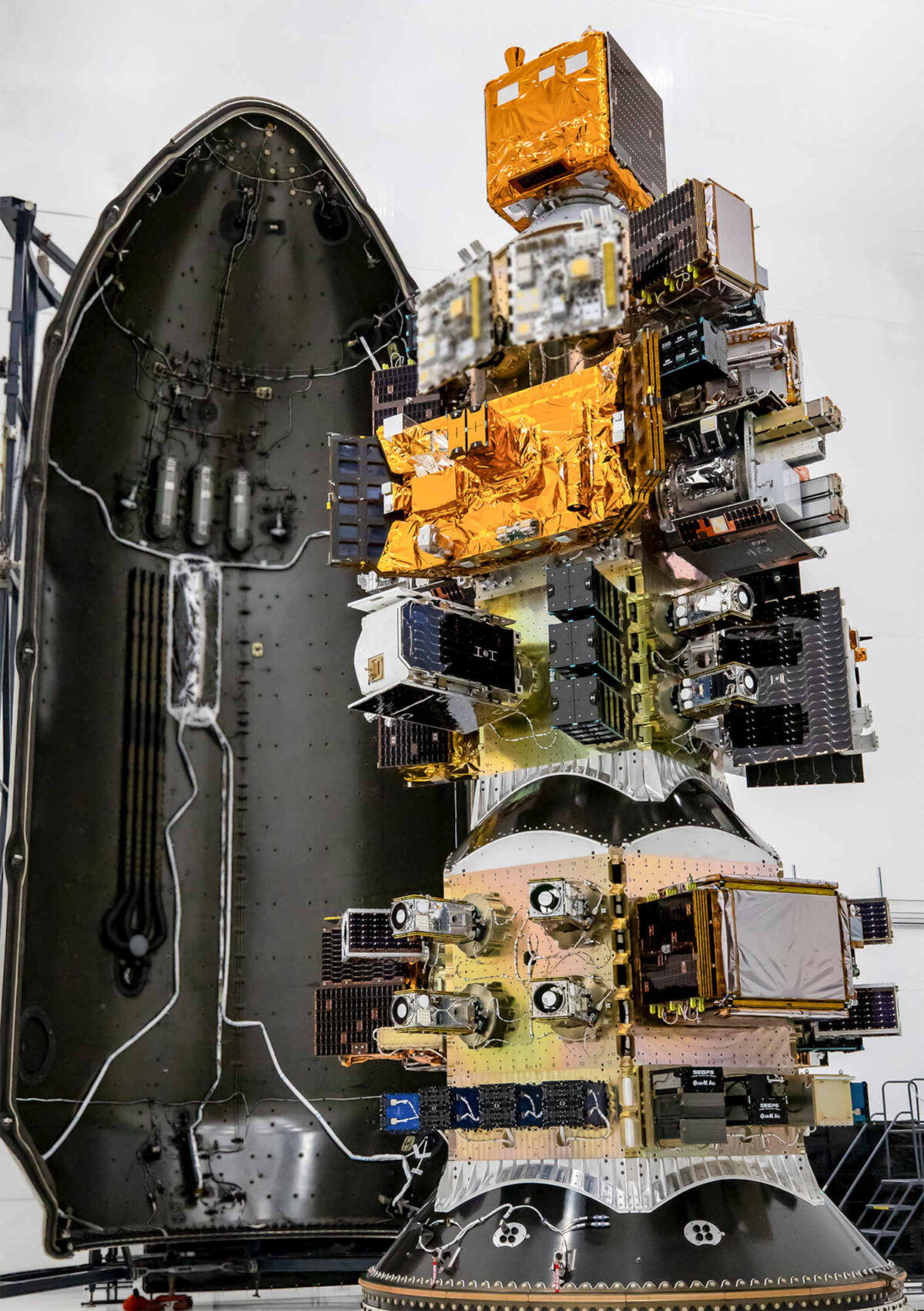
Inside a SpaceX Falcon 9 rocket, different types of satellites are carefully secured in preparation for launch. Commercial space companies like Umbra and Vantor put satellites into orbit on Falcon 9 missions.
Visual: NASA
Ukraine, the report concludes, has used space more effectively than Russia. It used optical satellite imagery, but often turned to radar data, since Ukraine can be cloudy for months of the year. The country also distributed intelligence to its forces using commercial communications satellites like Starlink. “Ukraine really did not have a space program at all,” said Gleason. “I’m not even sure if they had one satellite in space. But within weeks and months, Ukraine was using information from space, from commercial industry, a lot, for their defense purposes and military purposes.”
Russia, meanwhile, has its own satellites, and one of the world’s largest and oldest space programs, but its leaders didn’t effectively get the information from orbit to the people making decisions on the ground, in part because the country didn’t have policies and practices for doing so, nor did it prioritize that integration, according to Gleason.
Other countries saw how both countries used space in offense and defense, said Weeden. “There are going to be countries that leapfrog much bigger neighbors because they’re willing to engage with non-traditional sources of sovereign satellites,” said Morrison at Umbra.
One example that has taken heed is Germany, Gleason said: In 2025, it approved a 35-billion-euro budget (about $40 billion) for military and defense by 2030, an order of magnitude increase. A few months before that, the government signed a deal with a satellite company called Planet, which has a European headquarters in Berlin, for satellite imagery and is talking about building its own constellation of satellites for communication and potentially other uses, like a national version of Starlink.
Space-based telecommunications is something the Taiwanese government has also been pursuing, in part through a deal with the American company Astranis. And multiple countries are murmuring about having their own sovereign navigation and timing systems, so they don’t have to rely on the U.S. GPS system, or the Galileo, the European satellite navigation system.
“I’m not even sure if they had one satellite in space. But within weeks and months, Ukraine was using information from space, from commercial industry, a lot, for their defense purposes and military purposes.”
Those desires are partly about national security — keeping an eye on threats from above; communicating securely and independently; having GPS services even if GPS itself is compromised. But they are also about quality of life for citizens. In addition to allowing people to navigate, GPS satellites are central to modern electrical grids, cellphone communications, and financial transactions. Earth observation satellites, meanwhile, help farmers track crop health; the data also helps make weather forecasts more accurate; and if there’s a disaster, knowing the location of floodwaters or wildfire helps with quick emergency response. Under-resourced and remote countries also stand to benefit from reliable communications more than highly developed countries.
“Any government that’s responsible for the productivity and safety of society is going to have some interest in space now,” said Gleason.
Nation-states, it seems, are less content to rely on systems they don’t have sovereignty over — and with satellites becoming smaller and cheaper in recent years, now they don’t have to.
That could be important at a time when countries don’t feel as able to rely on allies’ capabilities, said Tatiana Sainati, an attorney who specializes in space law and policy at the law firm Wiley Rein: “You’re increasingly, I think, seeing a shift in geopolitical alliances, including longstanding ones.”
Capitalizing on private space offerings isn’t exactly a new phenomenon. Big contractors like Lockheed Martin and Raytheon have long built and launched expensive satellites for national governments, said Peter Wilczynski, the chief product officer at a satellite company called Vantor: “I think what’s new in the market is really this rise of a batteries-included solution” — meaning one that doesn’t require an existing national space program but is ready to go with the press of a purchase button.
It may even be possible for countries to one day credit-card their way into astronaut programs. The California-based company Vast is currently developing a commercial space station called the Haven-1 that will offer sovereign astronauts the chance to float above Earth. The Dream Chaser spaceplane, from Sierra Space, is in league with the UN to run a mission open to astronauts from all member states.
“Any government that’s responsible for the productivity and safety of society is going to have some interest in space now.”
Most of the movement, though, is on the less sexy side: satellites, rockets, and ground infrastructure. Vantor, for one, doesn’t focus on selling entire sovereign satellites outright. But it will gather and send images and analysis of what’s happening on Earth, on behalf of a government that doesn’t have the expertise or funds to build the type of huge and expensive spacecraft the company uses. “The vision for Vantor as a company is sort of an intelligence-service-as-a-service,” said Wilczynski. Vantor, in other words, can be a country’s space-based spy program.
“There’s always, in life, the question between what you need and what you can afford, and what you want and what you can afford,” said Wilczynski. “And I think what we’re seeing in the market is that wants are turning into needs.”
Vantor, for its part, sells U.S. allies access to its most detailed imagery, as well as 2D and 3D maps of the whole world. (The company, like Umbra, would not disclose to Undark which specific countries are clients. Wilczynski said they work with U.S. allies and partners, in places like Asia-Pacific, the Middle East, and Europe). One key offering is what the company calls the Direct Access Program. “We allow customers to access the satellites directly, without telling us where they’re going to look or showing us the images that they take,” said Wilczynski. The data go directly to the country’s antennas, never even hitting Vantor’s systems.

Think of it, he said, as the difference between calling an Uber and renting a car. “When you go to a Hertz rental car, they don’t see where you’re driving it. They don’t check where you are,” he said. “You get the car, you return the car.” What happens in between is between the driver and the vehicle.
Previously, companies had to artificially throttle the resolution of their images — making them fuzzier due to U.S. regulations that limited how sharp commercially available images could be. But in part because foreign companies now also have picture-taking satellites, regulations have changed to allow American companies to compete. Today, restrictions put the technology into three tiers: “If you’re offering a commercial remote sensing capability, and it’s a product that is widely available on the international market, there’s essentially no restrictions on who you can sell that to,” said Weeden. If only other U.S. companies have similar technology, more restrictions apply; even more apply if a company’s satellite observations are unique.
Umbra’s radar-based technology means its satellites can be smaller than Vantor’s while providing data with higher resolution. Like Vantor does with optical images, it also sells allied governments its radar images. In those images, a pixel could be as small as 16 by 16 centimeters. Umbra also lets governments buy dedicated time on the company’s satellites. The two companies have even partnered, so customers can buy Umbra images through Vantor’s platform, if, say, it happens to be stormy.

An illustrative rendering of Umbra’s current generation of satellites. These synthetic aperture radar satellites can reach a resolution as fine as 25 centimeters — or about 10 inches — in spotlight mode.
Visual: Umbra
Countries that want a fully sovereign radar satellite system of their own, though, can custom-design in collaboration with Umbra, or pick a kind of stock-vehicle version that’s part of the company’s product line. “When you knock those costs down by an order or two of magnitude, it reopens a trade space that wasn’t previously accessible,” said Master at Umbra.
Until the 2010s, that spacecraft trade space was inaccessible for a different reason: Space technology, on the hardware side, was on the federal munitions list, making it extremely hard to export. The administration of former President Barack Obama began the process of moving some to a less restrictive catalog supervised by the Department of Commerce, a shift that happened for reasons similar to the loosening of imagery regulations: If a sort of satellite is available on the global market, but an American company can’t sell it, someone else will. “We want to protect the state-of-the-art of technology, so that doesn’t get in the wrong hands,” said Gleason. “But at some point, state-of-the-art becomes state-of-the-world.” Still, the government imposes strict restrictions on exporting goods, technology, and software to political adversaries like Russia or China, making it very hard (and perhaps impossible) to sell space hardware or software that could be considered dual-use.
Those regulatory moves are part of an American power strategy. “We want to really have a robust commercial space industry in the United States, and we want to be kind of at the vanguard of that,” said Sainati, the space policy lawyer. “And part of that requires a certain amount of freedom to have contracts with governments that are not the U.S. government.”
Regardless of which orbital avenue is under discussion — whether it be data, dedicated time on a satellite, or a satellite of one’s own — many analysts and industry insiders see increased access to space as generally positive.
That’s because more people get to reap the benefits of space, from stronger communications to better situational awareness to more resilient navigation systems. More people can also have information about the planet as it is now and as it’s changing, with a big-picture view of military threats, incoming weather disasters, agricultural yields and concerns, and wildfire risk and spread. “In general, the more capabilities, the better,” said Weeden.

Bowen, for instance, thinks the autonomy that the space-program-in-a-box model offers could also be good for global stability. “In the next 10 years, not everyone is going to be relying on the whims of whoever is sitting in the White House for their most important critical infrastructure,” he said. “So that even if America lashes out, America’s allies can maybe not.”
Stability through autonomy isn’t the only story, though. An adversary could still get its own hyperpowerful space radar from a non-U.S.-based company and reap spy-like benefits.
Satellite companies could also make decisions on behalf of their international customers — as was the case when, during the war in Ukraine, Elon Musk refused to extend Starlink service to Crimea, changing the course of international relations.
Companies can also go bankrupt — and what if a nation had gotten a spy-program-in-a-box from a corporation that sank itself? Or what if it relied on commercial communications satellites that got hacked, as the company Viasat did just as Russia invaded Ukraine in 2022 — the company becoming a target precisely because of its communications value?
Cyberattacks on both commercial and federal satellites can have significant harmful effects, because of human reliance on their services; some of the United States’ largest defense contractors, like Lockheed Martin, have joined forces with the likes of the Space Force, Space Command, and National Security Agency to form the Space Information Sharing and Analysis Center, a nonprofit where groups share information about actual threats and potential solutions.
With more politically and economically valuable stuff in orbit, Bowen emphasized, space becomes a more attractive arena for international tension and attacks. “Generally speaking, there’s more critical interest in space, so there’s more chances of conflict spreading into space as the situation on Earth gets worse as well,” said Bowen.
“What happens in space is,” he added, “a continuation of what’s happening on Earth.”