










In 1739, a Jesuit priest took aim at the philosopher René Descartes’ contention that nonhuman animals were machines, “natural automata” that possessed neither language nor reason and did not feel pain — or, for that matter, any emotion.
The priest, Père Bougeant, disagreed. As recounted in E.P. Evans’ 1906 classic, “The Criminal Prosecution and Capital Punishment of Animals,” Bougeant argued that animals displayed many of the same emotions as humans. If they were just machines, “then the feelings of a man towards his dog would not differ from those he entertains towards his watch,” Evans wrote, describing the priest’s views. “Even the strictest Cartesian would never think of petting his chronometer as he pets his poodle, or would expect the former to respond to his caresses as the latter does.”
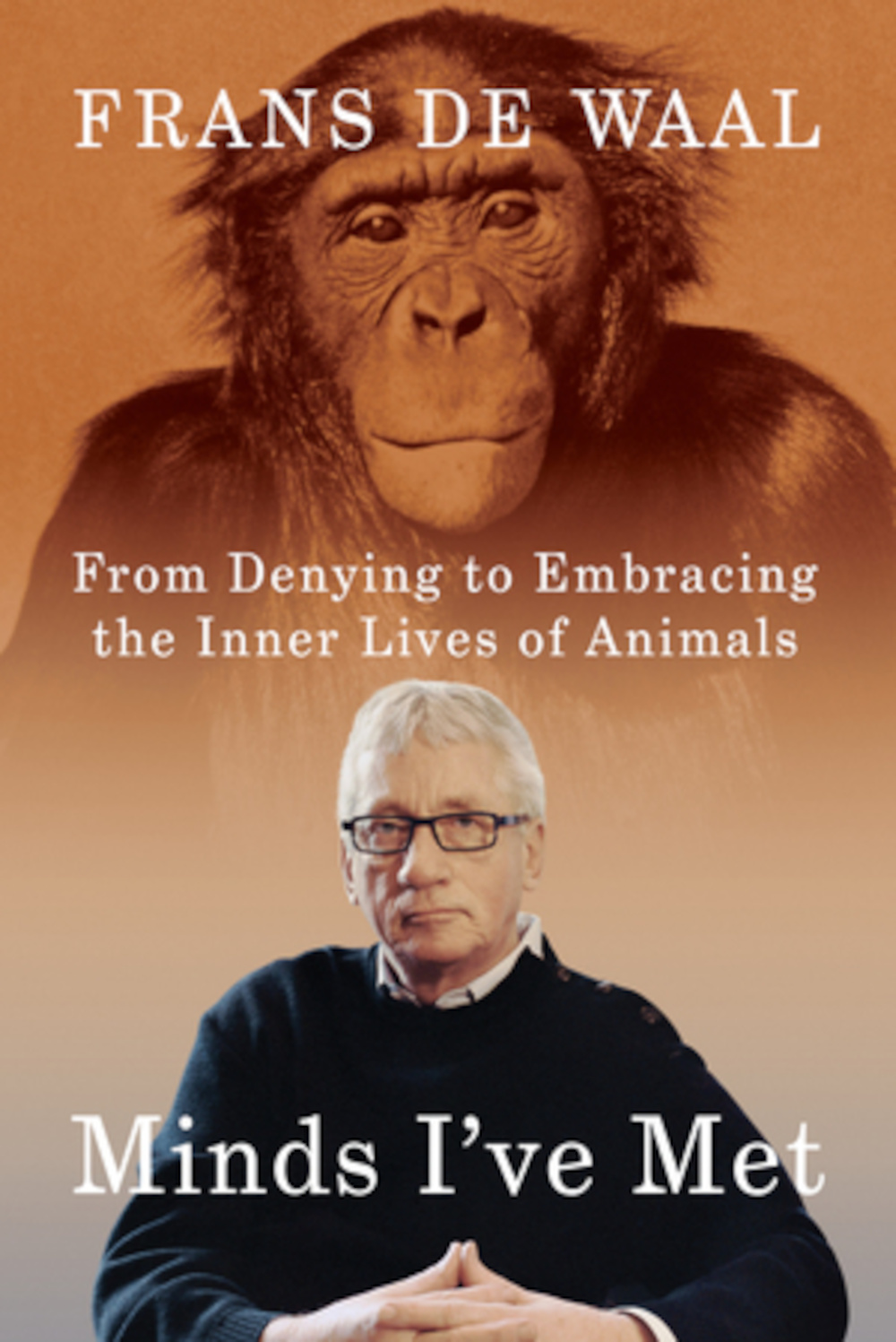
BOOK REVIEW — “Minds I’ve Met: From Denying to Embracing the Inner Lives of Animals,” by Frans de Waal (W. W. Norton & Company, 300 pages).
Yet somewhere between Bougeant’s 18th-century riposte and the 1960s, when Frans de Waal began learning about animal behavior as a university student in the Netherlands, scientists put Descartes firmly back on his pedestal. It would take more than 60 years before the imaginary wall science erected between humans and other animals began to crack — and then crumble altogether.
In “Minds I’ve Met: From Denying to Embracing the Inner Lives of Animals,” de Waal, a celebrated primatologist and ethologist whose work played a considerable part in the demolition of that wall, tells the story of those six decades and how they radically revised the way scientists — and the rest of us — think and speak about the other animals that share our planet.
De Waal was already the author of more than a dozen popular books, several of them bestsellers. But “Minds I’ve Met” clearly held a special importance for him as a place to sum up what he saw as a scientific revolution, one that moved us away from an “arcane, castrated vocabulary for animal behavior to one that openly discusses animals as intentional agents.”
“We have gradually positioned ourselves closer to them and they to us,” he writes in the book’s introduction, a shift that he said brought him “huge relief.”
It would take more than 60 years before the imaginary wall science erected between humans and other animals began to crack — and then crumble altogether.
De Waal died of stomach cancer in 2024, before he could finish “Minds I’ve Met.” He made it partway through the sixth chapter. It was later finished by three former students and his wife, Catherine Marin, who completed a seventh chapter, an epilogue, and an afterword following detailed instructions he had left for them.
Yet he got far enough to tell the story he wanted to tell, using as a frame the arc of his career and the studies — his own and those of many other scientists — that challenged the champions of human exceptionalism. Among these, he includes behaviorists of the B.F. Skinner persuasion; other psychologists and anthropologists who focused their work on the “special” traits and abilities of humans; and political scientists who denied that the power struggles, Machiavellian tactics, and deception that characterize chimpanzee society could have anything to do with what went on in Washington, D.C. (Defending his 1982 book “Chimpanzee Politics: Power and Sex Among Apes” to a group of political scientists at a conference, de Waal recalls, he was met with such skepticism that “I felt as if I were standing before the Inquisition as a total heretic.”)
As de Waal recounts in “Minds I’ve Met,” he grew up in the southern Netherlands observing animals: stickleback fish he collected from ditches and kept “in pots, buckets and tanks,” frogs, salamanders, insects, and birds he spent hours watching. In college he kept two jackdaws as pets, who flew around outside all day and returned to his apartment at night. He was a biology student, but it was only when he encountered the work on animal behavior of scientists like ethologist Niko Tinbergen, primatologist Jan van Hooff, and psychologist Wolfgang Köhler that he found his calling.
Get Our Newsletter

As a college student working as a research assistant in charge of two chimpanzees who lived in the psychology building, he learned a great deal about chimp behavior, and had no doubt of their intelligence or range of emotional expression. Yet, he writes, he was perplexed and frustrated by scientists’ insistence that animals had no interior life; that they were incapable of feeling affection, boredom, or anger; and that they could not plan, calculate, cooperate, or console.
Evolutionary continuity may be taken for granted today, but at the time that was far from the case. Scientists who applied words used to describe human actions when they talked about animals were reprimanded. Apes did not laugh when they were tickled; they displayed “vocalized panting.” When two apes kissed — a common occurrence when they reconciled or greeted one another — it was not kissing but “mouth-to-mouth contact.” Anthropomorphism, de Waal writes, was “the biggest sin one could possibly commit,” and “the enemy of science.”
“We needed to stamp it out,” he wrote, “even though everyone admitted that avoiding it in our language is nearly impossible.”
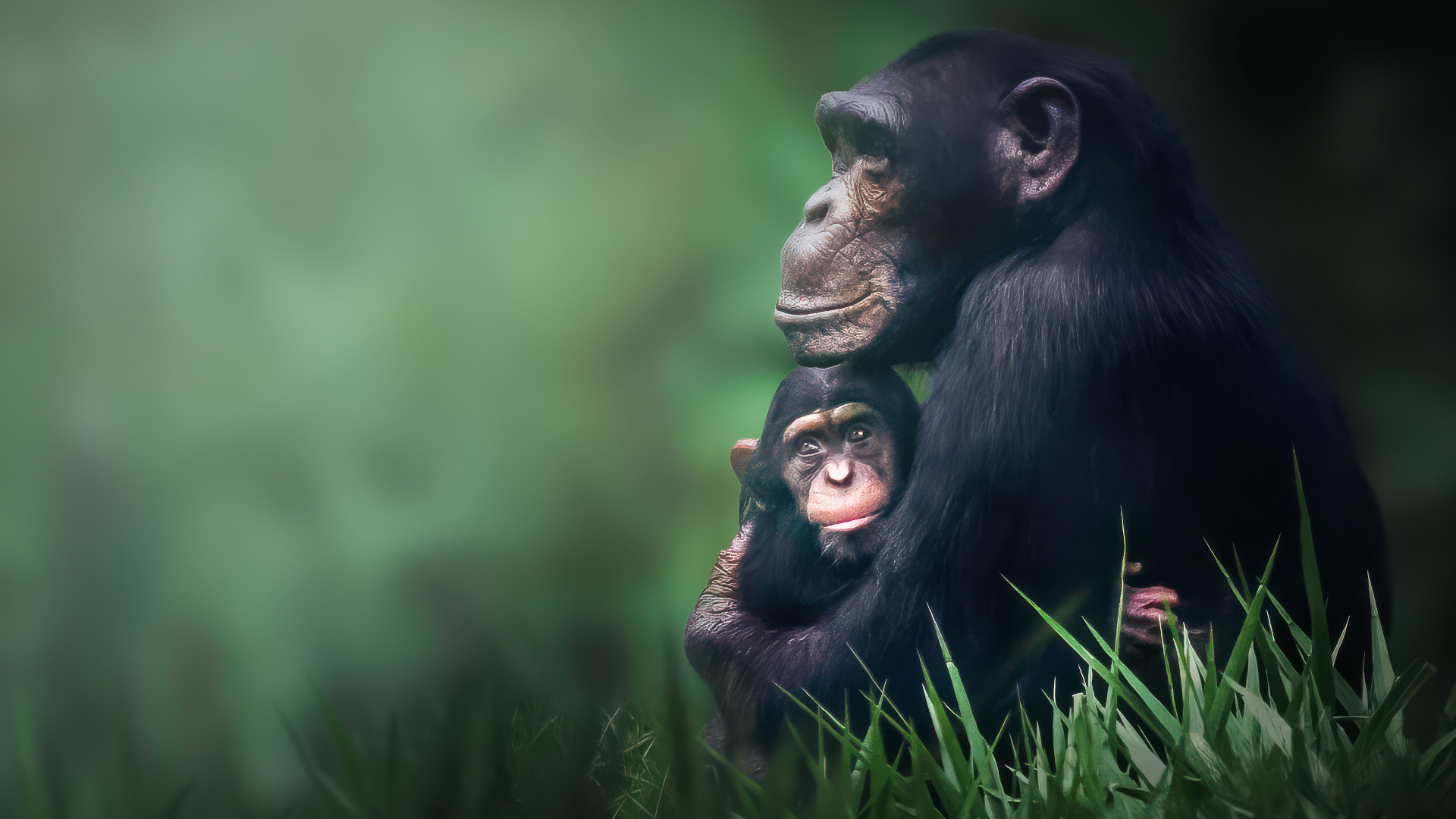
Throughout his career, Frans de Waal carried out foundational work on cooperation, conflict resolution, empathy, and other emotions in animals.
It was a view he continually fought against throughout his career, first as a graduate student at the University of Groningen, later at Utrecht University, and then at the Wisconsin National Primate Research Center in Madison and Emory University, the last of which would become his academic home. Along the way, he carried out foundational work on cooperation, conflict resolution, empathy, and other emotions in animals.
Readers of “Minds I’ve Met” may recognize some of the touchstones de Waal alights upon to prove his case. For example, the array of experiments that demonstrated that a variety of species, including apes, bottlenose dolphins, Eurasian magpies, and Asian elephants, recognize themselves in mirrors. Or the seminal research in chimpanzees — carried out first by the primatologist Emil Menzel and then by the psychologist David Premack — that showed that chimps could understand other chimps’ mental state, which Premack termed “theory of mind.” (Other psychologists, de Waal notes, later forgot that theory of mind was first demonstrated in primates, and claimed that only humans had such capabilities.)
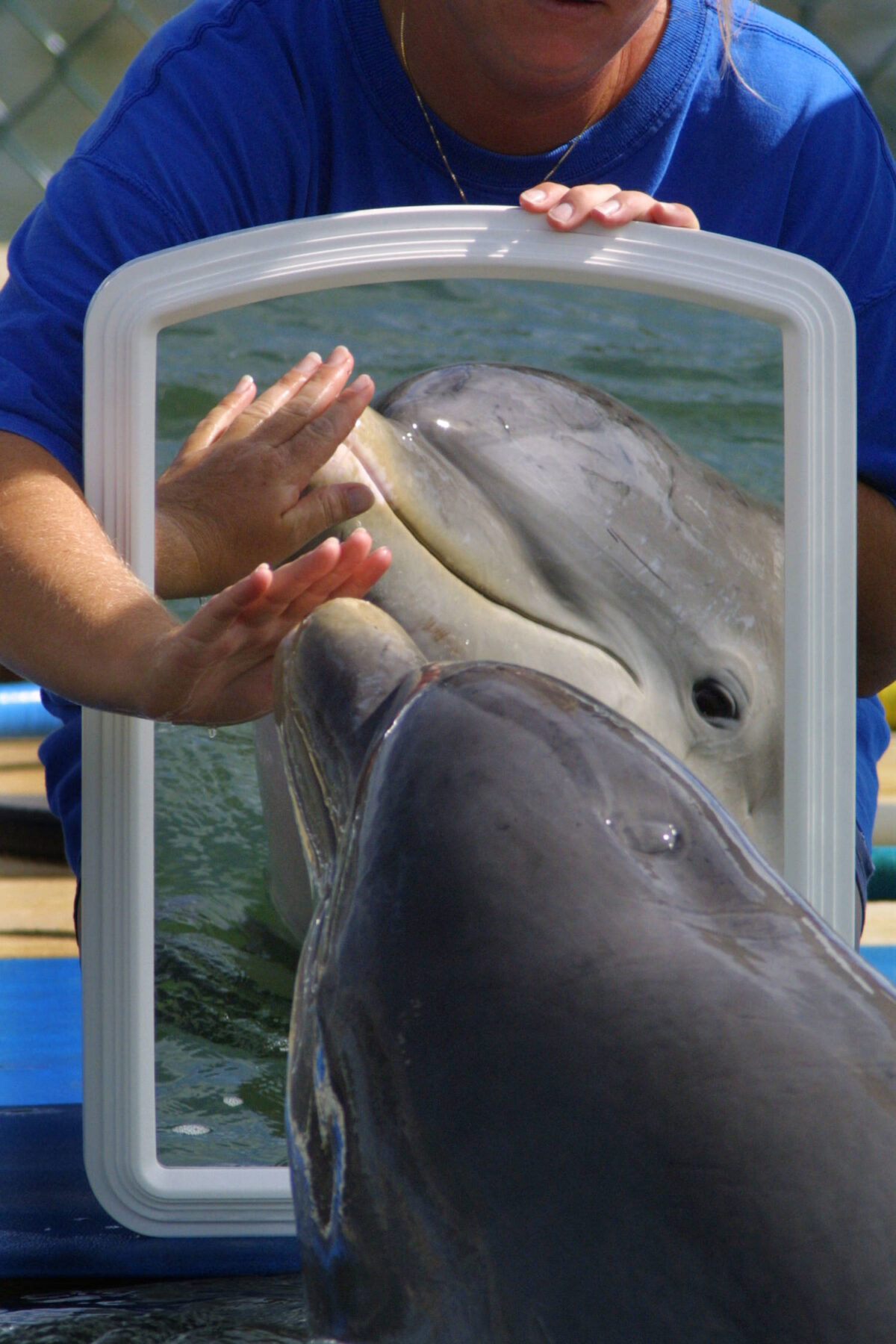
A variety of species, including bottlenose dolphins, recognize themselves in mirrors.
Visual: Joe Raedle/Newsmakers
Perhaps most memorably, readers may recall a widely publicized demonstration of animal fairness, the so-called cucumber-grape study conducted in 2003 by de Waal and a collaborator, Sarah Brosnan, one of the former students who helped finish “Minds I’ve Met.” In that study, capuchin monkeys were trained to trade pebbles for pieces of cucumber. But when they were shown another monkey receiving in return a grape, rather than a cucumber, they were outraged, hurling the vegetables at the experimenters.
But even those who have long considered their dogs (or cats) as fully sentient members of their families may find themselves surprised and impressed by some of the evidence de Waal summons: In Gabon, chimpanzees take with them a set of five distinct tools when they set off to raid bee nests, providing one of many examples of animal planning. In Japan, a young female macaque named Imo took it into her head to take a sweet potato given to her by researchers and wash it in the river, thereby starting a cultural tradition that has now been passed down through generations.
De Waal was a lively and engaging writer, a talent not easy to duplicate. The colleagues who jumped in to complete “Minds I’ve Met” after his death clearly tried their best, but the last parts of the book, while informative, are less compelling. Their continued use of their mentor’s first-person “voice” also reads awkwardly. Still, the book serves as a welcome armory for evidence against whatever Cartesian assumptions about animals remain, and de Waal needed only the chapters he finished to make it well worth reading.
Erica Goode is a senior staff editor at The New York Times. In her years at the Times, she has been a science reporter and editor, a national correspondent, and covered the war in Iraq. Trained as a social psychologist, she never viewed animals as robot-like automatons.