







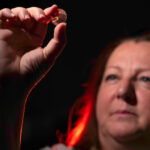

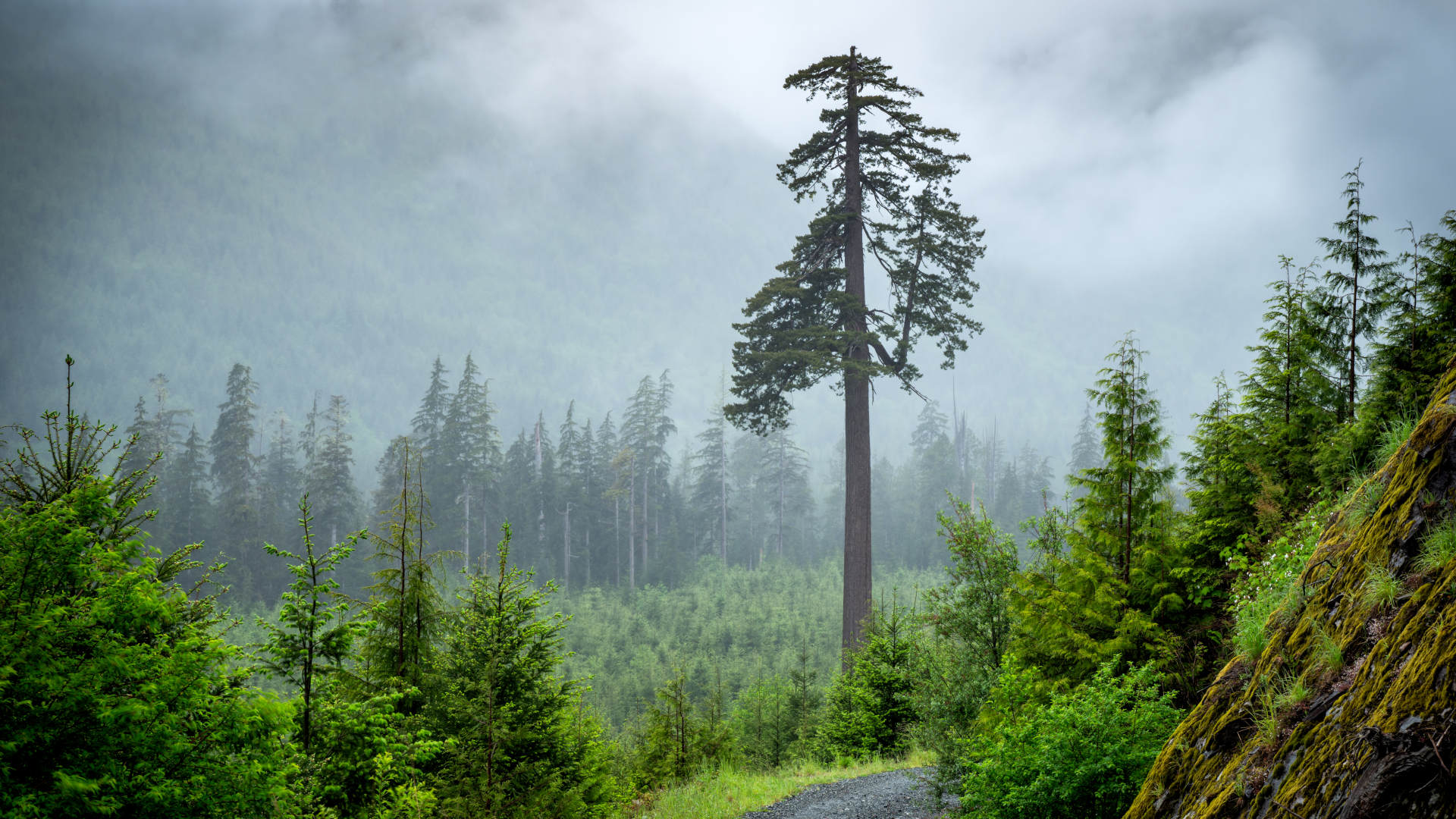


One summer day in 2020, forestry professor Suzanne Simard ventured into an arid forest in British Columbia to check on an experimental forest she’d planted as part of a research project. In a caravan of pickups and beaters, Simard and her team headed deep into the woods on a logging road, radioing ahead every half mile or so to alert loggers to their presence. Before long, a logging truck appeared. It was nearly 10 feet wide and some 50 tons, “accompanied by a tornado of dust backlit by the early morning sun.” The truck driver didn’t brake. Simard’s daughter, Hannah, who was driving the first pickup in their caravan, swerved right. The truck sped towards them, the driver refusing to move even an inch to the left. Simard screamed instructions at her daughter; at the last second, Hannah veered into a ditch as the logger barreled on.
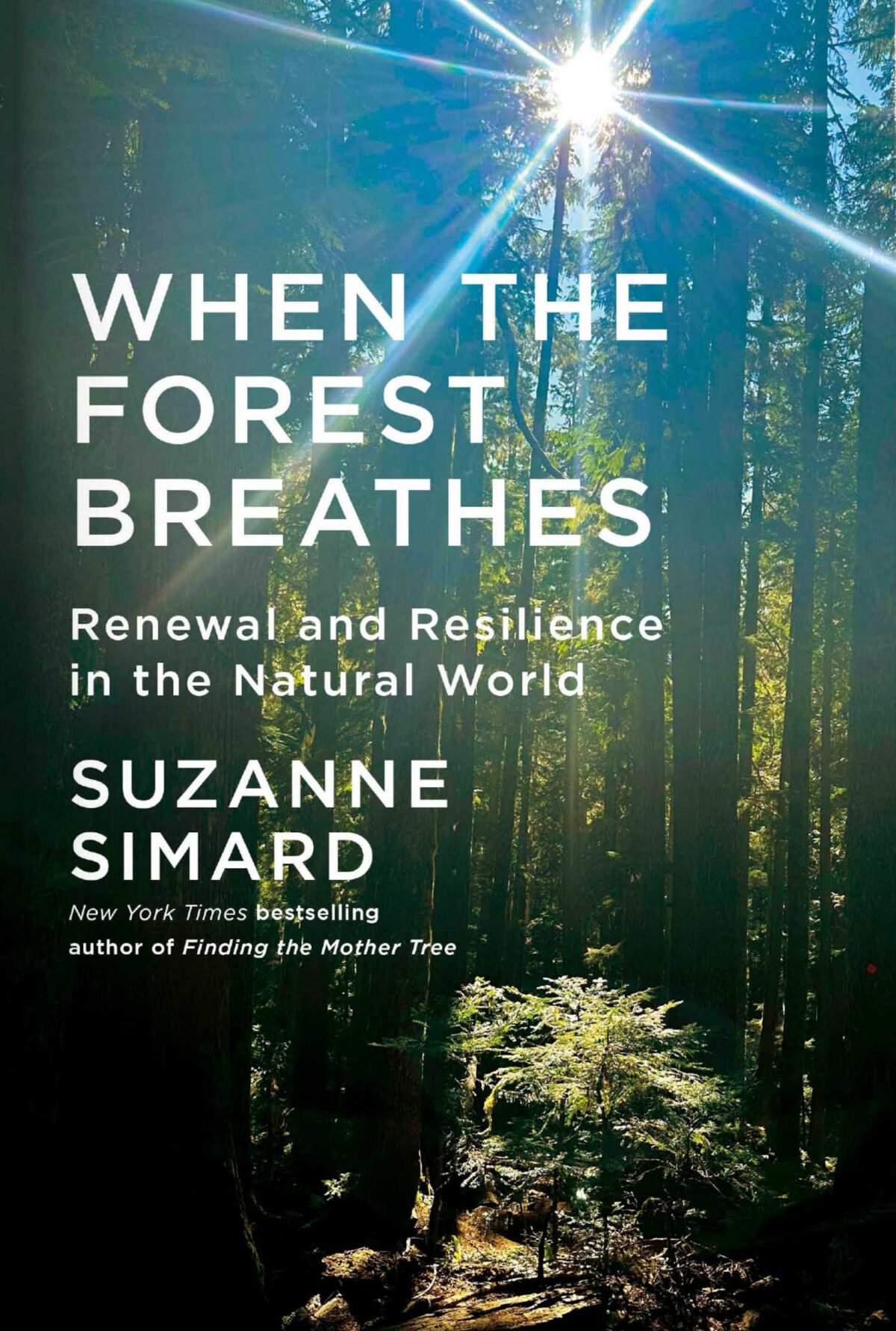
BOOK REVIEW — “When the Forest Breathes: Renewal and Resilience in the Natural World,” by Suzanne Simard (Knopf, 336 pages).
This encounter is one of many vivid, immersive scenes in “When the Forest Breathes: Renewal and Resilience in the Natural World,” Simard’s sequel to her 2021 bestseller, “Finding the Mother Tree: Discovering the Wisdom of the Forest.” In her new book, Simard builds on the argument she advanced in “Mother Tree” — that forests are interconnected ecosystems that communicate and collaborate using underground fungal networks, known officially as the mycorrhizal network and colloquially as the “wood wide web.” Trees rely on their elders, their relatives, and the rich community of animals, moss, and undergrowth to thrive, she argues, and when the modern logging industry wipes out entire swaths of forests, they’re destroying a complex ecosystem at an alarming, unsustainable rate, with drastic consequences for our planet.
Blending memoir with history, science, and politics, “When the Forest Breathes” is steeped in grief over the juggernaut of industry and the resulting loss of the primitive, inimitable landscapes where Simard has spent her career and her life.
Most forestry researchers aren’t household names. But Simard, a professor and researcher at the University of British Columbia, reached public acclaim first through a 2016 TED talk and then through the success of “Mother Tree,” which advanced the idea that specific “mother trees,” the oldest trees in any given forest, are essential elements of forest health. These trees are matriarchs, evolving traits to support the young trees around them, as Simard writes: “The mother trees transmitted their wisdom and knowledge to the young, ensuring life for future generations.”
When logging companies replace forests that they’ve cleared, they usually do so by planting rows of monocultural seedlings in white plastic tubes, with no regard for rebuilding the tree community that they’ve destroyed. Simard calls these replanted plots “cellulose cemeteries,” noting that they are useless as buffers against fire, underperform as carbon sinks, and fail to replicate the relationships so important in old-growth forests. Trees need older trees to protect and nurture them; they thrive when planted near other trees that they recognize as their relatives, “presumably because they had access to the established mycorrhizal network of the older sibling.”
Simard has advanced the idea that specific “mother trees,” the oldest trees in any given forest, are essential elements of forest health.
In researching and developing these theories, Simard has gotten her hands dirty: She’s spent the past four decades designing experiments in the forests of her native British Columbia. In “When the Forest Breathes,” much of the action revolves around Simard, her daughters, and her assistants investigating the negative impacts of clearcutting, the most common logging practice in British Columbia.
When clearcutting, loggers take all the trees in a particular area, rather than taking, say, 50 percent of trees over a larger area. Simard’s research involved establishing nine experimental forests on land slated for logging, in various climate zones across the province. To test the impact of clearcutting, she and her fellow researchers worked with loggers to cut down varying percentages of trees at each site, leaving between 0 and 100 percent of “mother trees” standing. She and her fellow researchers studied how well the forest regenerated at each of the sites. Her conclusion? “Clearcutting, we found, is the worst thing we can do.”
Simard has so many fans, perhaps, because the stakes of her research are eminently clear. Her writing shimmers with her deep connection to the forests where she’s spent her life. She runs a measuring tape through “creamy honeysuckles and ivory snowberries.” She witnesses “a sandhill crane stood Jurassic in the mist” and a clearing littered with salmon carcasses, gutted by bears. She pulls needles off a Douglas fir and rubs them on her cheeks to refresh her skin after a long day of digging. Implicit in these descriptions: If we are not careful, we stand to lose all of this.
Simard also makes the stakes explicit in her harrowing descriptions of the climate crisis descending on British Columbia. Clearcutting increases wildfire risk by stripping the ground of moisture and destroying overstory trees that protect the ground from baking in the sun. When fires sweep through, they scorch forest floors into hydrophobic crusts; with no soft ground to absorb snowmelt, torrential floods decimate surrounding communities.
Her conclusion? “Clearcutting, we found, is the worst thing we can do.”
State-of-the-art logging technology is making this problem worse. The heavy, efficient machines favored by today’s loggers don’t just remove trees; their weight strips away forest floors. By scraping up precious reserves of moss, lichen, and rich organic soil, they release dangerous amounts of carbon into our atmosphere.
“In the week it took the machines to scrape a stand of trees off the surface of the Earth, thousands of years of sequestered carbon was pushed with logs into piles and burned, combusted, vaporized, or eroded away,” writes Simard. Overall, according to Simard’s research, modern “whole tree” machine logging causes a 61 percent reduction in forest floor carbon; in other words, loggers are “detonating a carbon bomb.”
A cliché version of this narrative might involve noble environmentalists in a clash with evil, money-hungry industrialists. But Simard, who hails from a family of loggers, is careful to approach these tensions with sensitivity. She avoids demonizing individuals even when their actions make her life harder, such as when a logger ignores her instructions for one of the experimental forests in the name of economic efficiency. That logger, after all, needed to make money too.
Simard acknowledges that good versus evil in environmental movements is often far more complex than meets the eye. One chapter concerns the 2021 protests at Fairy Creek, the largest act of civil disobedience in Canadian history, which involved activists blockading roads leading to an unlogged tract of old-growth trees. During that protest, some Indigenous officials actually sided with the loggers and asked activists to get off their land; these Indigenous leaders needed their logging contract to pay back a loan from the provincial government.
Support Undark Magazine
Undark is a non-profit, editorially independent magazine covering the complicated and often fractious intersection of science and society. If you would like to help support our journalism, please consider making a donation. All proceeds go directly to Undark’s editorial fund.
Saving trees always involves a delicate balance between different interests — although Simard is adamant that when it comes to the obsession with profit motiving those at the top, questions of morality become clearer. She writes that we can no longer afford to sacrifice our forests’ “life-giving principles for the profit of a few.”
“When the Forest Breathes” is saturated not just with grief for a changing forest and for continued rapacious clearcutting, but also for the changes that touched Simard’s life as she entered late middle age. In these pages, Simard sits with her beloved aging mother as she chooses to die with medical assistance. She loses one of her young mentees, Amanda, in a freak skiing accident. With a mixture of pride and bittersweetness, she watches her own daughters evolve from teenagers into forest science researchers in their own right.
Then there’s the drama. Since before “Mother Tree,” Simard has faced criticism for some of her theories and assertions. This controversy heated up in 2023, when several scientists, some of them Simard’s former collaborators, began publishing papers arguing that she had strayed too far into exaggeration and anthropomorphism.
In the new book, Simard’s feelings of betrayal radiate off the page: She shrinks from public life, flees on a trip to the Amazon. Ultimately, she responds to these criticisms by questioning the tenets of Western science itself. Maybe, she argues, we should question whether that schema, developed by White Europeans during the Enlightenment, should be our only way of understanding the world around us. Take Indigenous knowledge, for example, which described kinship and community between trees long before the Simard family arrived on Canadian shores.
Simard writes that we can no longer afford to sacrifice our forests’ “life-giving principles for the profit of a few.”
Simard stresses the importance of working with and listening to Indigenous communities, many of whom are eager to design sustainable forestry methods based on what their ancestors have always known about ecology and the natural world. As one of Simard’s assistants says: “There’s the truth that is Western science, and then there’s the truth that is wisdom. We should be asking, What is the wise interpretation of this? What is the wise way forward?”
If there’s a criticism to be leveled at “When the Forest Breathes,” it’s that Simard perhaps doesn’t cover quite enough new ground beyond the points already explored in her earlier book. Still, though, fans and new readers alike will enjoy spending time with Simard and her ragtag band of helpers as they venture into these sublime, imperiled landscapes. And anyone dealing with mortality or loss will find solace in Simard’s musings, which include, alongside her grief, reminders of what we can learn from the endless cycle of birth, aging, death, and renewal found in the forest.
In one of the most stirring passages, Simard, searching for peace and solace amid turmoil, imagines herself as a tree: First as a sapling, then as a 200-foot mother nurturing the saplings around her. In her daydream, she ages, dropping her needles, and becomes a shell where she hosts other life in the form of fungi, bears, woodpeckers. Finally, she tumbles over into woody debris and plays host to a newly germinating seed, which blossoms into a seedling. “And,” she writes, “the great cycle starts all over again.”
Emily Cataneo is a writer and journalist from New England whose work has appeared in Slate, NPR, the Baffler, and Atlas Obscura, among other publications.
Wow