












When a child learns all 26 letters of the English alphabet, they’re “done” — but numbers, amazingly, just keep on going. A particularly enthusiastic kid might decide to see just how far they can go: Start from one and keep going into the hundreds, perhaps into the thousands, and — well, eventually they get tired or bored, and the exercise comes to a close. Jeremy Harper, with an eye on the record books, counted out loud to a million in 2007, a task that required 89 days. But a million is peanuts compared to really large numbers. Like the number of atoms in the known universe, for example, pegged at about 1080. (Notice how helpful the use of scientific notation is; it’s a lot easier to write 1080 than to write a 1 with 80 zeros after it.)
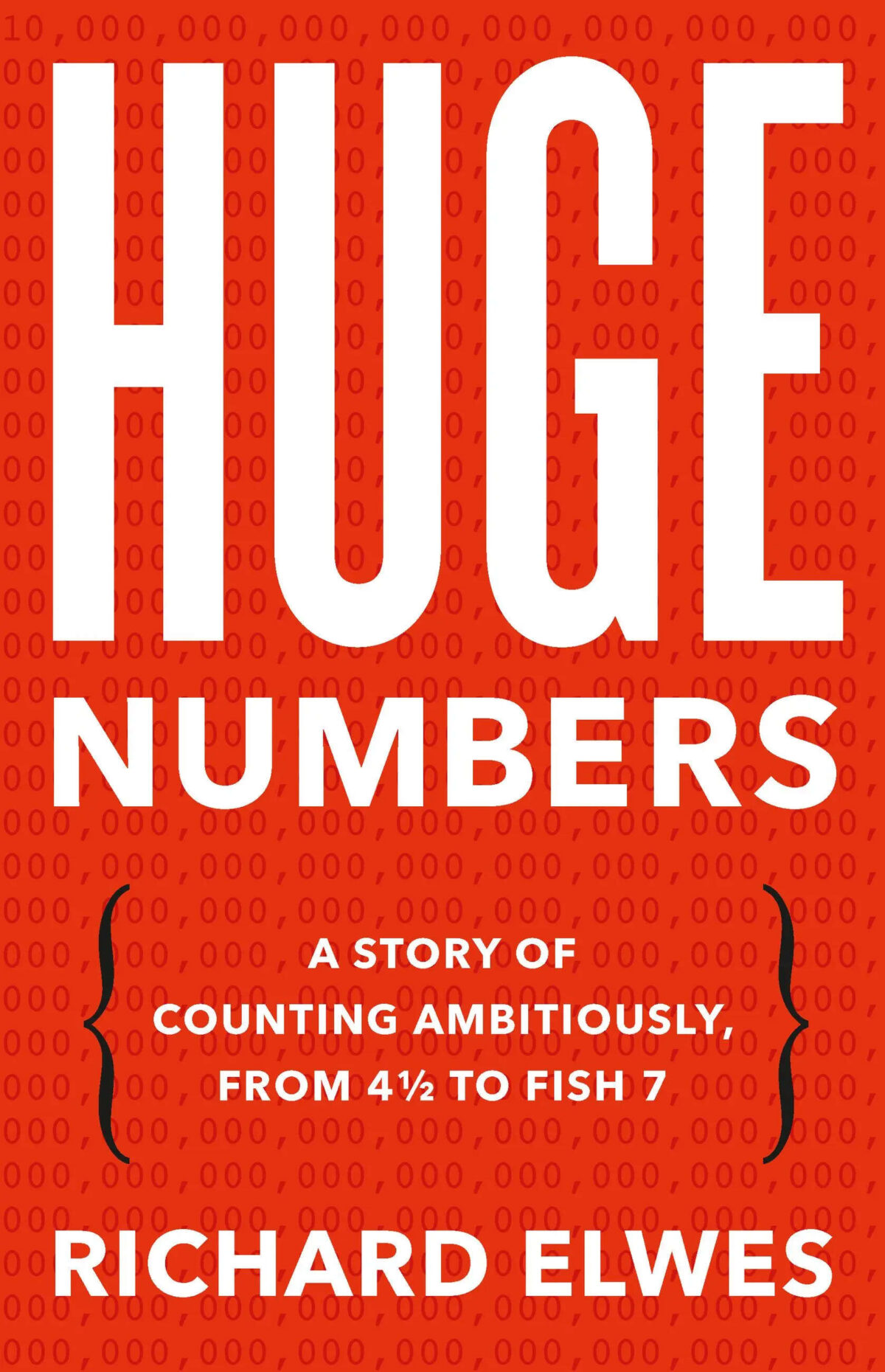
BOOK REVIEW — “Huge Numbers: A Story of Counting Ambitiously, From 4½ to Fish 7,” by Richard Elwes (Basic Books, 368 pages).
Other animals may have some capacity to grasp small numbers, but only humans have jumped on the number train and steamed ahead full throttle. As mathematician and author Richard Elwes sees it, it all began when our ancestors first used sticks or stones to keep a tally. “This is the intellectual ancestor of every more complex pattern humans have subsequently investigated,” he writes, “from the cycles of the moon to the Riemann zeta function.”
In his new book, “Huge Numbers: A Story of Counting Ambitiously, From 4½ to Fish 7,” Elwes, a writer and associate professor of mathematics at the University of Leeds in the U.K., shows off his love of all things numeric, and, in particular, shines a spotlight on some of the largest numbers humans have contemplated. (Aficionados of huge numbers are called “googologists,” a reference to the number 10100, known as a googol.)
Such numbers have a peculiar sort of existence. For the vast majority of us, they’re of limited everyday value. Calculations at the supermarket checkout, or at tax time in April, typically involve far more modest figures. Perhaps we’ve read that the U.S. national debt is in excess of $38 trillion — a mind-numbing figure, to be sure, but it’s not as though any one individual needs to count it up in stacks of $20 bills.
And yet, much larger numbers await those who seek them out. Consider the kinds of numbers that crop up in problems involving combinations and permutations. For example, in how many distinct ways can one shuffle a deck of cards? Elwes takes us through the calculation, and we end up with a figure of about 8×1067. Compared to that number, the odds of getting a royal flush when dealt a five-card poker hand seem pretty decent, sitting at a mere 1 in 649,740 (still rare enough that many poker players have never held such a hand). Or consider that famous 1980s cultural touchstone, the Rubik’s cube. In how many ways can one scramble the cube? It turns out that the figure is about 43 quintillion, or 4.3×10¹⁹ — but in spite of that ridiculously large figure, people do routinely solve the puzzle, and champions can do it in mere seconds. In fact, as Elwes explains, no Rubik’s cube arrangement is more than 20 moves away from any other arrangement.
The highest numbers contemplated by humans come not from physics but from pure mathematics and computer science.
Or consider the age of the universe, estimated to be about 13.8 billion years. This may seem like a lengthy span of time, but our cosmic future is where the really big numbers come up. Elwes examines the so-called heat death of the universe, in which all matter has broken down into subatomic particles. We may reach this point in years — this dizzying figure is 10 raised to the power of 10120 — at which point, Elwes says, the universe will have ballooned up to a diameter of 10 to the power of 10 to the power of 10120 light years. (Yes, that’s light years.) Elwes adds a footnote: “At this point, the choice of units hardly matters; the distance is so immense that whether we choose to measure it in Planck lengths or giga-light years makes little difference.” Let that sink in!
As mind numbing as such figures are, the highest numbers contemplated by humans come not from physics but from pure mathematics and computer science. Like “Graham’s number” — an immense figure put forward as the upper-bound for solutions to a problem in a branch of mathematics known as Ramsey theory. Some readers may find the ensuing discussion of multi-dimensional hypercubes a bit challenging, but one can enjoy the payoff regardless: We end up with a number that can’t even be expressed in conventional notation, and which earned a mention in the 1980 edition of the “Guinness Book of World Records” as “the highest number ever used in a mathematical proof.”
Reading this book is a little bit like sitting in the back row of an auction house where a rare Picasso (let’s say) is up for grabs: How high is this thing going to go? And indeed, Elwes keeps going. We eventually meet the so-called busy beaver numbers, a set of numbers that crop up in theoretical computer science, when one tries to deduce whether a particular computer program will eventually stop, or keep going forever — a conundrum known as the “halting problem.” As Elwes explains, it’s not at all straightforward to distinguish the two types of programs (and if it was, it would help mathematicians tackle some of the most vexing problems in their field).

The fifth busy beaver number, known as BB(5) — associated with a computer program that can access five internal states — works out to 47,176,870. And that’s as far as we’ve gotten, Elwes explains. No one has worked out the value of BB(6), but he assures us that it’s beyond the range of any physical computer; and BB(16) leaves even Graham’s number in the dust.
But wait, there’s more! “Rayo’s number,” concocted by Agustín Rayo — a dean and professor at MIT — using set theory, is bigger still (here’s a fun video about it); and “Fish 7,” mentioned in the book’s subtitle, named for a Japanese googologist who goes by the pseudonym “Fish,” builds on Rayo’s number, and … well, the details are not easily digested, but the mind-melting nature of these numbers comes across as a feature, not a bug, of Elwes’s story.
If the book was just a long list of big numbers and their origin stories, it might fall a bit flat, but the narrative is enlivened by explorations of the peculiarities of math history. For example, Elwes explains an oddity that some of us have likely wondered about since grade school: We all know that “bi” means two and “tri” means three — so why do we say “billion” for a thousand million (109), and “trillion” for a thousand billion (1012)?
To see how we got here, start with 1,000 and think about the power that it has to be raised to, to create those larger numbers. A billion is 1,000 raised to the power of (1+2); a trillion is 1,000 raised to the power of (1+3); a quadrillion is 1,000 raised to the power of (1+4). Knowing that readers will be scratching their heads over the mysterious “1+,” Elwes writes: “The recurring ‘1+’ is an annoyance; things would be neater if these numbers were defined as 10002, 10003, 10004, and so on. But a million, originally meaning ‘big thousand’, acquired squatters’ rights on 10002, which forced all the subsequent ‘illions’ to shift up by one. Like every language, English has its vagaries.”
If the book was just a long list of big numbers and their origin stories, it might fall a bit flat, but the narrative is enlivened by explorations of the peculiarities of math history.
And there’s the story of how Archimedes tried to estimate how many grains of sand would be needed to fill up the known universe, back in the third century B.C. Did he simply have too much time on his hands? Not at all, insists Elwes: The Greek thinker was articulating an important idea — that no matter how unfathomably large a quantity may be, we can describe it with precision, thanks to mathematics. “Archimedes,” he writes, “was penning a manifesto for the expressive power of large numbers.”
By now, popular math books have a long and established track record — Elwes himself mentions Stanislas Dehaene’s “The Number Sense” a few times — and over the years we’ve had a number of good, accessible books about infinity: one by Brian Clegg, another co-authored by Robert Kaplan and Ellen Kaplan. Yet few books seem to have explored the territory that Elwes has carved out here, focusing on numbers that are ridiculously large and yet finite. In the end, perhaps this is the most mind-boggling fact of all: that these enormous numbers, from Graham’s number to Fish 7 and beyond, fall as far short of infinity as does the humble number 1.