









Editor’s note: The original version of this review contained several factual errors. These have been corrected, and details of the errors, and the changes made, can be found at the conclusion of the article.
Its origins practically reek of conspiracy: The campaign to fluoridate water — an intervention aimed at preventing dental cavities and boosting public health — has its roots in a 1940s government program to convince Americans that fluorine compounds were safe. Fluorochemicals, after all, played a major role in the development of the U.S. nuclear weapons program.
This is among the many secrets — secret meetings, secret studies, secretly dumped sludge, secretly collected tap water — pried open in Mariah Blake’s “They Poisoned the World: Life and Death in the Age of Forever Chemicals.” By the latter part of the 20th century, fluorochemicals were everywhere, thanks to a postwar boom when powerful industries leveraged the wartime technology, finding new purposes for per- and polyfluoroalkyl substances, or PFAS. These fluorochemicals coat countless consumer products: fast-food wrappers, non-stick pans, waterproof jackets, stain-resistant carpeting, and those mile-long thermal-printed receipts you get at the drugstore.

BOOK REVIEW — “They Poisoned the World: Life and Death in the Age of Forever Chemicals,’’ by Mariah Blake (Crown, 320 pages).
PFAS seep into rainwater and groundwater and, inevitably, the human bloodstream. It’s the DDT of our time. Because they tend to be as durable as they are persistent, PFAS go by another, more familiar name: forever chemicals. “PFAS are extremely toxic, even in the most minuscule doses,” Blake writes. “They refuse to break down in nature, which is why they’re commonly called forever chemicals.”
“They Poisoned the World” is a braided narrative. One strand charts the historical introduction of poisonous substances into industrial products. Blake starts with leaded gasoline. Lead, of course, is a neurotoxin, and its calamitous applications poison the world’s soil to this day. These efforts spawned the Kehoe principle (named for DuPont toxicologist Robert Kehoe), which holds that substances should be presumed safe until proven otherwise; it’s the opposite of the precautionary principle.
That set the stage for the promotion of fluorochemicals. In the 1960s, despite growing signals about the toxicity of Teflon — which used PFOA from 3M — DuPont began to market it for cookware production. They did not stop there. Blake’s central thesis is that the companies wrote the playbook for concealing the harmful health effects of lucrative products. Big Tobacco later stole a page to defend cigarettes, but the chemical industry, she argues persuasively, paved the way.
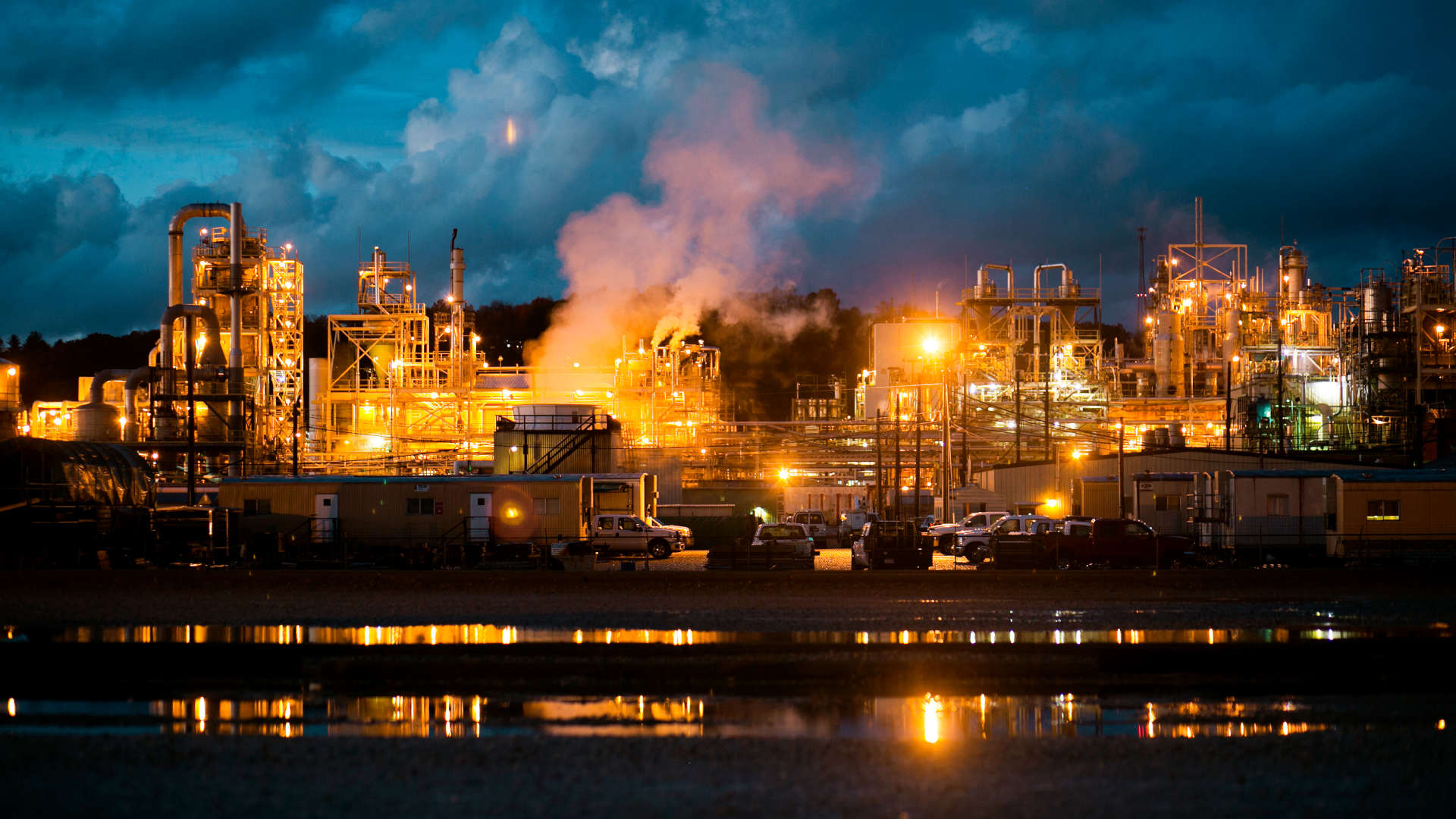
But the more profound braids of the book reveal the human side of PFAS. Blake, an investigative journalist, centers these sections in and around Hoosick Falls, New York. In the 2010s, the small town confronted a contamination crisis stemming from the Saint-Gobain Performance Plastics site. Initially, Blake follows an insurance underwriter named Michael Hickey. In her telling, Hickey initially seemed ill-suited for activism, but he turned citizen sleuth not long after his father was hospitalized with cancer. Down the hall, meanwhile, Hickey’s wife gave birth. Life and death, all wrapped up in PFAS.
Fluorochemicals, Blake writes, played a major role in the development of the U.S. nuclear weapons program.
Before long, a Google search turned up a probable link between PFOA, a fluorochemical used to manufacture Teflon, and the cancer afflicting Hickey’s father, who worked at the Hoosick Falls plant and stowed barrels of who-knows-what in his attic. “Michael agonized over what to do next,” Blake writes. “If there was any chance that other people were at risk of suffering like his father, he had to do something.”
“At the same time,” she continues, “he was scared of making a mistake that would hurt his family or his community.” So Hickey probed deeper: “Often, he sat up until four in the morning, poring over scientific studies, some of them so technical he had to read them four or five times before they made sense.”
The two sides — the us and them (those of us exposed to PFAS and, per the book’s title, the poisoners) — inevitably come to a head. In upstate New York, the Hickeys, a beloved community doctor, another concerned parent, a local teacher, and other residents exposed the contaminated water debacle. Then, Blake weaves in a third braid: a monumental legal battle in West Virginia. There, a crusading attorney named Robert Bilott filed the first PFAS lawsuit against DuPont in 1999 on behalf of a local dairy farmer. The twist: As an attorney, Bilott made a career doing the bidding for corporate America. According to Blake’s account, Rob pores over thousands of documents. Later, upon learning of a proposed safety standard for PFOA levels, he nearly falls out of his chair.

Some of this ground has been well trod. Bilott, for instance, wrote a 2019 memoir, “Exposure: Poisoned Water, Corporate Greed, and One Lawyer’s Twenty-Year Battle against DuPont,” one of the few book-length treatments about PFAS that is not textbook-level dense, and his story inspired the popular fictional film “Dark Waters” in 2019.
Like a familiar Hollywood trope, “They Poisoned the World” follows the familiar noble-crusader template, painting the corporate evildoers in flat, unwavering light. It’s galling but not surprising: The companies knew about the toxicity and extreme persistence of PFAS for decades, and behaved recklessly in the name of profit.
As Blake portrays it, ordinary people held them to account, filing thousands of lawsuits, which sometimes spurred the government to test and to regulate. “It shows just how much individual people and communities standing up and speaking out can do and the dramatic change they can put in motion,” she quotes Bilott saying at one point. “It took us way too long to get here, but it’s happening.”
In the course of her tale, Blake does not explore the potential downsides of litigation-funded research. Nor does she take on the conspiracy theories around fluoridated water, which have gained national prominence but, to be fair, have no plausible link with PFAS contamination in the public water supply.
Elsewhere, though, Blake folds in politics in nuanced ways, correctly suggesting that not all of the blame falls on the manufacturers nor on anti-science officials rolling back environmental regulations. She points out that regulatory capture, wherein regulators are unduly influenced by industries they’re supposedly regulating, is not a one-sided partisan issue. But her focus on individual struggles makes the systemic failures both relatable and compelling. Such framing also suggests that toxic exposures can be countered by strong personalities.
PFAS are hardly unique to West Virginia and upstate New York. Blake tells us they’ve been found on the summit of Mount Everest and in rainfall. Deeper scientific and societal issues remain: How do we undo contamination that’s forever? Blake acknowledges the incomprehensible, dizzyingly monumental problem.
But she never doubts that dedicated private citizens doing their own research can fight back. In 2017, Bilott won a $671 million settlement for his clients in West Virginia. In 2021, the firms responsible for PFAS contamination in Hoosick Falls — Saint-Gobain, Honeywell, and 3M — reached a groundbreaking $65 million settlement in what one corporate lawyer quoted by Blake predicted to be a “tsunami” of lawsuits. In these and several other cases, locals got payouts. And in 2024, the Environmental Protection Agency issued binding standards for about half a dozen types of PFAS in drinking water (although earlier this year, the agency delayed the timeline for water utilities to comply with standards on two of those compounds and rolled back the limits for the rest).
They did not stop there. Blake’s central thesis is that the companies wrote the playbook for concealing the harmful health effects of lucrative products. Big Tobacco later stole a page to defend cigarettes, but the chemical industry, she argues persuasively, paved the way.
Even so, some of the victories come off as a bit unsatisfying. Take routine blood testing for PFAS, part of the settlement in New York. As Blake writes in an intimate closing scene, a woman in a lab coat teaches Hickey and his son, Oliver, “how to check their testicles for lumps.”
“A kindly gray-haired nurse took their blood and showed Oliver how she processed the samples, placing the vials in a spinning contraption that separated the red blood cells from the plasma,” she writes. “Afterward, she took Michael’s hand and thanked him for fighting so hard to protect their community.” As much as Blake paints the heartwarming gesture as a victory, the scene only exists because something went very wrong, leaving both a warm and a queasy feeling.
But that should not deter us, Blake writes: “All too often, we respond to grave environmental threats with a kind of collective paralysis. The problems are so vast and mind-bendingly complex that our individual efforts to address them can feel meaningless, especially when our political leaders are bent on rolling back protections.”
But ultimately, she argues, PFAS, like other pressing global problems, seem solvable. Hoosick Falls recently turned on the tap for a new safe water supply — suggesting that a better world is possible. Some might see it as a marginal win; Blake casts it as victory for all of us.
UPDATE: A previous version of this review incorrectly attributed a detail about sitting in a corduroy chair to lawyer Rob Bilott, rather than to music teacher Rob Allen. That detail has been removed. The piece also stated that Bilott nearly fell out of his chair after seeing test results. He nearly fell out of his chair after learning of a proposed safety standard for PFOA levels. Further, the piece stated that Bilott filed his first class action lawsuit on behalf of a dairy farmer against DuPont in 2001. While he did file a class action in 2001, his first lawsuit against the company was in 1999. The piece also inadvertently implied that research arising as part of the DuPont settlement in West Virginia was unscientific. The passage has been rewritten. The piece also incorrectly stated that DuPont was aware of the toxicity of PFOA in the 1950s and subsequently scaled up Teflon cookware production. The piece has been updated to note that there were growing signals about the toxicity of Teflon in the 1960s, when the company began to market the material for use in cookware. The piece also stated that PFAS paved the way for the tobacco industry to defend cigarettes. This has been changed to note that the chemical industry in general paved the way, rather than PFAS manufacturers specifically. In one instance, the acronym for PFOA was incorrectly written as PFAO. This has also been corrected.