









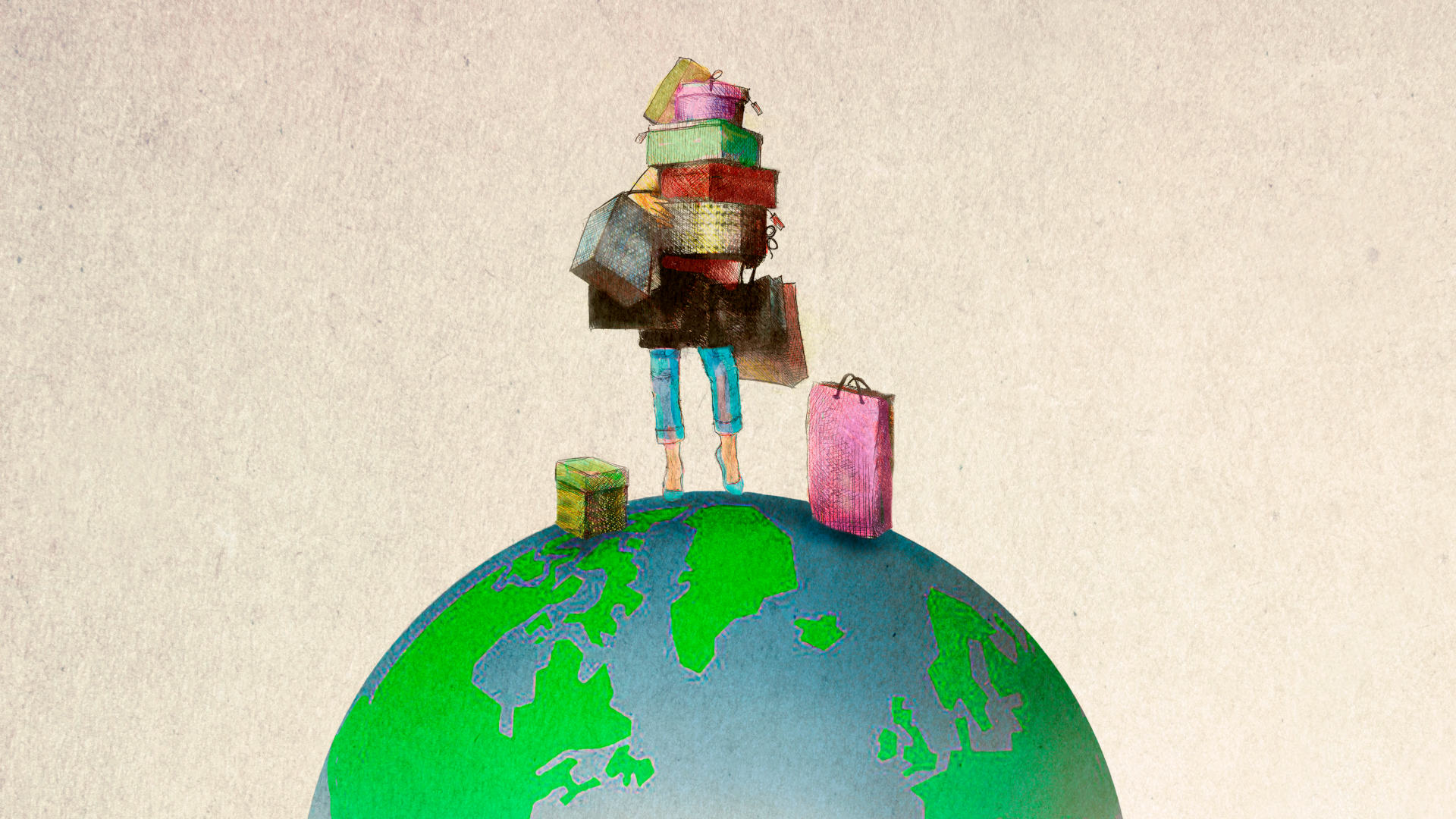
For much of the past decade, environmental debates have been dominated by a single question: How quickly can we decarbonize — that is, reduce the greenhouse gases emitted from activities like heating our homes, moving around, and producing food and goods? The urgency is justified. But as climate policy matures, another, more uncomfortable question is coming into view. Cutting carbon emissions is essential, but it is only one part of a broader environmental challenge shaped by how much societies produce and consume overall. Even in a low-carbon future, how much is enough?
This question sits at the heart of a growing body of research on “sufficiency,” often framed through the idea of consumption corridors. The concept is simple in theory: Societies should guarantee a floor of consumption that secures a decent life for everyone, while also setting a ceiling beyond which consumption undermines planetary boundaries, such as climate stability, healthy ecosystems, land use, and freshwater systems. Between those limits lies a corridor where people can live well without destabilizing those systems on which life depends. This framework links sustainability with fairness, acknowledging that people living in poverty should not be asked to consume less, while those with far larger ecological footprints may need to scale back.

Sufficiency is no longer a fringe idea. Climate researchers now estimate that changes across sectors such as construction, transportation, and agriculture could reduce global emissions by 40 to 70 percent by mid-century. In Europe, policymakers and researchers are beginning to explore how such ideas might be integrated into housing and building policy, including placing limits on the size per capita of new homes in wealthier countries. Civil society groups and research institutes have gone further, developing concrete policy options for applying the logic of sufficiency to buildings, transportation, and energy use.
But as governments and researchers begin turning sufficiency from theory into policy, a more difficult issue emerges. Who gets to decide where the floor and ceiling should be set, and for whom?
That question matters because environmental limits are not just technical decisions — they are political ones. Across many democracies, sustainability measures increasingly face resistance, not because people reject environmental protection outright but because they experience it as something imposed from above. In this political climate, sufficiency can either deepen suspicions of bureaucratic overreach, or it could offer a way to reconnect environmental policy with democratic decision-making.
Ceilings are not neutral facts waiting to be discovered. They reflect judgments about what counts as necessity, excess, and fairness. If these judgments are made through technocratic fiat rather than democratic deliberation, sufficiency risks reinforcing a familiar and politically powerful narrative: that sustainability erodes freedom and sidelines public voice.
In this political climate, sufficiency can either deepen suspicions of bureaucratic overreach, or it could offer a way to reconnect environmental policy with democratic decision-making.
Studies show that opposition to climate policies such as fuel and carbon taxes is often driven less by climate skepticism than by distrust in institutions and perceptions of unfairness. When environmental limits are experienced as top-down mandates, they can provoke anti-authoritarian resistance, even when the environmental goals themselves enjoy broad support.
Air travel brings these tensions into sharp focus. Aviation accounts for roughly 2.5 percent of global carbon dioxide emissions, with its contribution to warming rising to around 4 percent once certain atmospheric effects such as contrails are included. Flying is also deeply unequal. A small minority of frequent flyers is responsible for a disproportionate share of aviation emissions, while much of the world’s population never flies at all.
From a sufficiency perspective, aviation is an obvious candidate for reduction. Policy proposals include frequent-flyer levies that raise the cost of each additional flight taken in a year, as well as personal flight budgets designed to curb excessive travel while protecting occasional and essential trips. But the challenge is not only how to reduce emissions. It is how to decide which trips are legitimate, and who gets to make that call.
Get Our Newsletter

The Covid-19 pandemic offered a revealing glimpse of how such decisions can play out. In March 2020, governments around the world clamped down on aviation. In the United Kingdom, officials warned against all non-essential international travel, while the European Union put a temporary restriction on non-essential travel into the bloc. These categories often failed to reflect lived realities on the ground. Recent research has documented the human cost of these policies, as migrant workers visiting family, binational couples reuniting, and people returning to care for relatives found their needs squeezed into rigid bureaucratic definitions.
The lesson is not that limits are inherently illegitimate. It is that legitimacy depends on process. This is where sufficiency reaches a political crossroads. Defined bureaucratically, it risks becoming another example cited by critics of environmental “overreach.” But defined democratically, it could help rebuild trust rather than erode it.
There is growing evidence that citizens are capable of grappling seriously with environmental limits when given the opportunity. The Organization for Economic Co-operation and Development has documented hundreds of citizens’ assemblies on climate worldwide. Analyses of such processes show that participants frequently endorse sufficiency-oriented measures, particularly in sectors like transportation. For example, a national citizens’ climate convention in France came up with a creative solution by proposing limits on domestic flights where less-polluting rail alternatives existed.
Sufficiency is often framed as a call to live with less. In reality, it is a demand to decide together what we truly need to live well on a finite planet.
Deliberation does not eliminate disagreement, nor does it guarantee ambitious outcomes. But it makes trade-offs visible and contestable. It shifts sustainability from a project of compliance to one of collective self-rule. In this sense, sufficiency is not only an environmental proposal but a democratic test.
Sufficiency is often framed as a call to live with less. In reality, it is a demand to decide together what we truly need to live well on a finite planet — which, for some, in fact means living with more. Technology and economic modeling can help us understand what is physically possible, but they cannot tell us what is socially acceptable or morally just. Those judgments belong in the public realm.
If environmental sustainability is to succeed, it must be understood not just as a technical project but as a political achievement. The hardest limits we face are not only ecological but democratic. Whether sufficiency succeeds will depend less on where ceilings are set than on whether societies are willing to confront the question of “enough” — collectively, openly, and with care.
Peter Sutoris is an environmental anthropologist and associate professor in climate and development at the University of Leeds’ Sustainability Research Institute. He is the author of the books “Visions of Development” and “Educating for the Anthropocene,” and co-author of “Reimagining Development.”