







How Memories Might Be Used to Help Heal the Brain
As a new Ph.D. student in 2011, Steve Ramirez and his mentor performed a groundbreaking experiment in the field of memory manipulation. They placed a mouse in a small distinctive box and administered a mild electrical shock to its feet. When the rodent was placed in the box a second time, it froze up — anticipating another shock.
From there, the young neuroscientists placed the mouse in a different box, one where nothing bad had happened. They then directed pulses of light to a very specific region in the mouse’s brain that had been genetically modified to respond to the light. This caused the mouse to immediately freeze. Ramirez and his mentor, it turned out, had found a way to artificially activate a fear-inducing memory.
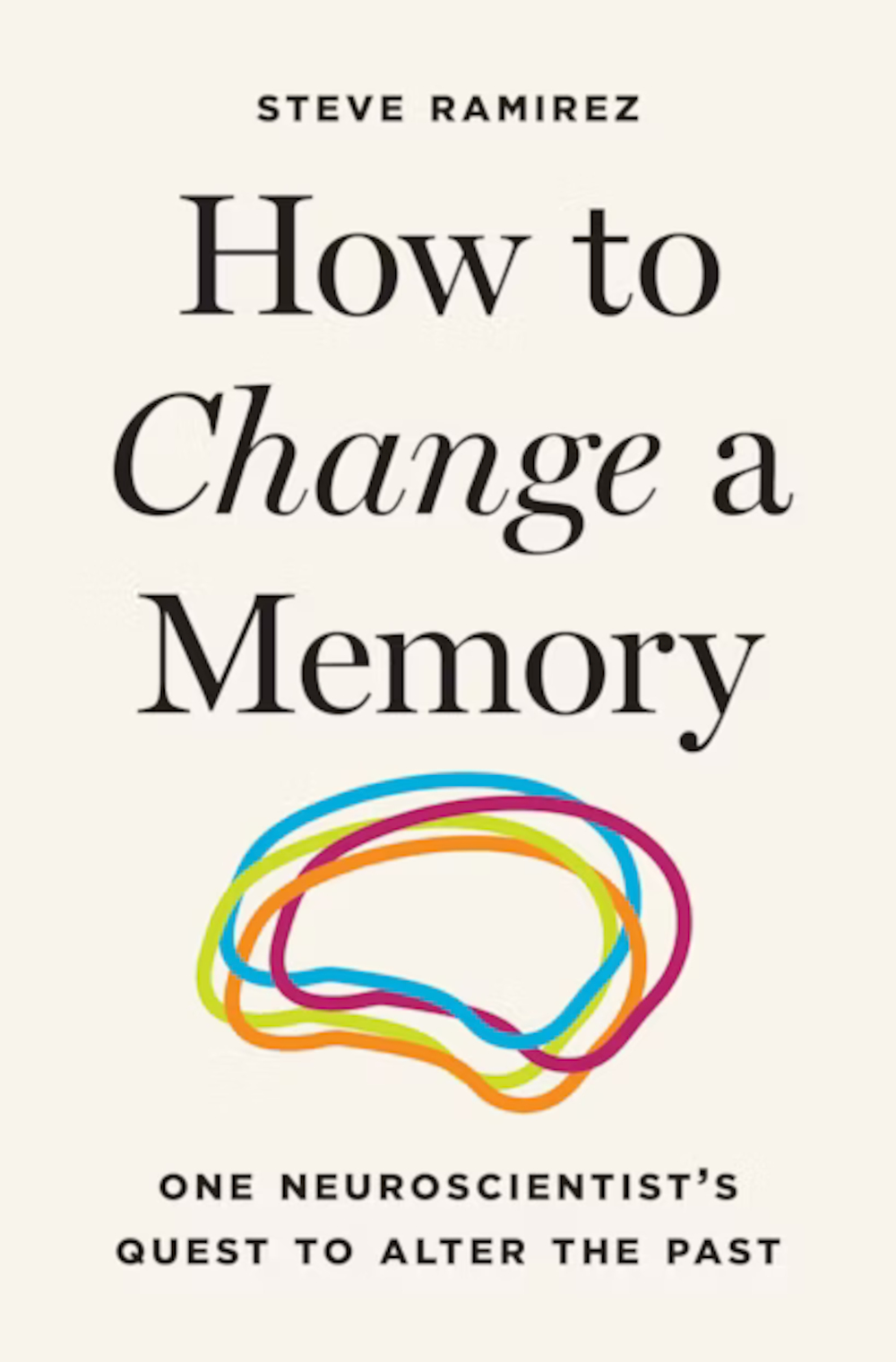
“How to Change a Memory: One Neuroscientist’s Quest to Alter the Past,” by Steve Ramirez will be available on November 4, 2025 (Princeton University Press, 256 pages).
What was the point? A central goal of such science is to learn how memories form and function in the brain and to then apply this knowledge to treat brain disorders, writes Ramirez in his forthcoming book, “How to Change a Memory: One Neuroscientist’s Quest to Alter the Past.” Perhaps one day, he suggests, it will be possible to activate positive memories to curb depression or to retrieve memories that have seemingly been lost to Alzheimer’s disease.
In the book, Ramirez explores the fascinating science of memory while tracing his own journey to becoming a successful professor at Boston University. His path was not without challenges, including the sudden death of his mentor and a decade-long struggle with alcohol addiction. “This book,” he writes, “is my attempt to make sense of the enigma of memory — the snippets of remembrances, the brief moments in time, the decisions we make, the blackouts, the imagined, and the dreamt of — all the things the brain does to breathe life into the past so that we can heal and become whole again.”
Undark spoke with Ramirez by Zoom. The interview has been edited for length and clarity.
Undark: In your book, you describe the slippery nature of memory by drawing on one of your own. As a child, you visited your family in El Salvador and the details of your meals there, you write, shape-shift every time you recall them: “Sometimes there’s a bit of yellow rice at the edge of the blue ceramic plate, and other times there’s a slightly burnt tortilla.” Many of us have probably experienced something similar. What’s going in the brain that causes it?
Steve Ramirez: We can’t ever recall the exact same bona fide memory twice, is my belief. It’s because our memories are just more warp-able and shape-shifty than we think. It doesn’t mean that they’re entirely wrong — although they can be sometimes. It’s just more of, every time we recall something, we’re recalling something within the context of what we’re feeling [and] what we’re experiencing in an ongoing world.
I think that what’s happening there is that our brain is inadvertently combining and recombining elements of a memory so that we can either imagine a scenario that hasn’t yet happened, or so that we can update memories with our current understanding of the world and what they might mean to us today.
Memory isn’t really like an iPhone video of the past. It’s more a reconstruction. And because we’re reconstructing it with the unstable and imperfect pieces that our biology tends to be, then when we recall a memory, there’s going to be some bits and pieces of information embedded into that memory that weren’t necessarily present at the time of making that memory.
UD: It sounds like your lab does basic science, but with an eye on how memory manipulation might ultimately be used to treat psychiatric disorders. Can you give an example of how a finding from your research might be applied to develop new medical treatments?
SR: We had a discovery in 2015 about being able to artificially reactivate positive memories to curb symptoms of what we think anxiety and depression look like in animals. The beauty of that is I don’t need to go in and stick an optic fiber into my brain, or your brain, to activate a positive memory. I can just ask you, “Is there a particular positive experience from the last month, or the last year, or across your life that really moves you in some capacity?’ It’s as non-invasive as it gets in this case. I just ask you to really sit with a positive experience.
UD: Right now, psychiatric disorders are classified by outward symptoms such as excessive anxiety and worry and depressed mood. You write about the Research Domain Criteria project, or RDoC, which was initiated by the National Institutes of Health. It classifies disorders based on neuroscience. Why might this be a better approach?
SR: It’s better temporarily, but in the long run, I think it’s complementary to the outwardly expressed behavioral symptoms that we may see in psychiatric disorders. An example: You and I both have a cough. You have a cough, a dry throat, and a runny nose. I have a cough, a dry throat, but my eyes are bloodshot. One of us could have the common cold and the other one could have Ebola. We can’t tell the difference between those two just based off of those outward symptoms. We have to dig deeper to be able to properly diagnose.
The thing that positive memory can do to our biology is pretty remarkable — all the way from resetting our stress levels, to getting our heart rate to go back to a healthy baseline faster, to motivating us and improving cognitive flexibility, the whole nine yards.
With the RDoCs, it’s a similar thing. There are many ways that a person can arrive to a state of anxiety. But what’s happening in the brain that gets the person to arrive there? The RDoC’s approach is to start from that brain-centric perspective of, what are the roads traveled in your brain by experience that can lead to a state of anxiety? And is that similar or different to my brain, or across populations of brains?
There are likely several different types of depression, for instance, and each of those has a unique underlying biology that outwardly manifests as the same thing, even though there might be different subtypes that have subtle differences under the hood.
The RDoCs take advantage of that by saying: “Well, let’s look under the hood and see. If we have 12 different patients living with 12 different kinds of depression, then let’s try to find 12 different underlying neural pathways, or circuit activity, or something that the brain is doing that can differentiate across those 12 individuals.”

In his book, neuroscientist Steve Ramirez explores the fascinating science of memory while tracing his own journey to becoming a successful professor.
Visual: Janice Checchio
UD: Is that a work in progress? How much are we actually able to do that?
SR: It is still a work in progress. It’s been around now for about a decade and a half. The big barrier right now is really the technology. Ideally, we want to be able to go in and really eavesdrop on the human brain with even better resolution than, let’s say, an MRI might be able to give us. We might be getting close to that. There’s all sorts of fancy tech now coming out of Silicon Valley on wearable EEGs and portable MRI.
I think that once we understand the human brain’s physical structure a bit more, and when we complement that with the functionality of the different types of brain cells, the different neuromodulators, and all the different ways that that symphony of activity can go awry or not, then I think we’ll really get closer to the holy grail of all this, which is precision medicine or personalized medicine, where each individual has a treatment plan that takes into account their unique underlying neurophysiology as well as outward behavioral responses. We’re certainly not there yet, but there’s no law of physics that says we’re not going to get there.
UD: I thought that the book presented a really optimistic view of what neuroscience can do for psychiatric disorders. I also appreciated that you wrote about the ethical questions that are inherent in memory manipulation. I wonder if you can talk about what neuroscientists are doing already, on the front end, to ensure that their research is used for good and not to create a dystopia?
SR: An analogous example that we can learn from here is the Human Genome Project, where the idea of editing our own genome was around for decades before the genome was ever sequenced.
If you can take something like water, which nourishes us, and use that to waterboard someone, then the most elemental thing in the world can be used for good and bad. So everything can be used for good and bad. The way of leaning into it is by saying: “What are instances where something like this has been used for good, and what did we do right? And what are instances where something like this has been used for bad, and where did we go wrong?”
The only answer that I can think of that at least gets us on a path in the right direction would be to start off by [keeping memory manipulation] in a clinical setting, where it’s not being used just because I can’t get over a high school breakup from a couple of days ago. It’s because I’m riddled with a given psychiatric disorder that’s debilitating my day-to-day.
If it’s kept in a clinical setting to start off — a therapeutic medicinal setting — then there’s at least some rules and regulations that can prevent its misuse until we better understand what it is that we’re dealing with.
UD: When you were writing, who did you imagine as the audience for this book?
SR: It kind of changed throughout the book. My nieces and nephews, most of them are in their teenage years now. I imagined writing it for them in a way where they were at least entertained enough, and where the plot captivated them enough, but where they left being like, “Oh, I didn’t know that about the brain, or about memory, or about where contemporary neuroscience is.” Or “I didn’t know that about a person doing science and all the highs and lows that come with it.” When I would go into descriptions of the science of it all, I would say, “How could I explain this to my parents?”
But the most common people that I had my mind were probably freshmen in college. They’re right at that cusp of, what am I going to do with the rest of my life? What does this career look like? What does a human doing science look like? And what are some pretty fascinating things about the brain — and the process of being alive, for that matter — that can piggyback along there?
UD: Is there anything else that you’d like to add?
SR: Of the many things that I hope people take away from the book, I hope that the wearing-my-humanity-on-my-sleeves part at least continues to normalize the process of “You’re going to have great days, and you’re going to have atrocious days in life.” These are just common denominators for every person who is experiencing being alive.
UD: You wrote about your struggles with addiction within this larger, very optimistic arc of your life.
SR: I haven’t gotten a chance to talk about that aspect of the book as much. I have so much to say about it. Addiction can be — but it doesn’t have to be — a sob story. It doesn’t just have to be: “Woe is me. Everything was horrible, and then I got better.” No, there’s so many nights that I was out drinking a ton, but I had some of the best nights of my life with my friends, or with my partner, or with family members. It’s not to say it was all doom and gloom, which speaks to how sinister those things can be.
[It was] cathartic to revisit some of the tougher memories that I have about struggling with alcohol because those tough memories — I’m at a point in my life now — they are always intertwined with what came next. I can’t talk about addiction without talking about healing.
I hope that silver lining is something that comes across in the book.