









In South Africa, ‘Decolonizing’ Mathematics
Twice a week, Tiri Chinyoka holds extracurricular classes for mathematics undergraduates at the University of Cape Town in South Africa. One October evening, a predominantly black group of first-year students gathered around whiteboards as they grappled with the intricacies of vectors and matrices, while on the wall behind them some oppressive history looked on: a mural spanning some 30 feet portraying students past, dressed in black gowns and mortarboards — all of them white.
“Structurally, nothing has changed from the colonial era, whether you’re talking about human experience or you’re talking about the physical infrastructure,” says Chinyoka, sitting later in his office in one of the university’s classically inspired buildings that overlook the city. Sporting a black leather flat cap and dreadlocks, Chinyoka is not a stereotypical mathematician. “If you look at what we teach in the mathematics curriculum, it is almost irrelevant to the South African context,” he says.
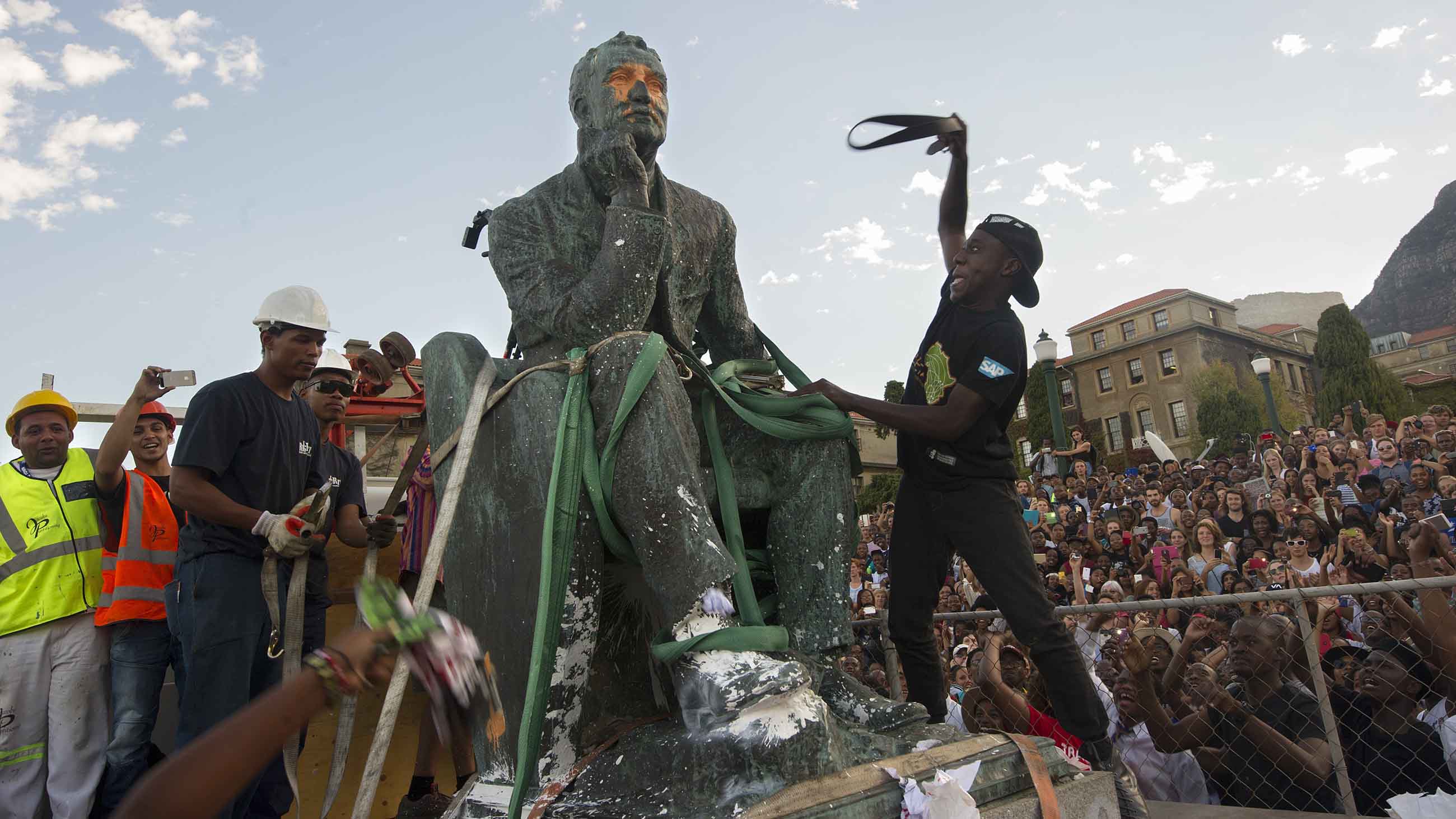
Since apartheid ended in 1994, South Africa’s universities have struggled to transform themselves, leading to escalating student protests over the last three years — including the toppling of a prominent statue of Cecil Rhodes, an infamous colonizer who donated the land on which the University of Cape Town now stands. And as students and academics accelerate the process of decolonization across South African universities, the spotlight has fallen onto mathematics.
Exactly what decolonizing math would entail isn’t entirely clear: Curriculum revisions that promote non-Western contributions to the field, new teaching methods rooted in indigenous cultures, and greater openness to ideas outside the academic mainstream are all under discussion. Some want to go further, challenging the philosophical foundations of mathematics itself.
That notion strikes many mathematicians as odd. After all, the patterns and equations that underpin our knowledge of the physical world would seem to have little to do with power dynamics. Math simply is.
“It doesn’t inspire a lot in me,” Henri Laurie, a soft-spoken academic who has spent three decades teaching math at the University of Cape Town, says of efforts to decolonize math. “I can see that it has meaning in the creative arts and possibly even in history and law” but “when it comes to science and mathematics, we want to be part of the international community.”
Unlike the arts and humanities, mathematics is generally understood to be universal and objective. Necessary truths are discovered through a process of logical deduction — with proofs as the cornerstones of the discipline. “What makes mathematics valuable, what makes it powerful, is that you can communicate mathematics without any change to a huge range of cultures,” says Laurie.
He is among those who are concerned that the decolonization movement could disadvantage young South African mathematicians on the international stage if curricula were changed or alternative methodologies take hold. “We can’t cut ourselves [off] from mathematical developments in the rest of the world,” says Loyiso Nongxa, vice president of the International Mathematical Union, which promotes international cooperation among mathematicians. “Our intellectual project would be impoverished.”
In his evening classes, meanwhile, Chinyoka hopes to broaden students’ understanding of what they can do with the mathematics they are presented with in lectures — from engineering to academia to law. He believes that South African mathematics should be reframed around the challenges faced by South Africa, as well as other developing countries.
“We still have this more Westernized view: You sit in a mathematics class on topology or abstract algebra, with zero idea about which context it applies to,” he says. Pointing to the current water and energy crises in South Africa, he argues that math should be taught with concrete applications in mind, rather than purely theoretically, which is a luxury afforded only by the West.
“What is the use of teaching the Bantu child mathematics when he cannot use it in practice?” asked Hendrik Verwoerd back in 1953. At the time, Verwoerd was in charge of South Africa’s education system for black students, and later he became prime minister. His racist legacy persists today: Only 28 percent of black students achieved a mark above 40 percent in mathematics in the 2016 National Senior Certificate examinations, compared to 86 percent of white students.
And while the number of black math graduates is increasing at South African universities, few continue into academia. “We are severely underrepresented as local Africans, and especially African females,” says Sudan Hansraj, a lecturer at the University of KwaZulu-Natal.
Growing up under apartheid, Nongxa of the International Mathematical Union experienced racism in the education system first hand. “I was only exposed to mathematics two years before I went to university,” he recalls. “There were very few African schools that offered mathematics.” Nongxa, who transformed himself from herd boy to professor of mathematics, is an outlier in his village.
The perception that math is disconnected from black lives may be perpetuated by the field’s distorted history, which often centers on the achievements of white men. “There was an erasure of contributions from the developing world and people of color,” says Fasiha Hassan, deputy president of the South African Union of Students. “We would acknowledge where it really comes from.”
Ethnomathematics is a global movement that recognizes non-Western contributions to the field. Founded in the 1970s by Ubiratàn D’Ambrosio, a Brazilian educator and philosopher, ethnomathematics seeks to include indigenous knowledge in math education. As an example, Xolisa Guzula, a specialist in multilingual education, points to a traditional southern African game played with stones called upuca that can be used to teach concepts such as number theory and estimation. In this way, she argues, mathematics is connected to a learner’s culture.
Teaching in indigenous languages alongside English (the dominant language of math education globally) has also been shown to improve mathematical comprehension by presenting concepts from different perspectives. “Multilingual people do not make meaning through one language — that again is a monolingual ideology,” says Guzula.
Yet ethnomathematics is generally used only to introduce math to students, who quickly switch to formal math, which has roots in the formalist philosophy of mathematics developed in Europe in the early 20th century. Formal math underpins both the academic discipline and how it is taught in schools and universities globally. And so while Asia and the Middle East have made significant historical contributions to mathematics — including algebra and the common number system — the methodological foundations of the discipline, as practiced by almost all mathematicians, remain Western.
C.K. Raju, an Indian polymath, is trying to change that emphasis. He has written provocative articles such as “Was Euclid a Black Woman?” and believes that many mathematical discoveries are falsely attributed to the ancient Greeks. But Raju goes even further, arguing that formal mathematics should be replaced with what he and others call “normal mathematics” — which has roots in Asian philosophy.
Formal math education was introduced in India, as in South Africa, by a colonial administration, Raju notes. “Colonial education replaced indigenous math without any critical comparison,” he said in an email exchange in which he promoted the benefits of his methodology in the teaching of such subjects as calculus and geometry. Over the last decade, he has led workshops in normal mathematics to teachers and university students in India, Iran, and Malaysia.
Centering mathematics around deductive proof, as formal mathematics does, is mistaken, according to Raju. He argues that an overreliance on pure reason can lead to false knowledge: if the premises from which the reasoning begins are false, then so too is the knowledge. Instead, in Raju’s normal mathematics, he places empirical knowledge alongside reasoning at the core of mathematics. It was unnecessary, he argues, for Bertrand Russell and Alfred Whitehead to write 378 pages of logic in their “Principia Mathematica” in order to prove 1+1=2 — when empirically it’s obvious. To Raju, this and much of formal math is “metaphysical junk,” and the only math of value is that which has practical application.
But Raju’s ideas are highly controversial in academic circles. Last year, he lectured at the University of KwaZulu-Natal and at the University of Cape Town — where Henri Laurie sat on the discussion panel. “However interesting Raju might be, he’s also quite outlandish and he makes claims that cannot be supported,” Laurie says.
Fierce debate surrounded Raju’s appearance at the University of Cape Town, where he was accused of being a “conspiracy theorist” and a “charlatan” by senior academics. Others have called for universities to remain open to revolutionary ideas such as these.
“There is no flexibility to try to do things alternatively or to try to open up ourselves to interrogating new ways of thinking,” says Chinyoka, adding that allowing researchers to explore new directions in mathematics would not mean throwing out existing methods. “Some students may want to carry out research using these alternative theories and they should be allowed to do that,” he said.
Several early-career mathematicians and scientists at the University of Cape Town declined to discuss the subject of decolonizing mathematics with Undark, citing professional repercussions.
To most mathematicians, the value of the discipline remains embedded in its rigorous standards of deductive proof. “I do think that as a driver for mathematics it is very important, and that’s something we should hold onto,” says Laurie. Bernhard Weiss, a philosopher at the University of Cape Town, agrees that the necessary truths of pure mathematics are foremost: “Unless you see through the applications to the central core, then you’re not getting at mathematics.”
Yet an opposing view regards mathematics as an evolving work-in-progress whose truths are dependent on culture and invented, rather than universal and discovered. Mathematics, in this view, developed as a result of problems that needed to be solved: the development of geometry to help ships navigate, or the invention of statistics to support the insurance industry.
“Truths in mathematics are never absolute, but must always be understood as relative to a background system,” writes Paul Ernest, a philosopher of mathematics at the University of Exeter and a proponent of this ‘fallibilist’ understanding of mathematics.
In this sense, the teaching of mathematics’ history might demonstrate to students the erratic path of revisions and modifications that have brought the field to its current form. “For me it’s like evolution,” says Nongxa of the International Mathematical Union. “There are mathematical ideas that flourish and mathematical ideas that go extinct. And one cannot say that this branch will flourish and this other branch will go extinct.”
Given the dominance and success of formal mathematics, Nongxa and others acknowledge that it is a difficult climate for alternative methodologies — one made harsher still if the academic community remains closed to ideas outside the mainstream. “We are academics and intellectuals,” Nongxa says. “We are open to debate things that we might disagree with — let’s not have this debate polarized right at the beginning.”
Thomas Lewton is a science writer and documentary filmmaker whose freelance film and photography work has been featured on the BBC, VICE, and The Guardian.
Comments are automatically closed one year after article publication. Archived comments are below.
Brilliant piece of writing …..
This is empty, pseudo-intellectual nonsense. Worst of all, it’s racist, sexist and a ton of other -isms to act like humans cannot agree on and use a consistent set of standards, and that the ones we already have, that let empty drivel like this be un-ironically published on the internet via a network of satellites put in orbit through math and science, are unacceptable. It’s racist to think that non-white people need their toolset or methodologies to come from people with the same skin color as they do. And it’s racist to assert that non-white people need a different standard; implying they could never reach it. You’re trying to justify your own racism by committing fully to the Genetic Fallacy that where an idea comes from has any bearing whatsoever on whether or not it’s true. You want to talk applicability? Fine. Use *your* math to put a satellite in orbit. Use *your* math to build a bridge. Use *your* math to construct anything of value other than your own sense of self-importance. Just because you’re a racist doesn’t mean your students should be subjected to you preaching that racism to them at the cost of their education. Ultimately, this will (and has) have the complete opposite of what it pretends. People of color subjected to this bigotry of low expectations will suffer lower employability, fewer opportunities and worse outcomes cause their teacher insisted on filling their class with polito-religious dogma instead of the tools to compete in the real world.
Clearly, Western mathematics and science helped the West obtain technological and economic superiority over countries which don’t want Western science and maths.
@Bernd Jendrissek
“I guess C.K. Raju thinks it is “empirically obvious” that 2^n – 1 is prime for all prime n and that such a conjecture need not be proved or even investigated.”
It is amusing to see how so many Westerners are still stuck with a false sense of superiority arising, like the racist sense of superiority, from a quagmire of church myths.
(a) First, the foolish belief that proof is something uniquely Western. As already explained in my response @Gareth Amery, and I repeat, all systems of Indian philosophy ((Nyaya, Vaisesika, Sankhya, Yoga, Mimamsa, Advait Vedanta, Lokayata, Buddhist, Jain) require proof, from before the West came into existence. But they accepted both empirical proof and reasoning, as does science. What is uniquely Western is the invention of “missionary proof” or reasoning minus facts just declared as superior to proof involving empirical facts. That is, the earlier prevalent notions of proof required proof for everything including (empirical proof) for the premises. But Western “proof” glorified FAITH in the initial premises, which were earlier made on the authority of the church (e.g. Aquinas on angels), and are today made on the equally untrustworthy authority of Western formal mathematicians (e.g. Ellis on creation).
Further, Jendrissek, is also stuck in the other witless caricature (b) that accepting the empirical means rejecting reasoning. Obviously not. All science is a counter-example. See, also, the counter-example in normal math of Aryabhata, already mentioned, who reasoned that the earth is round, long before medieval Europe had even heard of reason, through the fake “Aristotle” of Toledo. I guess, large numbers of Westerners are going to remain stuck in such superstitions and caricatures for a long time to come; the Western “Dark Age” is not over yet!
Presumably what Jendrissek expects is a “superior” missionary proof or formal proof which begins with some unverified, and unverifiable (empirically irrefutable) postulates about infinity. Such “superior” formal proofs are inferior, exactly like Aquinas’ deductive proof about angels, because we are told to not investigate the faith-based premises which may easily lead to absurd conclusions. Hence, such proof haves nil epistemic value for the sceptical non-Westerner, even when Western academics stonewall all attempts to investigate the nature of proof, in their constant attempts at cultural exclusion and suppression. Let the surviving racist bastions of South Africa run away from debate, but the mere undebated claim of the “superiority” of faith-based missionary proofs, which is what the proofs of formal math ultimately are, is just as absurd as the racist claims of “superiority”, and equally to be rejected.
@ Gareth Amery
1. “Raju spends much time “proving’’ (surely this is a category error since “proof” is “Western”?)”
It is Gareth Amery who is making a category error by relying on Western myths that proof is Western: he is conflating “missionary proof” (a uniquely Western invention) with proof per se.
Thus, proof surely existed from long before even the historical Aristotle. For example, ALL Indian systems of philosophy (Nyaya, Vaisesika, Sankhya, Yoga, Mimamsa, Advait Vedanta, Lokayata, Buddhist, Jain) require proof. That demand for proof clearly pre-dates the West: Buddhists and Jains, for example, were arguing ferociously 2500 years ago, on the basis of their syllogisms (explained in my book Eleven Pictures of Time). But this “normal proof” accepted facts; it accepted empirical proof plus reasoning, as does science. (Lokayata rejected inference or deduction as unsound, since it could be based on false assumptions, and hence lead to false conclusions.)
So, what is truly Western is only “missionary proof” or formal proof (= reason minus facts, as in Aquinas’ “proof” about the number of angels on a pinhead), and the belief that neglecting facts leads to a “superior” form of proof. As already explained, this “missionary proof” was an invention of the church which wanted to use “reason” as a religious tool to convert Muslims, but could not tolerate facts (e.g. no angels). The claim to “superiority” (by neglecting facts) was just a con-trick, like the racist claim to superiority.
2. “ Raju [says]… “the axioms of formal math cannot be checked empirically and are grounded solely on Western authority, which students are thus taught to accept over common sense’’. This completely ignores the fact that mathematicians accept this and spend much time considering which axioms are more useful than others,”
First, I am glad that you agree that (formal) mathematicians accept this: that the postulates of formal mathematics (set theory, etc.) are mere metaphysics, a metaphysics of infinity, accepted solely on the strength of Western authority, often contrary to common sense, such as Hilbert’s synthetic geometry which prohibits measurement of length but defines area. Obviously this has no practical use for scientific applications. Possibly, formal mathematicians (starting with Hilbert) may have spent time considering which postulates are more useful than others. But, so what? Surely church theologians like Aquinas also spent much time thinking on theology, but they led people astray for so many centuries.
Amery is missing the point: “usefulness” may include POLITICAL usefulness (but only for the West). This is true not only in the case of Aquinas, and his postulates about angels, or in the case of Hilbert and his attempts to defend “Euclid”, but also in the case of, say, the chronology condition of Hawking and Ellis. If people rely on authority, that authority can easily mislead them. Power, as they say, corrupts. So WHY SHOULD WE TRUST WESTERN MATHEMATICIANS? It is preferable to block this politics of cheating by demanding empirical proof, as in normal mathematics. That is common sense.
3. “mathematics is the language of science, empiricism is its heart [of science], and the two should not be conflated.”
First of all don’t conflate formal and normal mathematics, and lump them both into just one category, “mathematics”: that is sloppy. The “mathematics” used for practical calculations in science is all normal math. Normal mathematics, as applied to science, is just an auxiliary physical theory, just as fallible as science.
But the West is mired in the superstitious belief that “God rules the world with laws of nature”. This superstition was first stated by Aquinas (Summa Theologica, First Part of the Second Part, 91, 1, http://www.newadvent.org/summa/2091.htm). Aquinas, who presumably had several intimate conversations with God, added that given the nature of God, the “laws of nature” must be eternal. The West combined Aquinas’ superstition about “eternal laws” with the Platonic superstition about mathematics as “eternal truth”, which hence arouses the eternal soul by sympathetic magic (as in Socrates’ dialogue with the slave boy in Plato’s Meno). To reiterate, the West just put together the two superstitions: it came to believe that supposed eternal laws of nature must be written in the supposed language of eternal truth, viz. mathematics. Therefore, it is Amery who conflates mathematical theorems with some kind of trans-empirical super-truths just by using common Western superstitions. Credible to him maybe, but not to sceptical and decolonised non-Westerners like me. Give proof that there are ETERNAL “laws” of nature. Give proof that mathematics involves ETERNAL truths.
In fact, believe whatever superstitions you want to believe in, but why inflict them on others? Clearly, these superstitions, spread by colonial education, are used only to enslave and control the colonised mind, which must therefore resist them as hard as possible.
@Tony
“The big question should be, what errors in “formal math” has “normal math” exposed? the formality of “formal math” provides checks against bias and leaping to conclusions…”
Wrong question! Normal math existed universally, and was taught and used for its practical value, for thousands of years, before colonialism which brought in formal math. This change was never examined critically. To decolonise, the important question to ask is this: why change the teaching of math? What PRACTICAL VALUE did formal math add?. Obviously, none. For, at best, it provides a redundant metaphysical wrapper around normal math.
But formal math added POLITICAL value (for the West). This political value came through both (1) a false history of White/Western achievements in “formal math”, and (2) a bad philosophy, actually a church philosophy, misleadingly and falsely attributed to the early Greeks, such as the mythical white-skinned “Euclid”. (Not only “Euclid” did not exist, but the book Elements he supposedly authored, has no formal proofs, but we are just told the false tale, contrary to facts, that such was the intention of the mythical Euclid.)
More specifically, during the Crusades, the church (schoolmen) adopted reason (from the Islamic theology of reason, aql-i-kalam), to be able to convert Muslims. Since conversion by persuasion was the sole purpose of the church in adopting reason, it declared that the sole purpose of reasoning (hence math) was proof. Since church dogma is shattered by the slightest appeal to facts, it prohibited facts, and adopted a metaphysical method of reasoning (reasoning without facts), as in Aquinas’ absurd claims about the number of angels that fit on the head of a pin (http://www.newadvent.org/summa/1052.htm#article3). Obviously, this “proof” would not go through if we started demanding facts about angels, or how exactly we know that they do not occupy any space, like invisible geometric points. The church glorified this method of metaphysical proof (= formal proof), claiming deduction is infallible. But the purported infallibility of deduction is just another church superstition, like the purported infallibility of the pope. It is actually EPISTEMICALLY INFERIOR as explained during my keynote address last year in Durban (“Decolonising mathematics”, http://ckraju.net/papers/Decolonising-mathematics-AlterNation-25-2-2018.pdf).
That is, formal math, since it relies purely on authority, HELPS add all sorts of biases to math. Hawking and Ellis are just one example of how such biases may be easily pushed into science from mathematics. There are many other examples (see, e.g, http://ckraju.net/papers/Eternity-and-infinity-Pages-from-APA.pdf). This bias-pushing is not possible in normal math, because real facts act as a check.
There are many ways in which formal math enables the imposition of authority (and authority can and is often misused). The most obvious way is through its false history which not only denies Egyptian achievements, to denigrate Blacks, but obnoxiously claims that all math is the work of dead white men, hence that women and blacks (assumed bad at math) must be taught to think like the dead white men who supposedly created the subject. My hard-hitting response to this piece of nonsense from a “professor” of education in South Africa was censored (https://thewire.in/history/to-decolonise-maths-stand-up-to-its-false-history), for White South African academics censorship and abuse etc. remain key aspects of their (apartheid) “academics”.
A subtler way is this. Formal math is UGLY and its bad philosophy adds enormously to the difficulty of teaching math: even a simple thing like 1+1=2. (A. N. Whitehead and Bertrand Russell needed 378 pages of dense symbolism to prove it.) Because formal math is difficult, a large number of people remain ignorant of math, lifelong. The ignorant have no choice but to rely on the authority of “experts” (and “experts” are decided by certificates from Whites/West). Because the authority of “experts” is tied to the West, it can be and is misused to mislead people that there is no alternative, in the manner of Jeff Murugan who posed as an expert, but told abject lies.
Indeed, most people cannot catch even such false “expertise” for they are never actually taught formal math (e.g., formal real numbers, formal set theory etc.) purportedly needed for even the university calculus. Instead, in the typical style of church education they are taught FAITH in formal math through myths, and misleading oversimplifications such as Venn diagrams, and pictures of the real line (hence time) like a straight line. This has further implications to pushing religious biases through math (but can’t be discussed here).
So, let people know that colonial education had little intent of teaching the practical value of normal math, except the bare bones (“Bantuization”), but every intent of imposing colonial authority by teaching abject reliance on it. That is why formal math creates a slave mentality: the colonised are mentally enslaved. And that is why decolonisation and a shift back to normal math for its practical value is necessary.
BTW, I should add that I have already discussed some of the errors in formal math. For example, the Banach-Tarski theorem that a ball of gold can be divided into a finite number of pieces which can be reassembled into two balls of gold identical to the first, and so on. This nonsense is a theorem of set theory, the basis of almost all current formal math, and you call this unerring knowledge?
You may believe it if you like, like you may believe in angels. But why should such beliefs be inflicted on Blacks and non-Westerners in general, through the Western control over the university?
It is time the colonised ejected the coloniser from their minds, and from the educational system. A good way to start would be to revert to normal math.
@Sam G.
“Do you know why the senior academics mentioned accused Mr. Raju of being a “charlatan” or a “conspiracy theorist”? Maybe it was his belief that Stephen Hawking made a literal deal with the devil to prolong his life, and that all of Western science is somehow a front for the Catholic church”
First, there is no truth in the report: we are talking of “accusations” made ANONYMOUSLY, and WITHOUT the slightest EVIDENCE or even details (e.g. what conspiracy theory?) so the original reporter was being dishonest, and deliberately defamatory. Exactly the same conclusion (“intent to defame”) applies to those who relay or speculate about these anonymous, unfounded and defamatory allegations, without the slightest attempt to verify facts.
Second, “senior” in this context means relic of apartheid, hence White, because during apartheid the University of Cape Town (UCT) was a 100% racist bastion. The “academics” there (all Whites) believed in the foolish racist rant that Whites are superior, so blacks were not admitted to UCT, until about two decades ago. What such “academics” may say, when their academic bastion and ill-deserved privileges are threatened by decolonisation, has nil credibility, negative credibility, in fact, when it is said anonymously and without evidence, or even details. Nothing remotely academic about it, it is done in the manner of a racist mob. This much should be obvious to anyone.
Now, as regards Hawking, during the UCT panel discussion, I quoted from Tipler’s Physics of Immortality, that “physicists can infer by calculation the existence of God and the likelihood of resurrection of the dead to the eternal life….the central claims of Judeo-Christian theology are in fact true, and those claims are straightforward deductions of the laws of physics…. I have been forced into these conclusions by the inexorable logic of my own special branch of physics…..the area of global general relativity created…by…the great British physicists Roger Penrose and Stephen Hawking.” (p. ix)
Such scam claims “science proves the truth of Christian theology” were inspired not only by the theories of Hawking, but by the millions of dollars he made through his book Brief History of Time. One “senior academic” from the University of Cape Town, G. F. R. Ellis too won a million dollar Templeton award for similarly putting together science and religion.
The scam claim was explicitly put forward in the concluding (“takeaway”) line of the book by Hawking and Ellis, Large Scale Structure of Space-Time, that “the actual point of CREATION, the singularity, is beyond the…LAWS of physics.” (p. 364, emphases added). And Hawking elaborated in his Brief History of Time, that this meant God could create the world as he liked! Obviously this is not physics, not even remotely. Hence though the church greatly glorified and marketed Hawking, he could not be awarded the Nobel prize, for such claims are metaphysics not physics.
Now my critique of Hawking and Ellis’ book, in my book Eleven Picture of Time was as follows.
1. They POSTULATE the “chronology condition” which rules out any kind of cyclicity in time by fiat. As explained in my book, this postulate is similar to the church curse on “cyclic” time, central to its post-Nicene theology, and its related POLITICS OF INEQUITY. That church politics of inequity, as explained in more detail in my book Euclid and Jesus, eventually gave birth to racism. (Recall, also, my critique of formal math that bad postulates result in bad mathematical theorems. Postulates based on church dogma will naturally result in conclusions favourable to church dogma. Recall, further, that the first creationist controversy occurred not in biology but in cosmology in the 6th c. when John Philoponus dogmatically opposed Proclus’ belief in “cyclic” time, or rather a quasi-cyclic cosmos.) But Tipler and Hawking and Ellis falsely pass off these scam creationist conclusions to millions by appealing to the authority of science, or as due to the “inexorable logic” of science.
2. Hawking and Ellis defend that postulate using bad arguments strikingly similar to Augustine’s. (Instead of Augustine’s point that Christian morality would collapse if repeated births of Jesus, due to quasi-cyclic time, were allowed, Hawking and Ellis talk of the collapse of the experimental method, on the grounds that such repetitions go against “free will”. (But, where exactly is the “free will” in the equations of general relativity? So, should general relativity too be rejected for that reason, that it goes against “free will”? What about the “laws” of physics?)
3. Even granting their inequitable postulate, the conclusions of Hawking and Ellis from that postulate INVOLVE BAD MATHEMATICS—a bad understanding of calculus, actually, and a related bad interpretation of “geodesic incompleteness”. The bad mathematics arises from the belief that the differential equations of physics break down at any sort of discontinuity, because on the university calculus a differentiable function must be continuous. (As I have repeatedly pointed out this is false in both normal and formal math, but the error is much harder to understand in formal math, since it involves going far beyond Schwartz distributions.) The bad interpretation is that the metaphysical conclusion of geodesic incompleteness physically means the creation of the world or its end. A variety of other interpretations (e.g. firecracker, not big bang) are possible.
So, what awking and Ellis (and Tipler) did is charlatanry at its worst: using the authority of science to try to deceive millions to believe in the church, making tons of money in the process.
The above quote from Tipler during the UCT panel discussion was only a prelude. The key concerned senior academic (i.e. relic of the apartheid era) G. F. R. Ellis was expected to answer the above objections. Because they involve technicalities (e.g. Schwartz distributions, nonstandard analysis, apart from issues of normal mathematics), I had offered to take this part of the discussion to the math department of UCT (http://ckraju.net/papers/uct-panel-decolonising-science-ckr-summary.pdf). Obviously Ellis had no no answer to any of my criticism, and well knew that. Presumably my reputation preceded me: I had debated the scam aspects of singularity theory with Roger Penrose over two days in 1997, and had floored Tipler with a question about the delta function and Hilbert space in 1986. The “great” mathematician Atiyah had been caught trying to grab credit for my critique of Einstein, during his Einstein centenary lecture etc.
Afraid he could no match my knowledge of even formal math, afraid he would be exposed on his home turf, and before an audience containing black students, Ellis chickened out of an academic debate. But what explanation did he have. He went on to prove his lifelong commitment to untruth, by not only refusing academic debate, on a major scam claim in science, and instead telling the racist press in South Africa that people must blindly trust his authority.
The racist press in South Africa which had censored me earlier (https://kafila.online/2017/06/25/mathematics-and-censorship-c-k-raju/), and is obviously biased, did not allow me equal space to respond to its defamatory statements. I have shown what charlatanry Ellis is responsible for. But nobody ever pointed out what exact act of charlatanry I am accused of. Nobody specified what is the conspiracy theory I am accused of. That is racist justice at its worst. The accusations are not specified, details are not provided, and abuse from a white man is the gold standard of proof. Other racists relay it with relish, because that is the ultimate method by which something as foolish as the belief in racism and apartheid can be maintained. Note that even Lewton, in his report, did not bother to ask simple questions before relaying those false allegations.
Ellis shamelessly roped in even his student Jeff Murugan to throw further falsehoods against me hoping some of it would stick. Even a glance at tutorial for my calculus without limits course, shows that it teaches students to solve much harder problems not covered in standard university calculus courses. Murugan called this ability to solve harder problems as Bantuization! He should be sacked for his incompetence and for misleading Blacks to keep them suppressed.
Anyway, racist are totally committed to untruth and injustice, and “Sam G.” proves himself no less a liar. My objection is to the specific claims of Hawking, Ellis, and Tipler et al. But he says, I object to ALL Western science as a front for the Catholic church. Ha! Piling on brazen untruths and using straw men are your only defence, right Sam?
But I am tired of pointing out so many individual lies. As a general rule, the first step to decolonisation is that Blacks of South Africa must learn not to trust Whites, or their myths, or their house slaves one inch; they must constantly be critical, constantly demand evidence and proof to emerge from a cesspool of lies.
@John Galbraith Simmons
“it is dispiriting to see traction accorded concepts put forth by C.K. Raju that are demonstrably false”
Who demonstrated them false? When? How?
Let us take just one of my points: that two-valued logic used for proofs in both formal mathematics and church theology of reason is not unique, either culturally or empirically, therefore, the theorems of formal mathematics are not even relative truths, relative to the postulates alone. This point was presented as part of a keynote address before an international conference of philosophers, long ago, in 2000 (see draft at http://ckraju.net/papers/Hawaii.pdf), and published in Philosophy East and West 51:3 (2001) pp. 325–362.
Later I explained how this was related to the church superstition (on the church theology of reason) that a particular (“Aristotelian”) logic bound God and was hence universal (“Religious roots of mathematics”, in Theory, Culture & Society 23 (Jan-March 2006) pp. 95-97, posted at http://ckraju.net/papers/Religious-roots-of-math-TCS.pdf).
Clearly, Western scholars are completely unable to contest even one of my points for decades.
It is very encouraging to see that this has resulted in the conviction that the only way to refute me is through a chorus of demonstrable lies, like Simmons’.
@Patrick concerned about SA
“Instead, in Raju’s normal mathematics, he places empirical knowledge alongside reasoning at the core of mathematics. And before 1492 the world was empirically known by all knowledgeable people as flat.”
Empirical knowledge (experiment) together with reasoning is the basis also of science, and it is correct that normal mathematics is just an auxiliary physical theory. It is fallible, just like science, but there is nothing better. In particular, the metaphysics of formal mathematics is INFERIOR to the empiricism of normal math. Therefore Patrick uses false myths to make his point.
Knowledgeable people from long before 1492 knew the earth was round. For example, a thousand years earlier, Aryabhata (5th c.), in his book Gola, verse 7, likened the earth to the spherical Kadamba flower (google for a picture). The very word “Gola” means “round”. As Aryabhata’s disciple Lalla explains, the roundness of the earth is easily INFERRED from the EMPIRICAL observation that far off trees cannot be seen. (For quotations, and reference to original sources, see chp. 4 of my book Cultural Foundations of Mathematics.) So, here we have an example of how BOTH empirical facts and reasoning are used in normal mathematics.
Further, as my above book also explains (appendix to chp. 4), this provides a very easy way to accurately calculate the size of the earth, by measuring the “distance from here to the horizon”. Indeed, the traditional navigational unit zam was based on “the distance from here to the horizon” (see chp. 5 of the above book).
And, I taught students how to calculate the size of the earth from easy observations, and to laugh at excessively false Western tales, still being repeated by people like Patrick. This was in my course on history and philosophy of science. (See photos and account of the course posted at http://ckraju.net/blog/?p=89.) This method of measuring the size of the earth is so elementary, it is now part of my 9th standard school text on normal mathematics. But Europeans were arithmetically backward.
So, what did Westerners do? They superstitiously went by authority, the authority of the Bible (“gospel truth”) which asserts that the earth is flat. The Bible speaks of “four corners” of the earth, and about ALL the earth being visible from a high mountain. Extracts from the Bible are posted as part of the course materials, for the above course, at http://ckraju.net/hps-aiu/flat-earth-in-Bible.txt.
Therefore, clearly, the empiricism of normal math scores over formal math, which falsely teaches that reasoning minus facts, and hence blind faith in Western authority, offers certitude and infallibility.
And what is the practical consequence of that blind faith in authority? As further explained in Cultural Foundations of Mathematics, what Columbus actually did was to push a WRONG estimate of the size of the earth, an estimate off by 40%. That was a huge error, compared to Khalifa Mamun, who got the earth measured by direct measurement of 1 degree of the arc, and Al-Biruni (who used Indian methods) whose error was under 1%. But because Columbus gained authority, and Westerners blindly trusted authority, they believed Columbus’ wrong estimate of the size of the earth.
Now, the size of the earth is a critical parameter in traditional navigation, say traditional Indo-Arabic navigation. Therefore, Columbus’ wrong estimate of the size of the earth created a huge navigational problem specific to Europeans, and responsible for navigational disasters which led to the deaths of thousands of people. That was the reason why Portugal legally banned the carrying of globes aboard ships as early as 1500. Basically, though Europeans copied Indian navigational instruments, like those who copy, they did not fully understand the theory behind those instruments, involving the size of the earth. Hence, Europeans could not solve their navigational problem for centuries. (It was declared solved only in the mid-18th c.)
But note also what a “senior” academic, Judge, from that bastion of apartheid, University of Cape Town, said. He argued that no debate with me was necessary since I am a flat-earth theorist. This is, of course, CONTRARY to the publicly available evidence (e.g. my book, or the post at http://ckraju.net/blog/?p=89). Also, this public liar, hence charlatan, never objected to the teaching of the Bible, for the reason that it believes in the flat earth, or to the teaching of Christian theology (e.g. virgin birth) in university departments in Africa.
These “senior” academics (i.e., relics from apartheid times) from the University of Cape Town hope to use all sorts of brazen lies to mislead Blacks in a desperate attempt to preserve what remains of the power of Whites during apartheid, namely financial and academic power. That may well also be Patrick’s real concern: to see Blacks kept under the thumb of Western authority, for as long as possible, for that authority is threatened but not disbanded by the end of overt apartheid. This reaction, like that of the Ku Klux Klan, after the American civil war, needs to be put down.
@tomek rabalski
“Just please do not build a bridge or plane based on this “contextualized math”.”
I respond to this only because “a senior academic” in the University of Cape Town, a former racist bastion, also made a similar silly comment.
Normal math is what works, and was universal, not formal math, which mostly built a junk metaphysical layer around normal math.
The Arabs (and Incas etc.) were building bridges long before Adelard of Bath went to Muslim lands, during the Crusades, disguised as a Muslim student to bring back that knowledge of bridge-building, and brought back also what later became the Bible of formal math: “Euclid’s” Elements. Normal math is what is still used for the practical calculations needed for bridge building
What exactly is the practical value that formal set theory, for example, adds to the computations and error margins (“context”) needed for bridge building? What value do Peano’s axioms add to the arithmetic needed in a grocer’s shop? Just your fantasy, eh?
As for planes, any supersonic plane (or rocket) generates a shock wave, which involves a discontinuity in the pressure, temperature etc. across the shock. Neither the university calculus (as taught today) nor the Schwartz theory of distributions offers a solution to the problem of (1) how to make sense of a nonlinear differential equation in the presence of a discontinuity, and (2) to how to get the initial data for the Navier Stokes equations (not semi-linearised Euler equations) to be solved behind the shock to calculate precise temperature increase, needed for efficient design of heat tolerance. Normal math is absolutely needed for that. See the appendix to my book Cultural Foundations of Mathematics, and some of the later references already cited in my earlier replies
The reason science (as opposed to humanities) is able to construct a solid foundation for future growth is because it is evidence based and the evidence is universally accepted. The contrast with say, history or cultural studies, is stark. If there is a distinct other science based on race or cultural origin, it has to be shown how this is an improvement in what presently exists to be accepted and used by others. Nothing counts but utility.
Methink the man is right saying mathematics is western colonized. Not right as a fact but as a point of view, no problem with that. There are a lot of people thinking the ancients believed in a flat earth. In fact it was dogma of the catholic church which can be simple disproved by application.
Imo it’s much more colonized by academics and there branding requirements- E.g. there are a lot of crazy names for simple functions. Newtons law has no paragraphs, Maxwell equations describes fields not himself, Fourier transformation is totally illogical because the man never transformed and the four names of the different transformations have nothing to do with their functions. You have to learn a lot of crazy useless historical stuff just for the glory of the academic system.
Do this to every days life than a simple milk carton is named a Rausing container because Ruben invented the tetra pack.
This is even harder to learn for cultures outside the “west”. West btw. is another eurocentric term, the earth is of round shape and there are no westerner or easterner points on it.
On the other hand, the man do the same ideological stuff he claims on others. Colonization means to own an area. How can you do this in math where everything is free? Did he think, to spread this a little, that all the discoveries made by people in France, Germany, USA, GB etc are made to invade mathematics and conquer it? And his, very self referential, campaign is the arab-india-afrika expression of the reconquista?
There seem to be a rash of comments about me. Given my busy schedule (e.g. http://ckraju.net/blog/?p=163, and the summary of alternative ways of doing math mentioned there), I can only hurriedly answer some at a time. Let me start with the comment by “Old Nassau’67” about Maxwell’s equations and the Black Scholes model, and logarithms.
(a) The key problem with Maxwell’s equations is the century-old problem of radiation damping, which various leading Western minds failed to resolve. With normal math this is easily resolved. An EXPOSITORY account of its resolution and my modification of Maxwell’s equations is in “Functional differential equations. 3: Radiation damping” in Physics Education 30(3), July-Sep 2014, Article 8, and related references. http://www.physedu.in/uploads/publication/15/263/7.-Functional-differential-equations.pdf. One critical background issue here is the problem of products with Schwartz distributions which modify formal (university) calculus. Whereas earlier I had used formalist nonstandard analysis, to resolve this problem, the whole problem is easily resolved in normal math by using just the so-called non-Archimedean arithmetic which, along with zeroism, is key part of my “Calculus without limits” course. (Then one needs neither Schwartz distributions, nor nonstandard analysis.) Too long to discuss here, and should be discussed in a proper (non-Western, non-censored) academic forum. For further info, see my related article arXiv:0804.1998 and the appendix on “Renormalization and shocks” to my book Cultural Foundations of Mathematics, Pearson Longman, 2007, which also explains the ritualistic way in which the Fourier transform has long been used in quantum field theory. No way to do quantum field theory with formal math, eh?
(b) Regarding the Black-Scholes model, it is obviously defective in assuming the normal distribution. Stock-market distributions are fat tailed (e.g. Levy distribution). As I pointed out long ago, with regard to this very example, in “Computers, mathematics education, and the alternative epistemology of the calculus in the Yuktibhasa” (Philosophy East and West 51:3 (2001) pp. 325–362), formalists are restricted to the normal distribution and Wiener process, since there is no formal existence and uniqueness proof of solutions of stochastic differential equations driven by Levy motion. (That is still true.) But the solutions can be easily computed within normal math, e.g. using my computer program as described in my article on “Supercomputing in finance” (Pranjana, 3 (1&2) 2000, 11–36). As regards the complete failure of statistical inference on the belief that probability is measure, and the prime superstition of formal mathematical proof that logic is two-valued, see e.g. the section on quantum probabilities and quantum logic of my article on “Probability in Ancient India”, in Handbook of Philosophy of Science, vol 7. Philosophy of Statistics, Elsevier 2011, pp. 1175-1195. https://www.sciencedirect.com/science/article/pii/B978044451862050037X.
(c) More appropriate to this discussion is the logarithm. Let us note that the usual fat university calculus texts do NOT formally define the logarithm or even the exponential function, because they do NOT properly define real numbers, or limits of infinite series, and of course they never dream of doing the related formal set theory needed for formal real numbers. Indeed, university calculus texts do NOT actually define even “trigonometric” functions. Their sole aim is to indoctrinate students by making them memorise formulae about these improperly defined entities, just because the real aim of those courses is to teach mental slavery, along with a small bait of practical value. However, my course on “Calculus without limits” does define the exponential function, and teaches students to calculate it; see a stock tutorial sheet posted at http://ckraju.net/sgt/Tutorial-sgt.pdf, already cited in my earlier comment (search the page).
If you want more information, raise the issue in an academic forum, or join the class as a student instead of posing such questions with a gross air of superiority on a news discussion list, presumably in the vain hope of imposing formal mathematical authority by raising technicalities. That is what formal math is about: trying to impose Western authority through superstitions. Also, in future don’t comment without carefully reading and digesting what I have written, I will not respond.
From the range of comments on Lewton’s article you can see that the topic allows readers to come out with a great range of angry responses, many of them poorly argued. They seek to rehash arguments that have been going on for years, in an unproductive way. This makes me feel that the idea of ‘decolonising’ is too general to be useful.
In the fourth paragraph of this article, Lewton makes it clear that decolonisation of maths is not a coherent project. It seems to me unfortunate that a number of different ideas are put together under this banner. It is worth discussing whether non-European contributions to the development of maths should be given more emphasis, and whether maths teaching should draw more on mathematical ideas embedded in a particular culture. I imagine that some useful ideas might come out of such discussions.
The ideas that maths is distorted or even incorrect because of its history, and that it is an entirely provisional form of knowledge, are legitimate questions. However, lumping all of these issues together under the heading of ‘decolonisation’ is unhelpful. It can lead people to believe that they are being cheated by the educational system and that there is some other form of maths education, or even another form of maths, which is being withheld from them.
There is always a tension in maths education between, on the one hand, teaching ‘maths for its own sake’, maths as a thing of beauty, a result of millennia of human endeavour and, on the other, ‘practical maths’, the bits of maths which students will find useful in their future lives. Most curricula are a bit of both, which I think is essential if a course is to appeal to a wide range of students. But it’s difficult to predict which bits of maths will be useful – I recall being taught how to calculate the return on an investment given the principal, rate of return and period of investment. 50 years later I’ve never used that.
My comments are restricted to the part about me. Truth is decided by evidence, not adjectives. But apartheid South Africa believed and practised the exact opposite: that if Whites can apply all sorts of nasty adjectives to Blacks that proves White superiority. Lewton, regrettably repeats those unwarranted adjectives, while ignoring key aspects of the evidence he ought to have investigated.
For example, he says that my claim, that the author of the Elements was a black woman, is “provocative”. So, what exactly is the evidence that the author was a white male as is invariably asserted through fake images depicting a white-skinned Euclid? None obviously: that is just a sick racist fantasy. It is used to make the truly offensive claim today that women and Blacks are bad at mathematics and should be taught to think like the dead white males who supposedly created the subject of math. Lewton failed to mention my long-standing Euclid challenge prize of USD 3000 for the slightest serious evidence about “Euclid”, leave alone his gender or white skin. No one in South Africa or anywhere else in the world has produced that evidence. Naturally, there is no evidence, hence the leading Western expert on the history of Greek mathematics, David Fowler, concurred with me, long ago (http://mathforum.org/kb/message.jspa?messageID=1175734), that there is no evidence for Euclid.
Since Undark claims to be specially interested in censorship, Lewton should at least have mentioned that my article (https://thewire.in/history/to-decolonise-maths-stand-up-to-its-false-history) repeating the above challenge prize was censored. That article about decolonisation of math was published in the Conversation, went viral, but was then censored, to pander to and protect racist prejudice. This censorship by the South Africa editor of Conversation was on the frivolous “editorial rule” that it is illegitimate for non-Whites like me to cite their own published work. Had there been something wrong in what I said, the Conversation should have carried a rebuttal. Alas, to this day, no one could point to a single flaw in the evidence or arguments in my article, or the books and articles it quoted. The censored Conversation article was later published in full in Journal of Black Studies (https://journals.sagepub.com/doi/abs/10.1177/0021934716688311), and more recently in Rhodes Must Fall, Oxford, Zed Books, 2018, as described in my article on “Mathematics and censorship” (https://kafila.online/2017/06/25/mathematics-and-censorship-c-k-raju/). How come this celebrated case of censorship ceased to be news for Undark?
Lewton says that “senior academics” in South Africa called me a “conspiracy theorist”. “Senior” here means they flourished under apartheid, so Lewton should have investigated the strong possibility that they had a racist bias. and used abuse to express it in the biased South African press. to cover their academic incompetence to contest my claims on an academic platform. However, Lewton never thought fit even to ask them what the conspiracy theory was that I am alleged to have produced. Was it the theory repeatedly plagiarised from my published book (Time: Towards a Consistent Theory, Kluwer, 1994) by the supposedly “great” mathematician Michael Atiyah, who was indicted (http://www.scientificvalues.org/cases.html, case number 2 of 2007) after he repeated the act even after he was directly informed (http://ckraju.net/atiyah/atiyahcase.html), and only belatedly acknowledged my published work (http://www.ams.org/notices/200704/commentary-web.pdf)? Laughable isn’t it; a top Western mathematician repeatedly trying to grab credit for a conspiracy theory?
Regarding at least one “senior” academic, G. F. R. Ellis, Lewton, like the press in South Africa suppressed a key fact: I have a long-standing published critique of the book Ellis co-authored with Stephen Hawking. That critique is in my book The Eleven Pictures of Time, Sage, 2003. This critique was mentioned during my presentation in the panel discussion at the University of Cape Town (UCT). Specifically, I pointed out that bad mathematics (a bad understanding of calculus, even within formal math) was used by Ellis and others to explicitly advance the extreme Christian chauvinistic claim by F. J. Tipler in his Physics of Immortality that Hawking’s physics has proved the truth of all Judeo-Christian theology, in particular of creation, resurrection etc. It has been claimed this is top-class science, since Tipler has many publications in Nature. Is this not a matter for Undark?
In my advance summary for the UCT panel discussion (http://ckraju.net/papers/uct-panel-decolonising-science-ckr-summary.pdf) I had assumed I would be debating the technical aspects of that related bad mathematics in the math department at University of Cape Town, just as I had debated it with Roger Penrose in Delhi, way back in 1997. However, Ellis seems to have panicked at the thought of contesting me in an academic forum, even from within formal mathematics. In any case, Ellis, who was never able to respond to my critique, now avoided an open academic debate, by resorting to the one-sided racist press in South Africa which, like Letwon, asks no searching questions, and does not give equal opportunity to non-Whites to respond. Had he any credible academic response, he would have debated first, and then gone to the press.
Lewton does not quote any Black sources with regard to these issues. for example, those in Soweto who rightly characterized this nonsense conclusions from Hawking and Ellis’ singular theory as “Western superstitions packaged as science” (http://ckraju.net/blog/?p=126).
Lewton fails to mention another a very important point: that, over the last decade, I have conducted not only workshops but regular university courses on calculus without limits, as it developed in India (e.g., arXiv: 1312.2099, 1312.2100). In this regard, Ellis’ student Jeff Murugan, advanced yet another hysterical doomsday falsehood about the Bantuization which awaited those who took my course. This was widely circulated in the racist press in South Africa, on their usual standards of reporting, but is easily disproved by just a glance at the first tutorial sheet for my course on calculus without limits, available online (http://ckraju.net/sgt/Tutorial-sgt.pdf). My course teaches elliptic integrals left out as too advanced in the usual fat university calculus texts; it will leave others far behind as regards practical value. The vestiges of apartheid, which persist in academics, are loathe to admit the superiority of my calculus course, but they have yet to advance a single cogent argument. So, let the racists abuse away: the harder they abuse the more we will laugh, for abuse is the only thing racists know, and it conclusively proves their complete academic bankruptcy, no matter how highly they think of their capacity to abuse. Their empire is crumbling.
And what of Undark Magazine? Undark did not respond to my demand for representative space to counter a potentially biased report which I anticipated. Biased reporting, combined with an editorial policy of skewed representation is just a modified form of censorship, which Undark claims to condemn. But Undark’s credibility will be judged by its actions not its rhetoric. Hopefully, “Undark” does not mean anti-dark: the encouragement of biases against the dark complexioned in mathematics and science!
Patrick’ s comment: »And before 1492 the world was empirically known by all knowledgeable people as flat.” Patrick, you are repeating the most successful hoax in history, originating in the 19th century, and most popular in USA. From Wikipedia:
https://en.wikipedia.org/wiki/Myth_of_the_flat_Earth
“Russell suggests that the flat-earth error was able to take such deep hold on the modern imagination because of prejudice and presentism. He specifically mentions “the Protestant prejudice against the Middle Ages for Being Catholic … the Rationalist prejudice against Judeo-Christianity as a whole”, and “the assumption of the superiority of ‘our’ views to those of older cultures.”
The study of a serious academic discipline like mathematics presupposes an environment characterized by a degree of peace and order. Look anywhere in Africa or its diaspora and you must conclude that peace and order are gifts most Africans are unwilling to give one another.
Literally ‘Boko Haram’ except marxist. Very disgusting.
A more appropriate title might be, ‘Social Responsibility is Legitimate Issue for Mathematicians?’
There has been a western pioneer in social impact of mathematics on the social fabric. Norbert Wiener’s cybernetics books may provide a starting place for understanding socio-economics and address the legitimate, if not orthodox use of mathematics. Certainly, CK Raju and others in South Africa have a legitimate point as social activists in field of mathematics. As for Cecil Rhodes and his statue; his continued Anglocentric impact is worldwide and reprehensible to all Wall St. as well as South African critics.*
Applied math in form of financial trading algorithms increasingly polarize wealth distribution. What can democratising socially conscious applied mathematics and technology accomplish to provide solutions to South Africans and the human condition in general? Can mathematics curriculum be consciously engineered and applied to prove questions of social sustainability? We can find a failing analog in biological science curriculum and research in field of recombinant DNA. Agricultural science at post grad levels are overwhelmed by grants from Syngenta, Bayer/Monsanto, etc.+ I tried to commission an academic statistician to do a simple compilation and analysis of corn and soybean yields provided by Iowa State Dept. of Agriculture yields 15 years records covering the advent of RoundUp Ready© modified seed. Protection of funding dictates no interest out of school; economic polarization. A lay reading of the official stats reveal a flat to slightly negative trend in soy and corn yields for years 2001 through 2016; exposing false marketing by industry. Do departments of mathematic’s curriculum stimulate socially conscious graduates? “Several early-career mathematicians and scientists at the University of Cape Town declined to discuss the subject of decolonizing mathematics with Undark, citing professional repercussions.”
Human perceptions manifest in theoretical math. Can theoretical math effect human perception? Einstein laid little claim to being a mathematician yet was proud to claim his socio-political credentials. “We are academics and intellectuals,” Nongxa says. “We are open to debate things that we might disagree with — let’s not have this debate polarized right at the beginning.” Good advice!
* https://s3-us-west-2.amazonaws.com/freedomforce/pdf/futurecalling2.pdf
+https://www.foodandwaterwatch.org/sites/default/files/Public%20Research%20Private%20Gain%20Report%20April%202012.pdf
South Africa’s ‘Decolonizing’ mathematics is reminiscent of HIV-AIDS denialism under the benighted Thabo Mbeki regime.
I weep for Africa.
In this essay there is not a single number or equation. I would like, love, to see Mr. Raju use ethnomath or natural math to explain, say, Fourier transformations, Maxwell’s equation, Black-Scholes Equation,or an idea as simple as logxy=logx + log y. Any specific math concept explained through/by his “normal mathematics” would do.
We could do with some similar ideas in Britain. 9/10 maths students in schools havent a clue to the application of what they are being taught.
Firstly, apologies for a lengthy comment. This is, however, a critical issue from which practicing mathematicians (of all races) are largely excluded in favour of would be politicians and weak minded journalists, and which will be used to dictate both syllabus and teaching methodology. Quite apart from the implicit insult to a host of non-white mathematicians (was Maryam Mirzakhani a deluded “uncle tom’’?), attention should be drawn to some specific dangerous claims:
1) Raju spends much time “proving’’ (surely this is a category error since “proof” is “Western”?) that: “ the axioms of formal math cannot be checked empirically and are grounded solely on Western authority, which students are thus taught to accept over common sense’’. This completely ignores the fact that mathematicians accept this and spend much time considering which axioms are more useful than others, as I was taught: “good mathematicians prove theorems, great ones introduce new (fruitful) notions’’. Moreover, applied mathematics is always used in the context of the scientific method, which has empirical testing at its heart; mathematics is the language of science, empiricism is its heart, and the two should not be conflated. If “common sense’’ is to be the arbiter, then all of quantum mechanics (a non-intuitive structure formalized by rigged Hilbert spaces) is intrinsically “colonial’’ and to be ignored; and that means also all of its applications: silicon chips, MRI etc.
2) He further argues that: “Europeans added a useless metaphysics of infinity (formal real numbers etc.) … and globalised it through colonial education. ‘’ Thus, all concepts such as continuity and singularities are also “colonial’’ and to be eschewed. What a pity that there is empirical evidence of a black hole at the center of the galaxy; perhaps the scientists involved (from around the globe) are all racists and /or uncle toms? Moreover, we again ignore the deep role played by algebraic structures in, for example, High Energy Physics and Cryptography. I defy anyone to show me evidence of asymmetric (public key) crypto-systems in the ancient (and / or non-European) world, it originated on the back of earlier work yes, but it does go further. Yes, science’s leading edge is always where the power/money is, so lets talk about the power structures rather than blame the mathematics!
3) This programme does not offer a globalist / inclusive augmentation of mathematics pedagogy. Rather, it appears to be most concerned with how people feel about themselves, claiming that “… a non-Western philosophy of math is TABOO for the West, because it impacts the religious linkages in the Western philosophy of math since Plato. Hence, any non-Western mathematical philosophy is censored to defend the formalist claim of superiority.’’ This is factually wrong, as it is hard to argue that the success of the mathematics of the former Eastern Block was founded on religion. Moreover, foundational work on decolonial theory (by people such as Derrida) was directly inspired by, and used the techniques of formal mathematics.
To conclude: this type of discourse is going to be used to prevent us teaching mathematics (beyond an elementary level of, say, calculus) on the grounds that it is “useless’’ and “colonial’’. I suspect that Verwoerd would have loved these ideas and the implied continued exclusion of certain South Africans from the global discourse of science. In the context of the deliberate historical exclusion of people of colour from science, the most radical thing one can do is to teach them (using relevant examples, context and attribution) the necessary skills to participate.
I am a mathematical modeler with expertise in computational linguistics, and I am absolutely fascinated by a post here:
“Lwazi
01.02.2019 @3:50 AM
You have to be African to understand this plight. You all fail to understand that at the end of the day this universal language is still a language….”
I am not African, but surely Lwazi knows languages can be translated. I hope he/she will come back here and post the Bantu translation of the following article, which I happened to be reading when a colleague sent me a link to this website.
https://www.quantamagazine.org/how-space-and-time-could-be-a-quantum-error-correcting-code-20190103/
While I have no Bantu, I assume a translation is feasible, and I have software to reverse-engineer it into English. Thank you in advance!
Although it is dispiriting to see traction accorded concepts put forth by C.K. Raju that are demonstrably false, it should be noted that these ideas might be said to have their counterpart in climate change denial as promoted by any number of scientists and lay people, and supported by organizations such as the Heartland Institute, not to mention such people as the President of the United States of America.
Ours is the post-truth, post-objective reality era in which 2+2 = Racism, capitalism is evil, and Bruce Jenner is a woman.
This article does a poor job of explaining exactly what “decolonizing” mathematics – its central premise – would even look like. Clearly, using examples relevant to local communities – such as games, which often require an understanding of math or statistics to be played well – would be a good thing. If “decolonizing” math meant using magwinya and upuca to illustrate concepts instead of apples and chess, then I think this would be a common-sense suggestion.
Instead, this article conflates these reasonable ideas with the suggestion to upend the foundation of mathematics as a discipline. I had to read a half-dozen articles on CK Raju (including several written by the man himself) to try and understand exactly what “normal mathematics” means, and why his supposed decades of work are deemed “highly controversial”. I was aghast – your reporting does your readers a grave disservice to not cover the nature of this man’s ideas in more depth.
Do you know why the senior academics mentioned accused Mr. Raju of being a “charlatan” or a “conspiracy theorist”? Maybe it was his belief that Stephen Hawking made a literal deal with the devil to prolong his life, and that all of Western science is somehow a front for the Catholic church. Or maybe that he holds similar views on virtually every field, e.g. expounding on the “mistakes” that Einstein and others made in their fundamental equations, or that his ideas collapse under any scrutiny and he uses a logic that is internally consistent to only himself. It is an irony that he describes some of the most important work in formal mathematics as “metaphysical junk”, when his own work never rises above this standard.
I am not a mathematician but I am a mental health professional. I have known many very intelligent men and women like Mr. Raju, and the internet is full of them. I don’t believe he is disingenuous – simply deeply mistaken, fixated on an idea, and educated enough that people unfamiliar with these highly complex fields don’t see that he’s just a slightly more respectable version of the Timecube guy. Making these judgments and distinctions is, or used to be, the work of journalists. For you to present CK Raju as anything approaching a credible academic, or someone whose work is merely looking at common concepts in a different way, is failing basic journalistic standards of integrity. The non-White, non-Western world deserves justice and representation, but cannot hold up bad ideas as an alternative simply because they are non-White and non-Western.
Years ago I worked for a company that employed security personnel at a bakery. The bakery baked bread, which was then put 8 to a crate. Crates were stacked 10 high, 10 stacks per row, and 10 rows per column, meaning that you’d have 8000 loaves of bread as explained. For the love of me, I oversaw the Bantu security guards and even with a calculator they used to get outrageous totals nowhere near correct, and these ranged from youngsters who recently finished school with maths to older people who had been working for years. In South Africa, when comparing the four different races, you’ll find that the brightest minds are always in the Indian, Cape Colored (mixed race of white and Khoisan, Bushmen and Malay) and White communities, and both the Indian and Cape Colored communities also experienced apartheid. Yet, the problem does not end there, when looking at the results for most school subjects, it is clear that the Bantu struggles with most subjects. So to “rectify” this, the ruling ANC decided to lower the education standards to enable all school leavers to enter university. So the pass rate was dropped to 33%, so you have “qualified” doctors, engineers and lawyers, who barely have any knowledge of the area they work in, yet laws were introduced to force companies to employ these kids. Now the companies soon realized that although they are forced to employ them, their general lack of logical reasoning and related skills, made these kids worthless. Worthless employees who are forced on you, won’t be paid a premium, and herein lies the dilemma. It has long since been known that there are long discussions among the Bantu youth as to what job you should get to get paid a lot so that the people in your community can see you have “arrived”, and year after year, thousands flock to tertiary institutions to go and study in a certain field only to drop out before the end of the first semester. Yet, even the dropouts deem themselves “qualified” and often end up in government jobs where utterances such as “We will do an investigation and talk to the department of science and technology on what is the cause of the lightning, and if it only happened to the previously disadvantaged as I have never seen any white people being struck by lightning” (https://www.news24.com/MyNews24/Lightning-doesnt-strike-White-20120510) and the total lack of numerical literacy (https://www.youtube.com/watch?v=6lCSaLPNT2I). This whole debacle has nothing to do with racism, but rather changing the mindset of people.
“Centering mathematics around deductive proof, as formal mathematics does, is mistaken, according to Raju. He argues that an overreliance on pure reason can lead to false knowledge”
False knowledge huh? That’s just another name for “fake news.”
The more I hear this nonsense the more I see the similarities between the ideological-left and the ideological-right. Both are hide bound and wish to create a world view untethered to reality. Ridiculous. And we wonder how we end up with Trump in the Whitehouse. If every truth – even mathematical and scientific – can be trumped by feelings, then there is no truth. Suddenly, climate change isn’t happening, evolution doesn’t occur and the world is only 4K years old, vaccines cause autism, and GMO’s are dangerous….. and we end up with Trump in the Whitehouse.
Ignorance is not something to be celebrated, encouraged, or excused. Benevolent racism is racism.
I heard of a Christian school that taught Christian math. Like this: 2 apostles + 10 apostles = 12 apostles. Seriously. When I was told of this while teaching overseas at a Christian university, I and the others in the room laughed heartily.
It seems S. Africa may not get the joke.
“Decolonizing mathematics” is a synonym for maintaining ignorance of mathematics on the part of South Africans.
I would suggest asking yourself what the historical result of keeping a population ignorant is? There are ample examples to draw from. In summary, the ignorant population will be enslaved and ultimately exterminated in the longer term. An ignorant population basically offers itself up for exploitation by others.
Thinking about these issues in terms of the oncoming automation of mundane tasks that formerly required human labor is required. One might posit that we’ve transcended our traditional human impulses to dominate and use captive populations for labor. I would agree, if we take a reasonable view of what the world might look like in 20 years, or 50 years. With that said, do you really believe that the bean counters have transcended assessing and regretting the cost of feeding, clothing and housing a population that is unable to fulfill the roles that will still require humans at that time?
What happened the last time a polity decided that it had useless population? Famine is the euphemism that is often used, one need not go to the extermination example offered by mid-20th century Europe. One could call this a life or death decision on the part of South Africans, whether to give their young people maximal Westernized education or not.
I’m an undergrad math major, junior. This article makes me want to cry. When something is mathematically proven true, it IS empirically true. One counter-example is all it takes to shred a proposition. The beauty of mathematics is in its rigor and in the fact that anyone with the ability and work ethic can succeed at it. Of course, this wasn’t always true. I have a poster over my bed, “Great Women of Mathematics.” In order to study math, 7 of the 10 either had to pose as men, go to court/invoke the government of their country, or sneak into the study of mathematics via their father or husband. We will never know how much farther our discovery of mathematics would be if everyone with the ability had been free to study math all along. And that’s why instead of trying to delegitimize mathematical rigor, we should be celebrating the fact that things have changed so much. I get to major in math because I want to and I can do the work; my sex is no longer a barrier. My school’s tiny math department has several female professors now, two tenure track, and this is a reflection of genuine meritocracy in a way that no other discipline can match. It’s math: either your proofs are true or they are not.
We should be spreading access to sound mathematical teaching even further. I grew up in a POS unaccredited Christian school, but Khan Academy and YouTube got me ready for math in college, where I’m doing well. Students from poor countries need what I needed–internet connections and pencils. Nobody needs to participate in or be subjected to a dumbing down, delegitimization, or “de-colonializing” of the only source of absolute truth available to mere mortals.
Terrible. Race hatred has warped their brains.
No offense intended, but this kind of philosophical indulgence is one better left to those with trust funds and no need to actually be productive or support themselves. If math is racist, nothing is racist.
Thank you, Mexico, Andrew, Nexton and everyone else who commented on this insanity.
While reading this drivel I became more upset with every sentence. Math is math. 1+1=2. It’s the same everywhere despite what some may wish. “Proof” is proof. “Formal proof” is double-talk.
Decolonizing math seems more like an effort to ensure everyone gets a trophy even if they cannot compete. Africa got a bad deal because of colonization but trying to make it better by changing reality will do nothing but keep poor people poor and the uneducated uneducated.
I’ve seen it here in America and it may seem as if its an attempt to help but it really is evil because the damage of the do-gooders will, as a commenter noted, cost humanity a generation.
I enjoyed this article. I think there’s a lot of merit to contextualising mathematics – in Europe as well as Africa. Formal abstract trig and calculus etc is obviously necessary, but so are messier probabilistic problems, related to the real world, that are generally ignored at school maths (but are crucial to engineering).
As to teaching other civilisations’ contributions – that sounds like history of science, which is fascinating stuff bit something different. I took maths to degree level and never learnt about anything other than equations…
Every day, people and headlines like this prove that ending colonization in Africa was a terrible mistake.
Let’s cut the BS. Whenever people like these gibberish spewing ‘academics’ whine about “Western” culture, ‘colonization’, etc. what they’re really whining about is white Europeans. The fact that sub-Saharan Africa has made basically zero contribution to human civilization beyond cheap slave labor is one of those inconvenient facts these sorts of pet intellectuals are paid to explain away without stating. The only reason a place like SA HAS decent roads and flush toilets is due to Afrikaner settlers. After all, it’s kinda hard to invent reasons to claim these poor little victim societies & ethic groups are just as good as the ones that invented the modern world when basically all of recorded human history argues otherwise. If the BS these people are preaching wasn’t the anthropological version of Lysenkoist Genetics, they wouldn’t need an entire 21st Century mass media & academic ComIntern to push it 24/7.
Frankly, by any objective standard Africa was better off as colonies. The standard of living and life expectancy did a nose dive not seen since 500s Europe as soon as the Western empires pulled out. But we’re not supposed to even hypothesize that, let alone note the concrete evidence for it. That could lead to “bigoted” and this somehow automatically wrong conclusions. Modern universities aren’t about pursuing truth anymore, but instead focused on teaching the general public what they should & shouldn’t think. Hence we get every more ridiculous notions like ‘biased math’ to try and preempt the obvious explanations for why most of Africa is a perpetually backwards shithole.
And by the way, Roger Mexico, DNA was discovered by a white female and the two white males claimed the discovery for themselves. Check your facts.
You have to be African to understand this plight. You all fail to understand that at the end of the day this universal language is still a language- like all languages before you can all arrive at the same conclusion you have to interpret, and interpretation is a matter of perspective. This is what we are talking about here- forcing the African child to arrive at the same conclusion from a European perspective. But carry on with your myopic ideas…
2^n – 1 is not prime for n=4 (15).
Also math’s biggest advantage is self-sufficiency and internal consistency. Math, standing alone, is still accurate, true and complete. It can be applied to physical reality, but need not be.
Many things are “intuitively obvious”, but that changes over time. The earth was flat. Newtonian mechanics explained everything. I won’t go into what used to be “obvious” in the so-called “social sciences”.
All empirically based science gets things wrong from time to time. N-Rays. Cold fusion. How many chromosomes humans have.
Sadly all this article is talking about is more indoctrination. Not education.
Funny how Mercedes Benz is an acceptable token of colonizations
In the field of psychology, the Dunning–Kruger effect is a cognitive bias in which people of low ability have illusory superiority and mistakenly assess their cognitive ability as greater than it is. Wikipedia
Total idiocy! We need to stop humoring fools like this
I read some of the links to C.K. Raju’s writings and the guy is a complete nutjob.
So, in ‘de-colonizing’ mathematics, will they teach mathematical or societal regression? And what are the roots, the derivatives and projections of their exercise? It seems political science has politicized science, and now the language of science itself – mathematics. I do not understand how that will end well.
If math is racial, how about science? The periodic table of elements was a European invention. And DNA was discovered by 2 white males. So wrong on so many levels! Surely science should also be racialized.
If math is an artifact of Europeans, isn’t use of math by other races cultural appropriation?!
I kept reading this article waiting for the moment it would start making sense.
God help these people. Just please do not build a bridge or plane based on this “contextualized math”.
But, by all means base your banking on it and you will be colonized again.
This long form pseudo-essay nonsense is found on every major mainstream Internet outlet selling pure dribble to the ill-educated ‘chattering’ classes. The trick of these authors is to sound ‘plausible’ to people who are ill-educated in the area under discussion, using various methods of false argument to sell a position. One of Germany’s major print/Internet outlets of these type has a massive scandal revolving around a long form author who made up everything he wrote.
Maths is not science, but is the syntactical language of science. Maths is not capable of being challenged – the very concept is meaningless. A ‘complex’ proof may contain mistakes that take x days to identify, but ultimately the process of checking is definitive, and once a proof is confirmed it is beyond question. Ethnic/cultural concepts have zero meaning in this context.
The effective teachings of maths at various levels is a different issue. Teaching can be better or worse, and does respond to cultural issues- but only in the sense of how effective the teaching proves with particular pupils.
The dribble in this article telling maths illiterate readers that ‘applied’ maths isn’t a thing in the West is a sickening piece of fake news. At univeristies in the West, more students study applied maths over pure maths.
What African readers must realise is that the West doesn’t want competition. Using well funded NGOs, backed by propaganda outlets like the BBC, to ruin African education, is a key goal. Most people find higher maths ‘hard’. Giving them a fake news excuse to blame this on BBC backed conspiracy theories serves key ‘bad actors’ perfectly.
Africa currently suffers from many false ‘prophets’ who spout utter nonsense, but via the internet (and statist organs like the BBC) earn a great deal of followers. The same tribal nonsense that led to twins and albinos being butchered at birth across much of Africa in the recent past is being mined here to hold back the quality of African maths education. The same types who claim their are ‘money rituals’ now claim there are ‘maths’ rituals, which is why ritual conman Raju is boosted in this article.
Of course numerology is a common superstition like astrology. So maths is vulnerable to ritual superstition, which is what Raju, and his BBC backers promote.
Please be hyper doubtful of any website using these long form continuously scrolling ‘essays’. They are all designed to sound kind of convincing to a target audience that knows next to nothing about the subject being discussed. Team BBC, and the other outlets BBC contributors write for have but one goal- to dumb you down.
This article proves you can’t fix stupid. Honestly, if there were a better way than “decolonizing math” to ensure that SA students remain ignorant and marginalized, I haven’t heard it.
Geometry has roots in ancient Sumeria and for this reason a circle has 360 degrees worldwide. They also structured our year into 360+ days, 12 months, 2*12hours per day and 60 minutes per hour. All in a numerical system that allows for easy sharing between multiple people 2*3*2*5 = 60. This all happened 5000 years ago, so the West preserved mathematical genius of other people and distributed it.
Algebra has still the name of an Arabian mathematician. Algorithms reference a Persian mathematician.
Pythagoras is a figure often attributed to the Greeks, although his mathematics have been documented in earlier versions in Babylon, from where our 7 day week and our dice with 7 eyes on opposite sides comes. He was a mystical transmitter, like other figures in Greek history.
The problem with these fringe guys, is that they try to throw out logic and try to devalue Western achievements. If your culture needs to put down another cultures achievement to shine, then your culture’s achievements aren’t great. As such, Western, especially French, contributions should receive the same respect as Sumerian, Babylonian, Persian, Arabian and other’s achievements.
There are other cultures, who developed interesting math puzzles. It’s generally a good idea to connect mathematics to applications that students can relate to their life experience in a useable manner irrespective of the country or culture. And variety in exercises of logic can help to see problems from different angles, but it’s still the same old logic and has nothing to do with decolonialization and alternative logic.
Well, math will give them the tools to calculate how many text books a family of four need to eat to survive. By running out the white farmers and their maintained fields, they will return to the pastures of their ancestors, wearing scraps of leather and feathers and hoping they don’t starve to death by the new year.
Why have Africans not learned anything from their “white oppressors”? Weed control, proper drainage, good commercial pest resistant seed, is not a secret. It is a formula to feed a country.
Instead, in Raju’s normal mathematics, he places empirical knowledge alongside reasoning at the core of mathematics.
And before 1492 the world was empirically known by all knowledgeable people as flat.
And before Galileo’s work on telescopes in 1609 the sun was empirically the center of the universe as known by all knowledgeable people.
Math, and science, doesn’t care what is empirical knowledge.
If this is the new leadership in South Africa, I suspect we will lose that country for a generation, maybe more.
From early in the article: Chinyoka: “If you look at what we teach in the mathematics curriculum, it is almost irrelevant to the South African context.”
You can teach math in a social context/different language to give the learners a new view, or view they can understand.
You can apply math to a social need… “Applied Mathematics” or “Engineering”.
But in the end, math is math. Math does not change for a social “context”.
The Soviets in 1920 USSR tried to “teach wheat” and other food crops to grow in their cold environments… it lead to famine.
The Chinese under Mao wanted China to be a steel leader and had millions of Chinese create village iron ore furnaces that produce unusable iron crap.
Science… and math…does not care about social context. If the author wants a “South African context”, then stop teaching math and move to politics.
The big question should be, what errors in “formal math” has “normal math” exposed? Not, as Raju’s end of the stick has it, can normal math reach the same conclusion… sometimes that’s certain to be the case. But the formality of “formal math” provides checks against bias and leaping to conclusions… that whole “self-evident” part of “normal math.” So… what accepted part of “formal math” has “normal math” disproven?
Without an answer to that, this is just another unfortunate fad that will flush a generation down the drain.
Article is much ado about little.
Meanwhile, innocent whites including men, women and children are being murdered by these savages.
“We still have this more Westernized view: You sit in a mathematics class on topology or abstract algebra, with zero idea about which context it applies to”
Actually Western math hides these connections before its white pupils as well: most of physical apparatus is based on geometry of foam (quantum mechanics), deform of elastic environment (Maxwell’s equations) and/or particle packing (Lie groups) – but they don’t tell them about it, because they also pretend, that concept of luminiferous aether doesn’t apply to vacuum. It’s intuitive understanding would not only enable pupils to understand its mathematical models faster and deeper – but it would also reveal their trivialness and limited validity scope.
In this way mainstream math and physics teachers maintain their informational monopoly about physics and cosmology in similar way, like medieval theologists or tribal shamans kept their peers in awe and respect for their alleged power.
It’s as simple as it is – and nothing very much changed with it from medieval times.
As usual, Africa will find novel ways of destroying itself. Unfortunately, what begins in Africa won’t remain in Africa.
This article seems to promote those who believe that math can be (and should be) separated from proof. I need to add that I am not sure what “formal proof” means and how that is different from “proof.” The distinguishing characteristic of math is not application to other fields, it is proof. If we say that students should learn the valuable parts of math instead of learning a system based on proof, we are saying that we wish to ignore the ideas and focus on the plumbing. I can not imagine why students should be taught techniques which computers can do quickly and correctly if we do not wish them to study the ideas of math. It saddens me greatly to hear people advocate abandoning the notion that we are all citizens of the world and can learn from the great minds of various eras and places, that we should be taught within our narrow culture in order to learn, and that learning to improve the mind is not valuable.
Any effort to “decolonize” mathematics will only isolate and further impoverish their intellectual standing.
Math is math, and they must either get in with both feet, as done internationally, or retreat into their own backwater.
What utter insanity. There is no faster way to set South African students back then by letting this handful of theorists undermine the greatest tools for human liberation humanity has ever achieved.
Try building a bridge you are the first to use with your Marxist math. You drive across it first, idiot.
Meanwhile you impoverish millions of eager desperate children with this self-indulgent nihilism.
God I thought STEM would be free of this Marxist evil.
Yet the most vulnerable will be made to suffer the worst for this cultural sabotage and tomfoolery.
50 years from now, millions will have been betrayed by this evil.
Amazing that liberal fascists screw up EVERYTHING their fetid hands touch! Even mathematics!
I guess C.K. Raju thinks it is “empirically obvious” that 2^n – 1 is prime for all prime n and that such a conjecture need not be proved or even investigated.