




In many Western societies, parents eagerly await their children’s first words, then celebrate their arrival. There’s also a vast scientific and popular attention to early child language. Yet there is (and was) surprisingly little hullabaloo sparked by the first words and hand signs displayed by great apes.
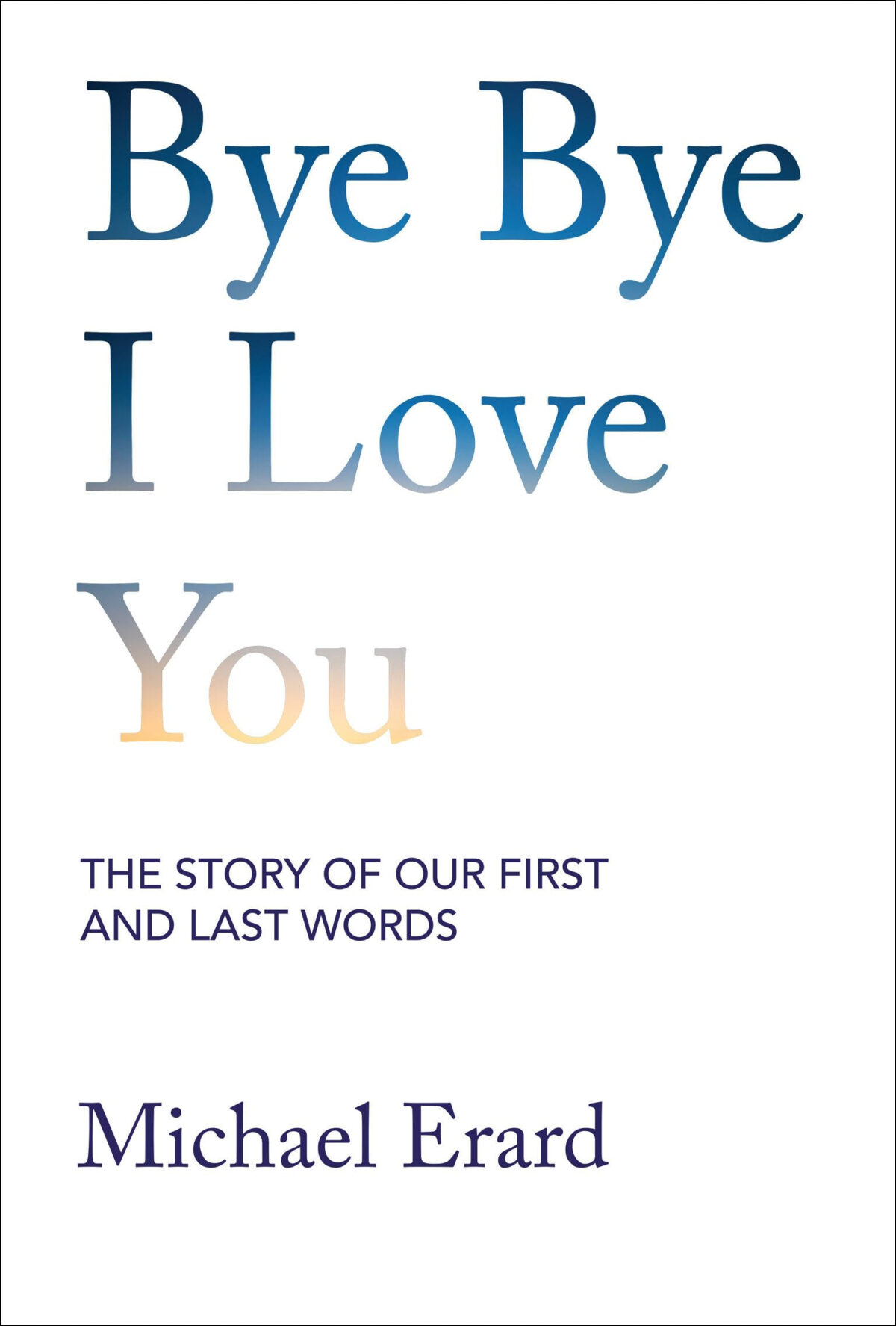
WHAT I LEFT OUT is a recurring feature in which book authors are invited to share anecdotes and narratives that, for whatever reason, did not make it into their final manuscripts. In this installment, author and linguist Michael Erard shares a story that didn’t make it into his recent book “Bye Bye I Love You: The Story of Our First and Last Words” (MIT Press, 344 pages.)
As far back as 1916, scientists have been exploring the linguistic abilities of humans’ closest relatives by raising them in language-rich environments. But the first moments in which these animals did cross a communication threshold created relatively little fuss in both the scientific literature and the media. Why?
Consider, for example, the first sign by Washoe, a young chimpanzee that was captured in the wild and transported in 1966 to a laboratory at the University of Nevada, where she was studied by two researchers, Allen Gardner and Beatrice Gardner. Washoe was taught American Sign Language in family-like settings that would be conducive to communicative situations. “Her human companions,” wrote the Gardners in 1969, “were to be friends and playmates as well as providers and protectors, and they were to introduce a great many games and activities that would be likely to result in maximum interaction.”
When the Gardners wrote about the experiments, they did note her first uses of specific signs, such as “toothbrush,” that didn’t seem to echo a sign a human had just used. These moments weren’t ignored, yet you have to pay very close attention to their writings to find the slightest awe or enthusiasm. Fireworks it is not.
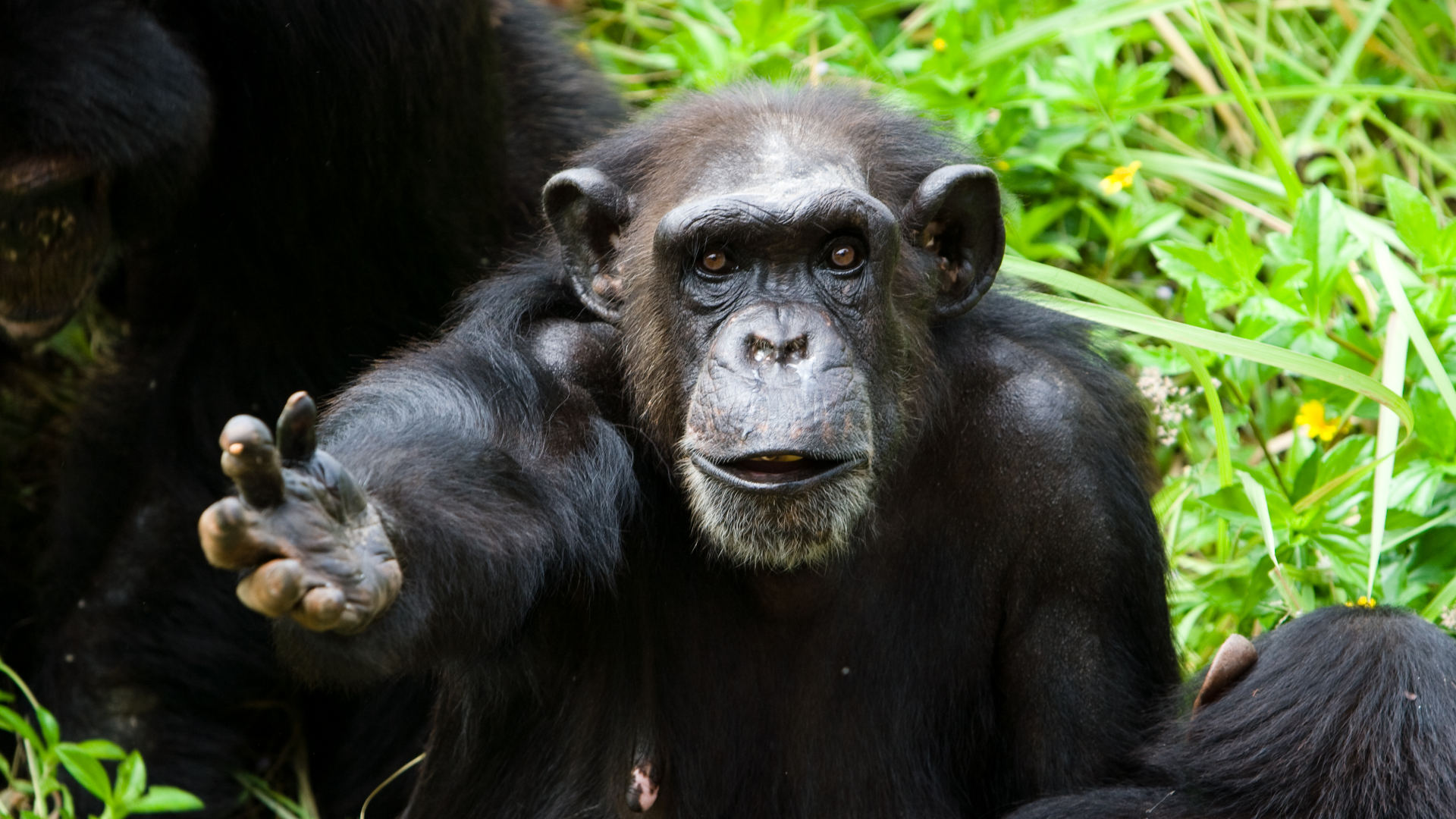
Her first sign — a begging gesture — appears about halfway through an article that the Gardners published in the journal Science, in a table of signs that Washoe used “reliably.” The first gesture that Washoe made spontaneously, “independently of any deliberate training,” was an open hand extended, palm up. She did this in situations when she wanted some help or if the humans had an object she wanted.
Later, she added a wrist movement to the sign. A “beckoning,” the Gardners described it. It was easily added to the list of her words. The scientists called this first sign “come-gimme,” describing it as a “beckoning motion, with wrist or knuckles as a pivot.” It’s almost as if she were babbling, reaching for motor control itself, then finally achieving it. Come-gimme. She was between 1 and 2 years old at the time — about the same age as many humans’ spoken first words.
These moments weren’t ignored, yet you have to pay very close attention to their writings to find the slightest awe or enthusiasm. Fireworks it is not.
The Gardners had an elaborate protocol for formally agreeing that Washoe had acquired a sign: It had to have “a reported frequency of at least one appropriate and spontaneous occurrence each day over a period of 15 consecutive days. Based on this protocol, her three other signs in the first seven months were “more,” “up,” and “sweet.”
True, the Gardners were sober scientists, but there was little celebratory flavor in their reports, nor in most of the media accounts that followed. Even her obituaries omitted it. There were exceptions, however, including a 1974 documentary titled “The First Signs of Washoe.” Another came from Jane Hill, a linguistic anthropologist who closed a 1978 article on ape language with a loose bit of hyperbolic flourish: “It is unlikely that any of us will in our lifetimes see again a scientific breakthrough as profound in its implications as the moment when Washoe, the baby chimpanzee, raised her hand and signed COME-GIMME to a comprehending human.” Profound? Few others seemed to think so.
The first human word pronounced by an ape appears to have been the French word “feu,” for fire, even if calling it a “word” is a stretch, since the young chimpanzee Moses didn’t know what it meant. An American named Richard Garner bought him on an expedition to west-central Africa in the late 19th century, and Moses only knew that his human friend would give him corned beef if he made certain sounds with his mouth.
Garner, who was investigating “monkey” language, was disappointed that Moses had not progressed further, yet the articulation of feu was “quite as nearly perfect as most people of other tongues ever learn to speak the same word in French,” he wrote. Other sounds made by Moses were “mamma”; the German word for how, “wie”; and the word for mother in a local Ghanaian language, “nkgwe.”
In 1909, a captive chimpanzee named Peter was brought to psychologist Lightner Witmer at his clinic in Philadelphia. Dressed in top hat and wearing roller skates (mainly so he wouldn’t escape by climbing things), saying “mama” was among his tricks.
A colleague of Witmer’s, a tattooed adventuring anthropologist named William Furness, also tried his hand at the talking ape game. Over six months, he taught a female orangutan to pronounce “papa” by pressing its lips together, until one day she did something amazing: her first word! “One day of her own accord, out of lesson time, she said ‘Papa’ quite distinctly and repeated it on command,’’ Furness wrote. “Of course, I praised and petted her enthusiastically; she never forgot it after that and finally recognized it as my name.”
It’s almost as if she were babbling, reaching for motor control itself, then finally achieving it. Come-gimme. She was between 1 and 2 years old at the time — about the same age as many humans’ spoken first words.
About four decades later, two Americans, Keith and Catherine Hayes, home-reared a chimpanzee named Viki, treating her like a like a human child to test her developmental capacities. After training her to grunt on command (“speak”), the Hayeses taught her to vocalize “mama” by manipulating her lips. “She soon learned to make the proper mouth movements herself, and could then say ‘mama’ unaided — softly, and hoarsely, but quite acceptably.” Her other three words: “papa,” “cup,” “up.”
But reactions to these performances were subdued, compared to the florid reception that human first words typically receive. In the early 20th century, a chemistry professor named W. G. Bateman became so enamored of his children’s language that he published a small collection of first words. “At one moment something is not and at the next moment it is and we do not know what miracle fills the infinitesimal gap,” he wrote.
Another famous first word by an ape came from Kanzi, a bonobo born at the Yerkes Regional Primate Research Center in 1980, then moved to the Language Research Center at Georgia State University. A young scientist there, Sue Savage-Rumbaugh, had been teaching chimpanzees how to use a keyboard with visual symbols called lexigrams. Savage-Rumbaugh also taught Matata, Kanzi’s adopted mother, who proved to be a bad lexigram learner.
To everyone’s surprise, Kanzi began using lexigrams, having learned them indirectly. His first button push was for the symbol “chase,” Savage-Rumbaugh recalled: “He would look over the board, touch this symbol, then glance about to see if I had noticed and whether I would agree to chase him.”
Get Our Newsletter

Only after Kanzi and Matata were separated did the extent of his abilities become clear. On his first day alone with the keyboard, he used it 120 times. “One of the first things he did that morning was to activate ‘apple,’ then ‘chase,’” Savage-Rumbaugh wrote in a 1994 book about Kanzi. “He then picked up an apple, looked at me, and ran away with a play grin on his face.” Within four months, he had learned to use more than 20 symbols. He was just shy of 3 years old. And in his lifetime, he would learn hundreds more.
In her account, Savage-Rumbaugh listed the first 10 words that Kanzi, Mulika, and Kanzi’s half-sister, Panbanisha, had produced. “In general,” she wrote, “the apes’ first words reflected their own particular interests.”
And those interests varied widely. Kanzi’s first 10 words were “orange, peanut, banana, apple, bedroom, chase, Austin, sweet potato, raisin, ball.” Panbanisha’s were “milk, chase, open, tickle, grape, bite, dog, surprise, yogurt, soap.” And those of Mulika were “milk, key, t-room, surprise, juice, water, grape, banana, go, staff office.”
Reactions to the initial signs and words by apes were subdued, compared to the florid reception that human first words typically receive.
Critics of the results of these ape language experiments argued that the utterances of a 2-year-old child didn’t qualify as language yet, and in the early days of Chomskyan linguistics even human first words weren’t interesting because they gave no inkling of linguistic structure. Therefore, it was the strings of signs or symbols by apes that received far more attention. “The production of novel combinatoral utterances,” Sue Savage-Rumbaugh wrote, “is a powerful communicative process that characterizes all languages.” And if the prize is grammar, the lonely word loses currency.
As it happens, a combination of signs brought significant attention to Washoe in the 1960s. Apparently, she signed “water” and “bird” upon seeing a swan. Roger Brown, a noted Harvard psychologist who had studied word learning in children, said at the time this two-word sequence “was like getting an S.O.S. from outer space.” (No such hyperbole was directed at Washoe’s first signs.)
More than a decade later, an orangutan named Chantek at the University of Tennessee at Chattanooga built a vocabulary of about 150 modified American Sign Language signs. H. Lyn Miles, an anthropologist who worked with Chantek, told me she reported downplaying his first words for several reasons. One was the fear that attributing “first words” to animals would be perceived as anthropomorphism.
“We wanted the apes to be precocious. But since they were not our biological children, we didn’t harp like human parents and repeatedly encourage first words like ‘mama’ and ‘dada,’ or even ‘up,’ as we urged them into our loving arms,” she wrote in an email.
“I had just had a conversation with a nonhuman, and its impact on me was far more significant than the details of the conversation.”
Critics of ape language research also maintain that the apes only learn words to get what they want, not to ask questions about objects or persons, or perform social functions. Indeed, Chantek’s first words were FOOD-EAT and DRINK. “We somewhat underplayed the first words,” Miles wrote.
Another reason for her reluctance to focus on first words was sexism, Miles reported. Some female scientists battled the perception that they couldn’t be objective or nonemotional, so they went out of their way to not be perceived as maternal. “The last thing we needed in this patriarchal scientific culture was to appear as if we were over-bonding with the ape as if he/she were a child and highlight ‘first words’ like a baby shower or getting baby’s first teeth,” Miles wrote.
And yet, she told me, her personal reaction to Chantek’s first words were “joyful and ecstatic.”
Buried in our language histories are ideas about first words that we didn’t know we had. One is the notion that “mama” — meaning mother — is everyone’s natural first word. Another is that animals can’t have first words. It violates a category, somehow; it asks us to believe something that we can’t quite recognize. Some scientists who have worked with apes did, of course, but they weren’t ever able to persuade their scientific peers and other doubters that the animals were communicative agents, legitimate speakers, valid conversational partners.
And yet, the first symbols, words, or signs of apes have remained significant parts of the researchers’ private experiences. One researcher, Mary Lee Jensvold, had her first experience in 1985 with a signing ape with Koko, a gorilla who had been taught to sign by Penny Patterson in the early 1970s.
“I had just had a conversation with a nonhuman, and its impact on me was far more significant than the details of the conversation,” she remembered later. She felt as if she’d spoken with a child.
Eventually she would work with a number of chimpanzees in graduate school and afterword, including Washoe. In a chapter in the 2020 anthology “Chimpanzee Chronicles,” Jensvold recalled entering Washoe’s room when the ape was close to death in late October, 2007. Deborah Fouts, a scientist who had taken over from the Gardners, said, “Washoe, Mary Lee is here.”
Washoe lifted her arm toward Jensvold. The human told the chimpanzee how much she loved her. “Then,” Jensvold wrote, “she took her last breath.”
Michael Erard is the author of “Bye Bye I Love You: The Story of Our First and Last Words.” His previous books include “Um …: Slips, Stumbles, and Verbal Blunders,” and “Babel No More: The Search for the World’s Most Extraordinary Language Learners.” He is a researcher at the Center for Language Studies at Radboud University in Nijmegen, the Netherlands.