









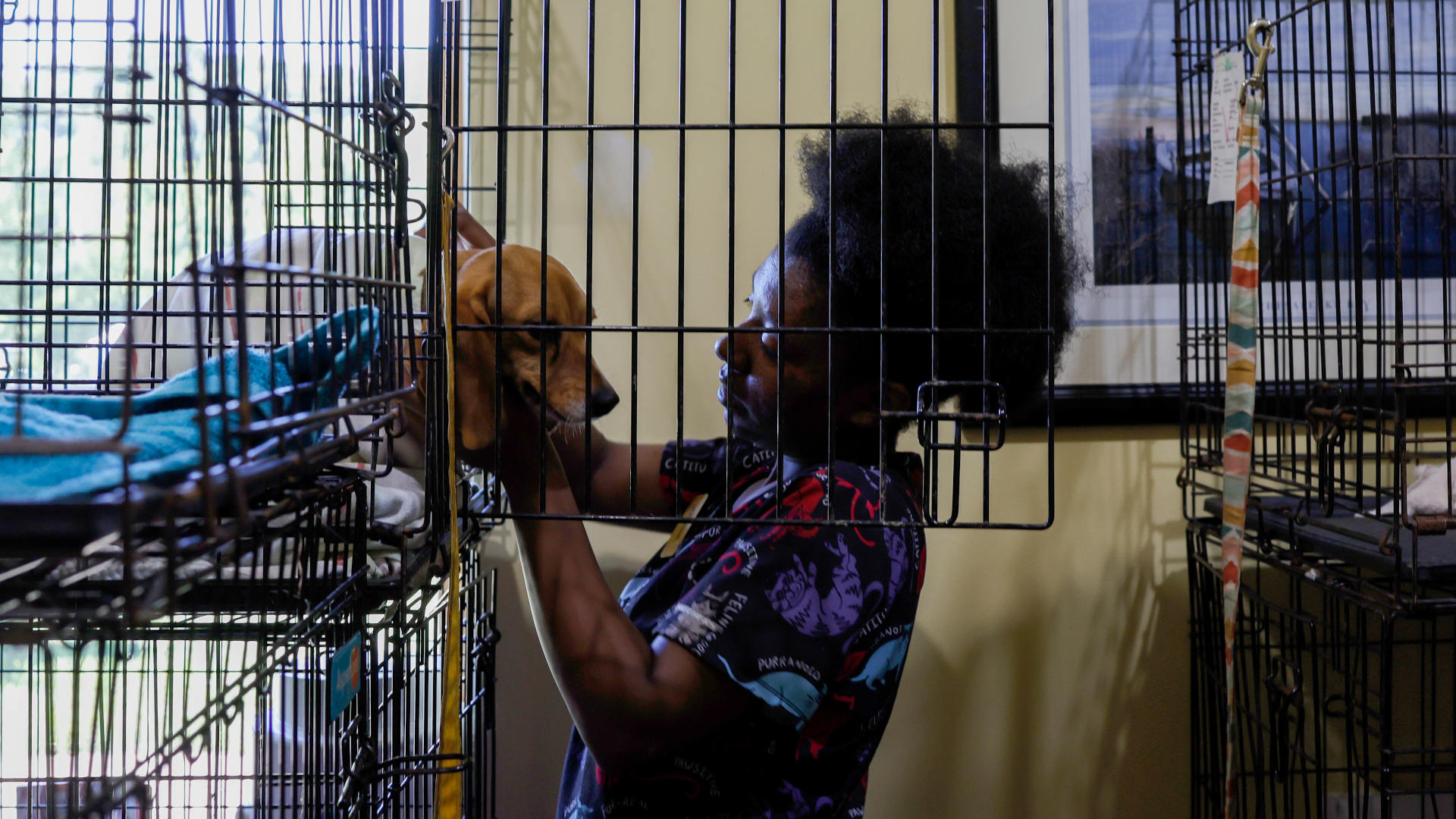
In 2013, I adopted a beagle who had spent nearly four years in a lab. I didn’t know any details about his past, but when he came to live with me, he was scared of just about everything, and his sense of smell — the beagle superpower! — was woefully underdeveloped. Over time, he gained confidence and learned to sniff out treats. Mostly, he loved eating. And Hammy especially loved his cruciferous vegetables. Whether they were roasted, sautéed, or blanched, he never met a bit of broccoli, brussels sprout, or bok choy he didn’t love. But in the late summer of 2021, I chopped them out of his diet altogether.
About six months earlier, I’d noticed a thin ribbon of bright red blood in Hammy’s poop. His veterinarian told me to monitor the situation. Summer came, and I was still regularly seeing the tiniest red streak. Plus, Hammy was needing to go out more frequently. Something was up.
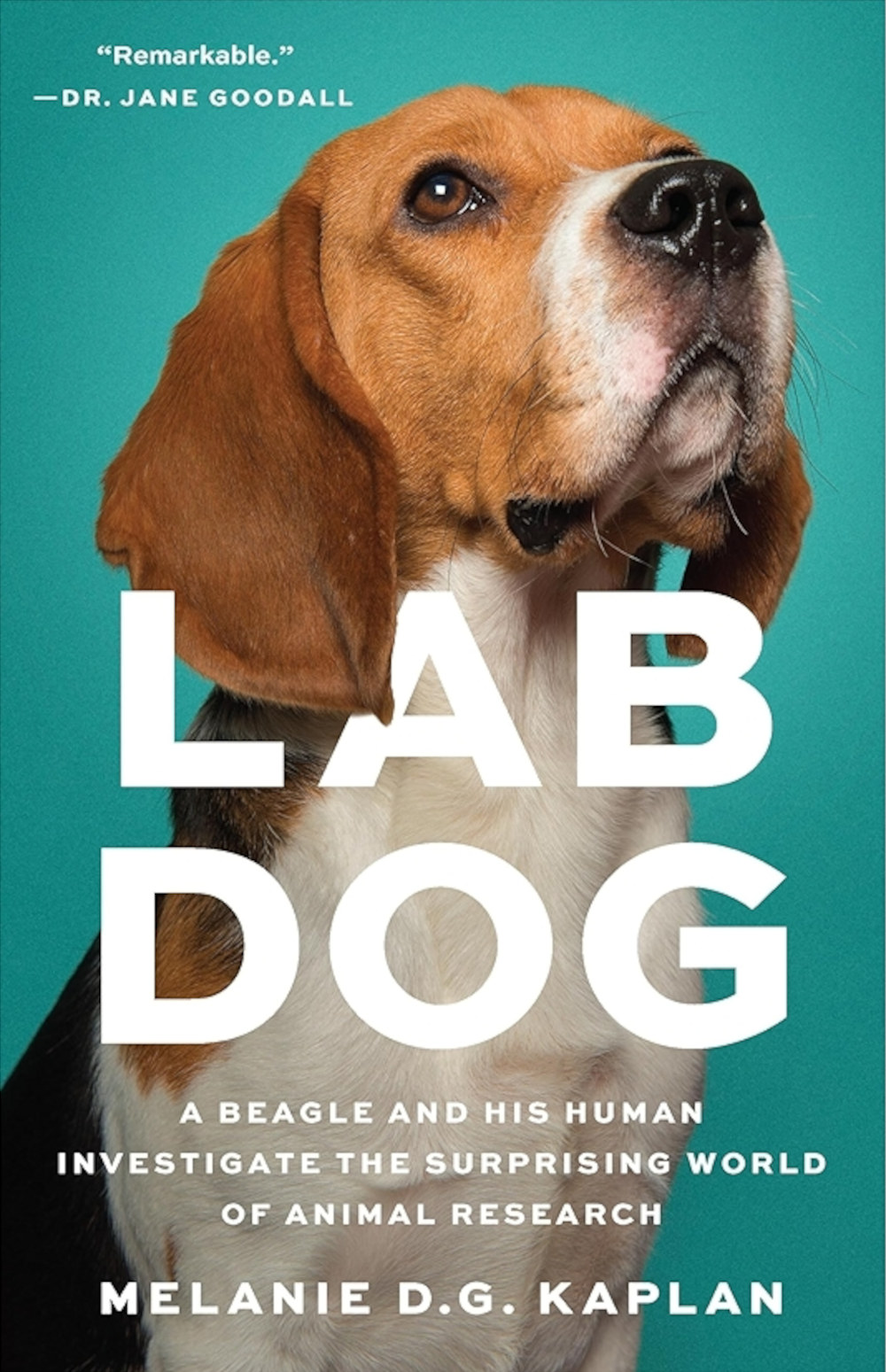
The accompanying article is excerpted and adapted from “Lab Dog: A Beagle and His Human Investigate the Surprising World of Animal Research,” by Melanie D.G. Kaplan, published by Seal Press, an imprint of Hachette Book Group, Inc. ©2025 by Melanie Kaplan.
To rule out common causes for the blood, the veterinarian put Hammy on a dewormer and an antibiotic that targets bacterial infections and parasites. No difference. The doctor also suggested cutting out Hammy’s treats to see if he had a food allergy. If things looked better in a couple weeks, I could add one food at a time back into rotation and see if that induced the symptoms. If taking away the snacks didn’t solve the problem, we’d know those weren’t the culprit.
So just like that, we cut out the cauliflower, stopped the sweet potato chips, even paused the peanut butter. It wasn’t lost on me that we were experimenting on Hammy. Whatever happened with the food restriction plan, we’d learn something. This was a pretty harmless experiment, although Hammy — who mostly lived in the moment — might have said these cutbacks diminished the joy in his life. Also pretty harmless: Hammy’s blood test (which came back normal), even though his body language told me the needle stick hurt.
I’d made snap decisions to move forward with both of those diagnostic steps because I knew the pros far outweighed the cons for his own health. But I started wondering: What if the decision weren’t so clear-cut? What if subjecting Hammy to a mildly uncomfortable blood draw somehow helped me? Or another dog? What if a procedure caused significant pain but promised to improve my parents’ lives? Or the lives of a dozen friends? A hundred strangers? What if a lethal operation on Hammy might — no guarantees — benefit a million people 10 years from now?
As I contemplated these hypothetical questions, my mama bear heart said “No!” even if inflicting pain on Hammy meant saving the planet. Intellectually, I had to acknowledge that this line of questioning was provocative, and contemplating the answers lit up my brain in a not unwelcome way. Ethicists grapple with these dilemmas all the time.
“Since animal experimentation began, the public has asked whether the practice is justifiable,” Lori Gruen, an animal studies scholar at Wesleyan University, writes in “Ethics and Animals: An Introduction.” She reasons that while some experiments have caused useless suffering and death to animals, others have yielded insights important in the development of drugs and therapies. But, she asks, “Is the fact that some benefits have emerged from animal experiments enough to justify doing them?”
This was a pretty harmless experiment, although Hammy — who mostly lived in the moment — might have said these cutbacks diminished the joy in his life.
Philosopher Jeremy Bentham, born in 1748 and best known as the founder of utilitarianism, would have said it depends. His moral theory argued that “it is the greatest happiness of the greatest number that is the measure of right and wrong.” Or, as Spock says in “Star Trek II: The Wrath of Khan,” foreshadowing his decision to sacrifice himself to save the Enterprise, “The needs of the many outweigh the needs of the few.”
There’s a tidy logic to utilitarianism, but it doesn’t fully account for the pain and suffering of individual sentient beings. After generations of abusing humans in medical research, we now have laws — based on ethical guidelines of the Nuremberg Code of 1947, Helsinki Declaration of 1964, and Belmont Report of 1979 — that prohibit experiments on certain populations of people. Those laws restrict research on prisoners, for instance, and require the informed consent of participating adults. But there are no such laws for animals, Gruen explains, in part because many researchers believe lab animals experience much less pain and distress than would human test subjects.
But who is measuring pain and happiness, anyway? How do you put a price on that? Or on the life of a person saved by a medical device developed with the use of an animal? Even if we justify animal suffering for human benefit, many of the experiments, Gruen writes, “may not even be expected to lead to any benefits down the road; as experimenters like to say, scientific research is not linear.”

In the 1945 report for President Harry S. Truman, “Science — the Endless Frontier,” Vannevar Bush, director of the Office of Scientific Research and Development, describes basic research as that “performed without thought of practical ends.” In other words, it’s research in the pursuit of knowledge — more for curiosity than cures.
The Dana-Farber Cancer Institute, the world-renowned comprehensive research center in Boston, explains that medical research falls largely into three categories. Basic research looks at how the building blocks of life work, translational research applies what’s learned in basic research to the development of drugs and medical devices, and clinical research studies these solutions in trials, looking at the best treatment for a patient with a given condition and leading to more research. (Clinical trials generally refer to human testing, unless the patient is an animal.)
The important thing to remember is that scientists conduct research on animals in both basic and translational stages in an attempt to explain how human bodies function — or react to a compound or recover from an illness. And research designed to answer these questions often leads to — that’s right — more questions.
And oh, do we have questions. “Of the 7,000 known diseases, only about 500 have treatments,” writes Richard Harris in “Rigor Mortis: How Sloppy Science Creates Worthless Cures, Crushes Hope, and Wastes Billions.” As Harris explains, the goal of biomedical research is to “understand the basic processes that lead to disease so that medical science can intervene to ease human suffering and improve health.”
“Is the fact that some benefits have emerged from animal experiments enough to justify doing them?”
Over the centuries, scientists have made countless discoveries about human physiology through the study of untold numbers of animal species, from armadillos to zebrafish. Scientists study aging in salamanders, nerve cells in squids, liver cancer in woodchucks, respiratory disease in ferrets, and sensory systems in cats.
Biomedical advancements often rely on many species. Bypass surgery, for example, was introduced in the late 1960s to treat heart disease — the leading cause of human death — and is now performed on nearly four hundred thousand people a year. But the path to a successful bypass procedure began in 1628 when scientists started studying circulation in frogs. Later they learned about blood pressure and temperature regulation in dogs, cats, horses, and sheep, and eventually studied dogs and chimpanzees to learn about catheterization. With each experimental step, researchers didn’t know what might come next. There are no blueprints. Biomedical research involves a lot of uncertainty and serendipity.
The United States government and private sector combined likely spend between $200 and $300 billion a year on biomedical research. Most of the government spending, about $50 billion, funds research at universities, and many universities that conduct biomedical research have dogs in laboratories. In 2024, dogs were likely used in experiments in every state except Maine and Montana, according to the Humane Society of the United States (now known as Humane World for Animals); Illinois, Massachusetts, Missouri, New Jersey, Pennsylvania, and Wisconsin used the most.

A 2021 report from the Humane Society and the Humane Society Legislative Fund says that between 2015 and 2019, more than $200 million was awarded by the NIH to two hundred individual institutions for more than three hundred projects using purpose-bred dogs. The report states, “There appear to be few, if any, appreciable benefits to humans.”
Over the years, millions of dogs — purpose bred and randomly sourced — have been used to study myriad human ailments, including diabetes, anemia, osteoarthritis, hemophilia, sleep apnea, and cardiac, pulmonary, renal, and age-related diseases. They’ve also been used to develop prosthetic devices, such as those for hip and knee replacements and tendon and ligament repair.
Researchers say dogs are good proxies, or models, for humans in the study of human disease. According to Understanding Animal Research, a U.K.-based nonprofit funded largely by pharmaceutical companies, academic institutions, and disease-focused charities, we share more than 350 diseases with our canine friends.
From time to time, there’s a dramatic breakthrough with dogs in labs, as when two young Canadian researchers used them to discover insulin more than a century ago. In that case, a severely diabetic dog named Marjorie gained renown after researchers kept her alive in the lab for 70 days, much longer than untreated dogs typically survived. But typically, scientific progress is slow and complicated; medical advances can rarely be credited to two humans, and the dogs who lose their lives along the way go unnamed. Marjorie was an exception.

Rebecca Walker, an ethicist and professor at the University of North Carolina at Chapel Hill, said if people accept that animal research will be around for a while — as many biomedical researchers believe — we can do better simply by looking at each research study (rather than animal research as a whole), asking whether it will be more beneficial than harmful and deciding what kinds of harms are done to animals that are impermissible. As it stands, there isn’t an upper limit for pain and suffering, as long as it’s justified by the researcher. Maybe, Walker said, that needs to change.
I asked her how this would look in practice. She said it’s pretty simple to understand the harms to an animal ahead of time, whereas the benefits to humans are speculative. “But it’s also ethically really important,” she said. “Any time you use a group of animals and cause harm but don’t get any benefit, it’s a waste.”
Melanie D.G. Kaplan is an independent journalist whose travel and science writing has appeared in the The Atlantic, The Washington Post, The Wall Street Journal, and National Parks magazine. She is a graduate of Columbia Journalism School, a 2022 MIT Knight Science Journalism fellow, and 2022 Vermont Law School media fellow. She lives in Washington, D.C.