









How Los Angeles Can Fireproof Communities, Not Just Houses
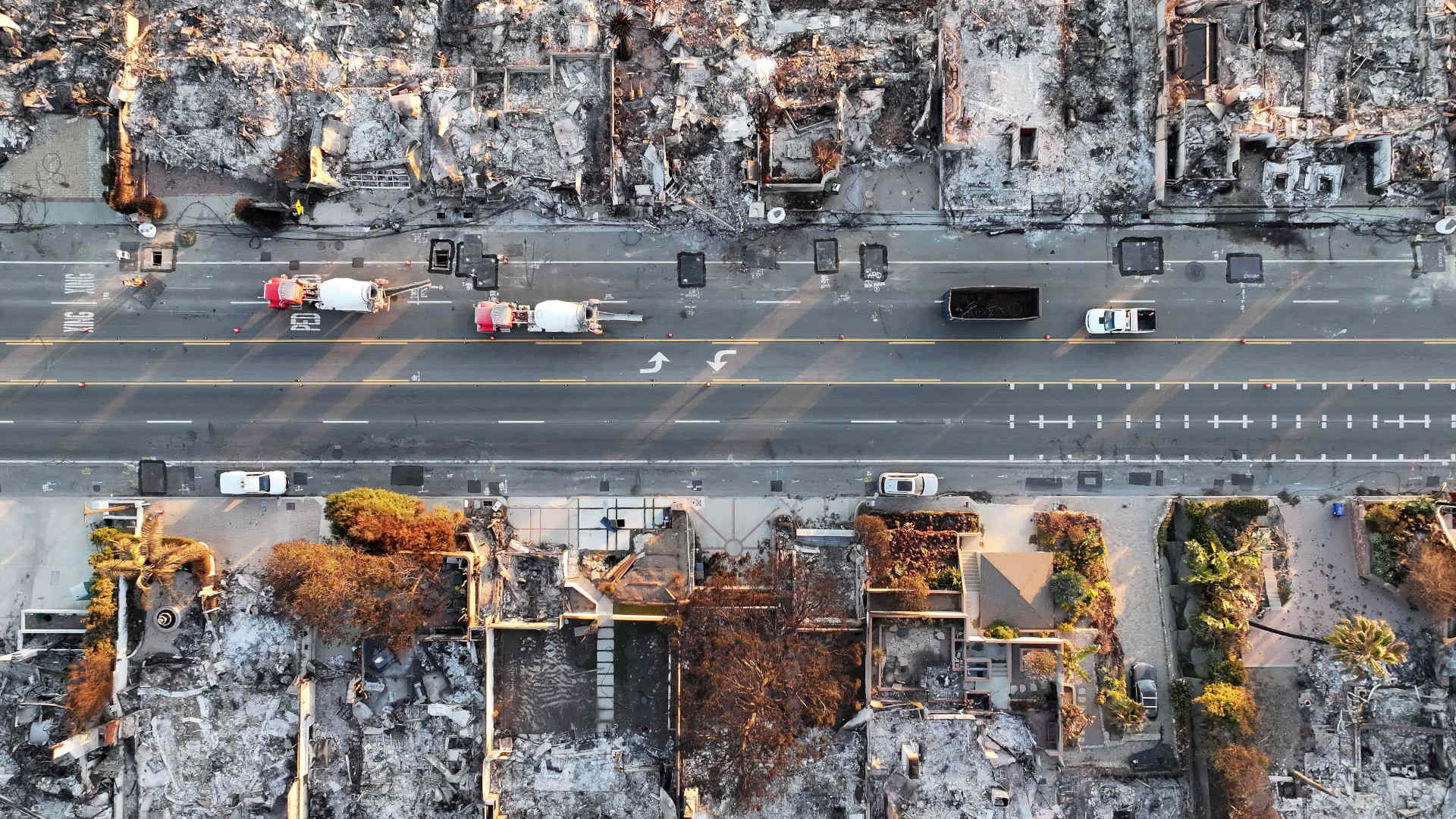
As houses continued to burn in Los Angeles, officials had already started talking about rebuilding the city. “We’re going to rebuild this remarkable community and we’re going to come back,” California Gov. Gavin Newsom said in a call with President Biden on Jan. 10. Los Angeles mayor Karen Bass added her own call for action. “We’re going to recover, and we’re going to rebuild and we’re going to rebuild better.”
This story was originally published by WIRED and is reproduced here as part of the Climate Desk collaboration.
The challenge facing the city is huge. An estimated 12,000 structures have been destroyed in the Palisades and Eaton fires, neither of which has been contained as of last week. At least 25 people have been killed by the blazes, which are on track to be the costliest wildfires in U.S. history. But as the risk of devastating wildfires increases with climate change, the calls to rebuild Los Angeles raise a series of tricky questions: How and where to rebuild — and whether to rebuild at all.
In November 2018, the Camp Fire razed most of the northern Californian town of Paradise to the ground and killed 85 people. The population of Paradise is now just a third of its pre-fire levels, but the town is rebuilding in a way that residents hope will make future wildfires less devastating. “We’ve gone from fire suppression to that not even being possible once there’s an ignition,” says Dan Efseaff, who started working for Paradise Recreation and Park District about a year before the Camp Fire.
One way to lessen the spread and intensity of fires is to reduce the amount of flammable vegetation — often called “fuel” — through prescribed burns, cutting back shrubs, and allowing animals to graze. Forest trails can also give authorities access for fuel management, provide a break in vegetation that slows fires down and, as was the case in the Camp Fire, provide evacuation routes in an emergency.
As well as reducing fuel and introducing more forest trails, residents are also thinking about where new homes will be built and what surrounds them, says Efseaff. Rather than building homes that back directly onto wildland, the town is exploring the use of buffer zones — areas of managed land that distance homes from the highest-risk areas. The idea is that homes can be clustered closer inside these defensible areas, making them easier for fire-fighters to access and defend.
Parks can also be an important part of fire defense: Open spaces like managed parks contain much less fuel, slowing down fires and halting their spread. As the Camp Fire raged, some 80 to 120 Paradise residents sheltered under the pavilion at nearby Bille Park. Since the fire, Esfeaff’s crews have worked in the park removing shrubs and small trees that could spread fire into its taller trees. “We wanted to get rid of those not only from a fire-protection standpoint, but because it also makes the park feel safer,” he says.
There are all kinds of buffer zones, says Max Moritz, a wildfire specialist at UC Santa Barbara. Vineyards, golf courses, baseball fields, and public parks can all be used to provide an open, less flammable space between homes and more flammable vegetation, to attempt to stop and slow fires before they enter neighborhoods. Once fires spread into denser urban areas they become urban conflagrations with whole blocks in danger of going up in flames, as has been the case in northern and eastern Los Angeles.
Rather than building homes that back directly onto wildland, the town is exploring the use of buffer zones — areas of managed land that distance homes from the highest-risk areas.
The planners and residents working to rebuild Los Angeles won’t be starting from a blank slate, however. Existing roads, infrastructure, and plots of lands will all shape how the city is rebuilt. Some residents may want to immediately rebuild on the same plot of land, while some may be willing to sell their land to create a buffer zone.
On Jan. 13, Mayor Bass issued an executive order that will expedite permits for rebuilding “like for like” and exempts these from reviews that would slow down the rebuilding process. Gov. Newsom has also relaxed permitting rules under the California Environmental Quality Act in order to speed up rebuilding.
Exactly how LA then chooses to rebuild is a “social values question,” says Moritz. “It’s not so much of a science question any more. Shouldn’t we as a society be able to weigh in on where and how people are building or rebuilding, so it’s safer and has less of an impact from a public funding perspective down the road? Because a lot of these events will recur.”
Wildfires in California have grown larger and more damaging in recent years. Some 7.08 million acres burned in California between 2009 and 2018 — more than double the area burned between 1979 and 1988. The number of fires encroaching into urban areas has gone up too. In the 10 years between 1979 and 1988, around 22,000 acres of burned land was within so-called wildland/urban interfaces — areas where housing is close to wildfire-prone nature. By 2009–2018 that increased to 32,000 acres.
“Shouldn’t we as a society be able to weigh in on where and how people are building or rebuilding, so it’s safer and has less of an impact from a public funding perspective down the road?”
One result of all this is that Californian authorities have good maps of high-risk areas. Many of the areas hit by the Palisades and Eaton fires were classified as very high fire hazard zones, which means new developments in these areas have to take steps to minimize the risk of fires spreading from wild vegetation into homes, including planting fire-resistant vegetation and keeping any other trees and shrubs trimmed and away from houses.
But housing demand is so high in cities like Los Angeles that developers often end up building in these very high fire-hazard zones anyway. After a wildfire, developers tend to slow down building in high-risk areas for a while, but after a couple of years they return to previous rates of development, says Nicholas Irwin, who studies real estate economics at the University of Nevada, Las Vegas.
Cities and local authorities need to think about ways to discourage development in high-risk areas, says Irwin. One way would be to increase development taxes in areas prone to fires, but another would be to incentivize developers to infill — building more houses and apartments in underused urban areas.
“We do need denser development, especially in places like Los Angeles. The property market there is out of control, and it’s going to be getting even worse,” he says. “We need to think about ways to rebuild that allow more units to be built to help affordability but also ways that are more resilient to future wildfire risks.”
Get Our Newsletter

Burying power lines might also go a long way to defending houses against wildfire risks. The fire that destroyed Paradise was sparked by a power line fault, as were at least seven other of California’s most destructive wildfires. Burying power lines isn’t cheap, and those costs get passed on to utility customers, many of whom don’t live in areas at risk of wildfires.
“It’s these little things that would make a difference in the long run,” says Irwin. Burying power lines, encouraging denser development, and building more defensible communities. But these long-term investments require changing how people think about living in wildfire risk zones and accepting that more resilient communities come at a cost. “I just don’t know if we’re going to learn anything,” says Irwin.
Matt Reynolds is a senior writer at WIRED, where he covers climate, food, and biodiversity.
Comments are automatically closed one year after article publication. Archived comments are below.
It was embers and fire spreading from house to house that caused the catastrophe. Many trees survived. A totally fireproof house is feasible and is not very much more expensive. Rebuilding on the burnt out sites is more economical because the roads and water pipes are still there.