









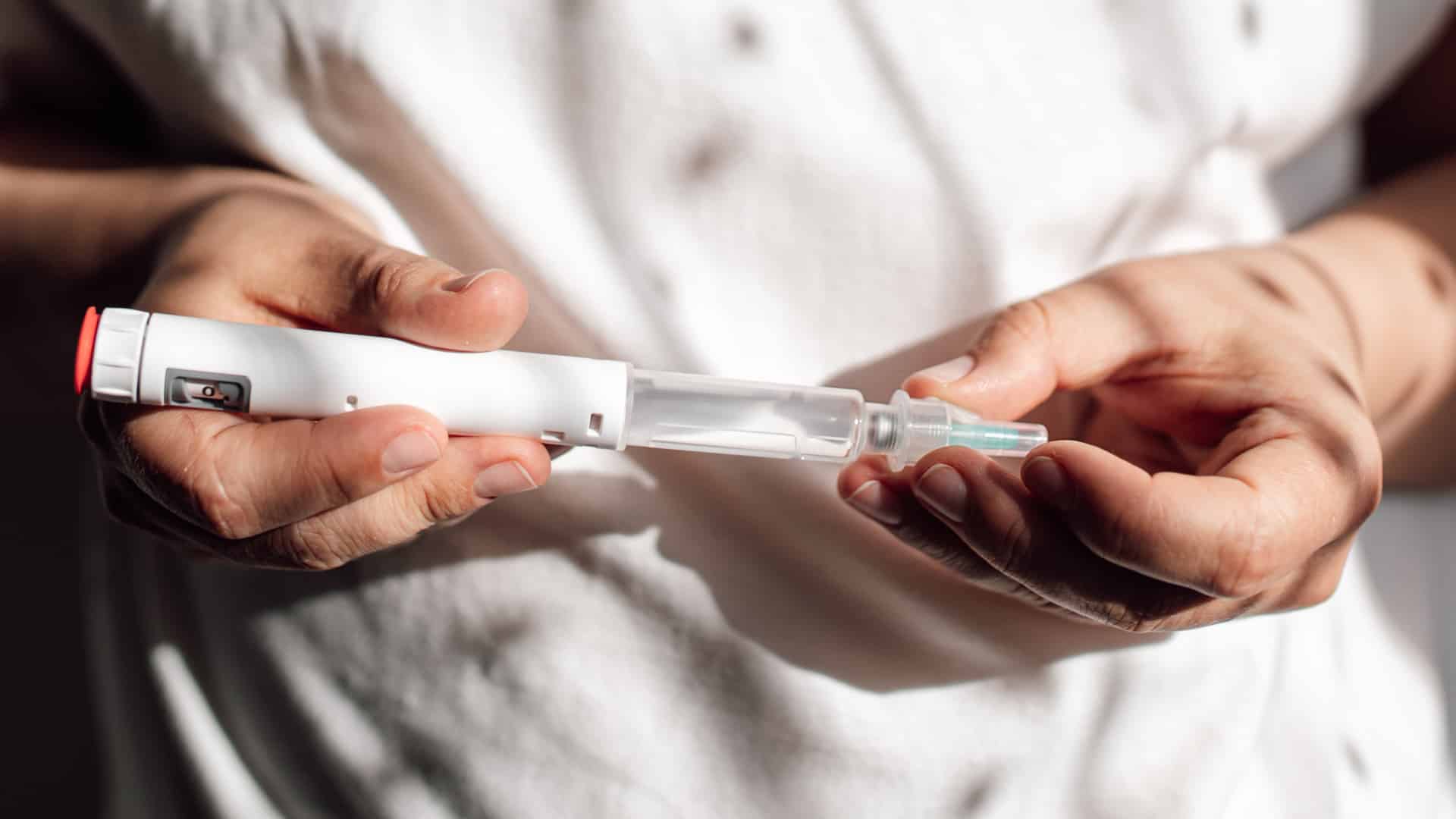
Earlier this fall, the Centers for Disease Control and Prevention reported data showing that adult obesity rates — long trending upwards — had fallen modestly over the past few years, from 41.9 to 40.3 percent. The decline sparked discussion on social media and in major news outlets about whether the U.S. has passed so-called “peak obesity” — and whether the growing use of certain weight-loss drugs might account for the shift.

An opinion piece in the Financial Times suggested that the public health world might look back on the current moment in much the same way that it now reflects on 1963, when cigarette sales hit their high point and then dropped dramatically over the following decades. The article’s author, John Burn-Murdoch, speculated that the dip is “highly likely” to be caused by the use of glucagon-like peptide-1 receptor agonists, or GLP-1s, for weight loss.
It’s easy to see why one might make that connection. Although GLP-1s have been used for nearly two decades in the treatment of type 2 diabetes, their use for obesity only took off more recently. In 2014, the Food and Drug Administration approved a GLP-1 agonist named Saxenda specifically for this purpose. Then in the late 2010s, a GLP-1 drug named Ozempic, made from the active ingredient semaglutide, began to be used off-label. The FDA also authorized Wegovy, another semaglutide-based GLP-1 medication, explicitly for weight loss in 2021.
Still, it is premature to declare that GLP-1s have caused overall declining obesity rates in the U.S. There are a number of ways to interpret the CDC data, and not all of them suggest that obesity rates have actually fallen. Further, recent evidence indicates that GLP-1s might not be as effective for weight loss as initially thought. And there are reasons to question the comparison to cigarette sales. Taken together, all of this suggests that we may need to wait to understand how this new class of drugs affects weight loss at the population level.
The CDC’s recent findings come from a long-running survey known as the National Health and Nutrition Examination Survey, or NHANES, which employs health experts to collect information like weight and height measurements from a nationally representative sample of study participants. Obesity and severe obesity are determined based on body mass index, and results are reported every two years.
There are a number of ways to interpret the CDC data, and not all of them suggest that obesity rates have actually fallen.
Although the recent dip in the overall obesity rate is promising on its face, the survey also found a slight uptick in the percentage of people with severe obesity. As reported by the Associated Press, experts say it’s unclear what might be behind this increase. Furthermore, without granular, patient-level data that links people’s BMI categories to their GLP-1 drug usage, researchers can’t properly ascertain whether the medications are impacting rates of obesity and severe obesity.
In addition, the recent dip in the overall obesity rate was not statistically significant. In other words, the numbers are “small enough that there’s mathematical chance they didn’t truly decline,” according the same article from the Associated Press. And further, the CDC reports that the prevalence of obesity has barely changed over a 10-year period. This contrasts with rates of severe obesity, which did increase from 7.7 to 9.7 percent in surveys running from 2013 to 2023.
In addition, the decline in overall obesity rate reported by the CDC isn’t the first such drop. Between 1999 and 2018, the NHANES results found two instances of slight decreases in obesity rates and two dips in severe obesity rates. These falls were followed by steady increases in both categories.
But with the increased use of GLP-1s, haven’t we reached a tipping point? After all, around 12 percent of American adults have used a GLP-1 agonist, according to a KFF Health Tracking Poll, and about 6 percent, or roughly 15.5 million people, currently take one. The poll also found that just 38 percent of those taking GLP-1 drugs did so mainly to lose weight. A much larger percentage, around 62 percent, said they have taken GLP-1 drugs as a treatment for diabetes, heart disease, or another chronic condition.
Deirdre Tobias, an obesity and nutritional epidemiologist at the Brigham and Women’s Hospital and Harvard Medical School, has cautioned on X against leaping to conclusions about the GLP-1s’ role in possibly having turned the tide on obesity. Despite the recent increase in GLP-1 use, she wrote in an email to Undark, 15.5 million is an “optimistic upper bound.” Within that group of patients, there will be some that “go off the drug before it is effective, go off it after then lose and regain, and those for whom the drug simply does not work,” she wrote.
Get Our Newsletter

There is indeed reason to believe that GLP-1s are not as effective for long-term weight loss as initially hoped. This is in part because discontinuation rates are so high. A study first published late last year in the journal Obesity indicates that only 44 percent of patients who started taking weight-loss medications were still taking them after three months, putting them at risk for regaining any weight that was lost. And recent research from Blue Health Intelligence, a health care data analytics company owned by the Blue Cross Blue Shield Association, found that 58 percent of patients discontinued use before reaching meaningful weight loss, generally defined as at least a 5 percent reduction in baseline.
While patients who do manage to stay on the medication can lose as much weight as the study participants in the pharmaceutical companies’ clinical trials, many don’t. Patients discontinue use for a variety of reasons, including side effects, lack of adequate insurance coverage, and drug shortages. Moreover, even when patients are persistent with their medications, their results might not match trial data (or patient expectations upon starting the drugs). To illustrate, a real-world study published recently in JAMA Network Open found that after one year using semaglutide for obesity, participants lost an average of 12.9 percent of their body weight. That’s a small drop off compared to a 2021 clinical trial published in the New England Journal of Medicine, where the mean reduction in weight across a comparable group of participants after a little over one year was 14.9 percent.
Of the patients currently taking a GLP-1, there will be some that “go off the drug before it is effective, go off it after then lose and regain, and those for whom the drug simply does not work.”
If obesity rates truly are falling, there may be other explanations. The Sports & Fitness Industry Association reported a 5 percent increase in exercise since 2017, for example, and a 2024 study found a slight decrease in the number of people eating unhealthy diets from 1999 to 2020. Also, perhaps higher rates of inflation in the early 2020s have contributed to fewer purchases of junk food, though we don’t know this for sure.
These kinds of non-medical factors were at play when smoking rates first began to drop in the U.S. Anti-smoking efforts picked up speed with the 1964 U.S. Surgeon General’s Smoking and Health report, which was quickly followed by legislation that added warning labels on packages of cigarettes. Over time, public health messaging on the harms of smoking became ubiquitous, and policymakers made use of a wide range of tools, from advertising restrictions to increases in excise taxes to prohibitions on smoking in public buildings. By contrast, the use of GLP-1s isn’t focused on preventing obesity. Rather it aims to treat it, which differs from the preventive messaging of anti-smoking campaigns.
All of this makes it difficult to know if the U.S. has reached an inflection point. Perhaps over time — at least another NHANES cycle — as more data come in, a pronounced trend will emerge and researchers will be able to pinpoint potential causes.