









In Virginia, Data Centers Collide with Zero-Carbon Goals
While short-lived, the denial came as a surprise.
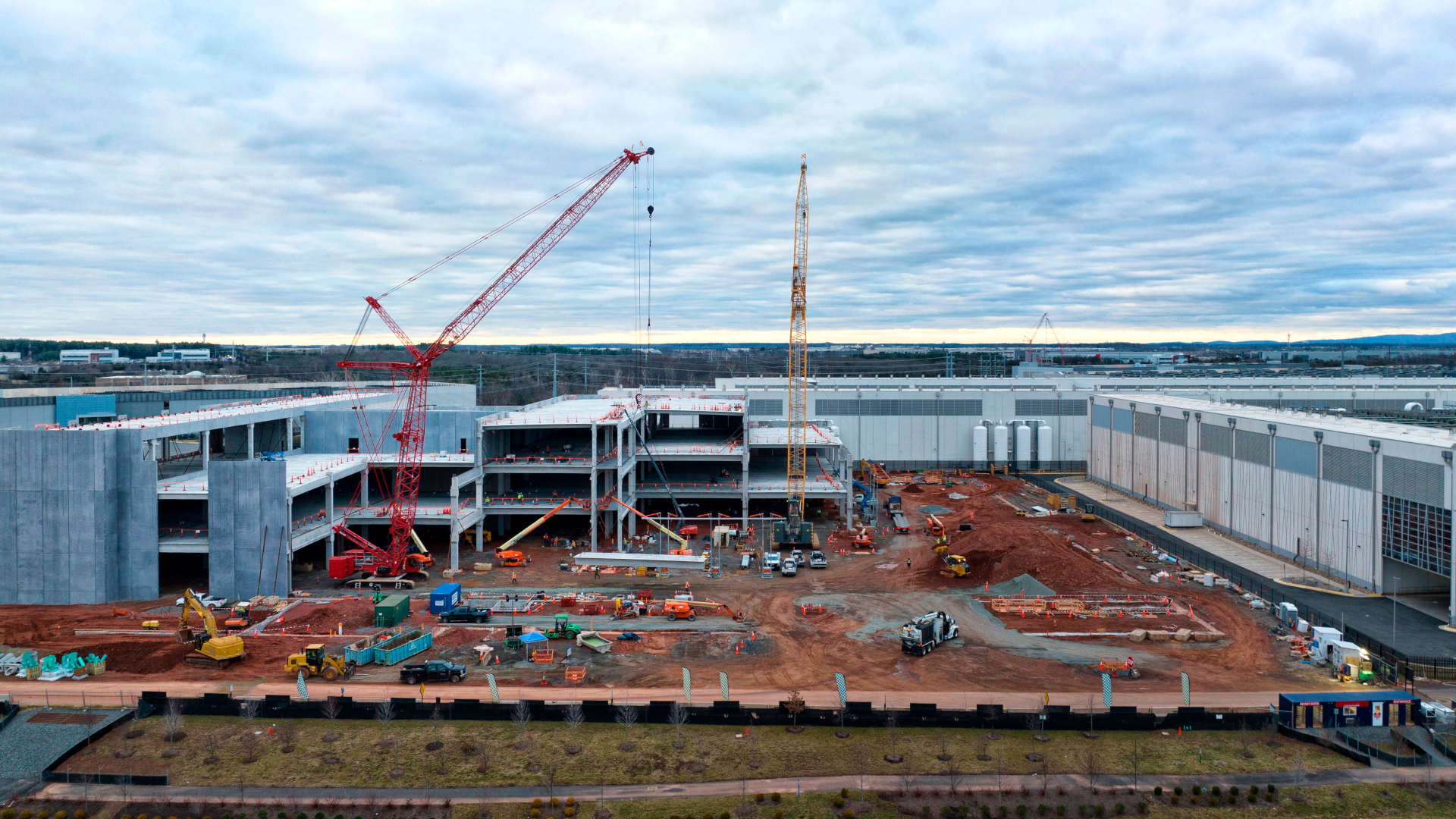
This March, Loudoun County, a suburb of Washington, D.C. in Northern Virginia that is home to the greatest concentration of data centers in the world, made an unexpected move: It rejected a proposal to let a company build a bigger data center than existing zoning automatically allowed.
“At some point we have to say stop,” said Loudoun Supervisor Michael Turner during the meeting, as reported by news site LoudounNow. “We do not have enough power to power the data centers we have.”
This story was originally published by Inside Climate News and is reproduced here as part of the Climate Desk collaboration.
County supervisors would later reverse the decision, approving a smaller version of the project. But the initial denial sent ripples throughout Virginia, where concern over the rapid growth of data centers and what that means for the state’s ambitious decarbonization goals is growing.
“It is really a salient issue for climate right now,” said Tim Cywinski, a spokesperson for the Virginia chapter of the Sierra Club, which has been vocal about its desire to slow down data center development in the state. “The data center industry is about 2 percent of global carbon emissions,” he said, adding “In about two years, I think it will surpass the airline industry.”
Dominion Energy, Virginia’s largest electric utility, has forecast that data centers will be the most significant driver of rising energy demand in the state over the next 15 years. And while the utility has pledged it will decarbonize its Virginia grid by 2045, in line with the Virginia Clean Economy Act passed by the state legislature in 2020, it has also indicated in its most recent long-range plan for utility regulators that new natural gas plants will be needed to meet demand.
“In about two years, I think it will surpass the airline industry.”
“We are 100 percent committed to achieving the goals of the VCEA. We are not taking our foot off the accelerator with renewables,” said Aaron Ruby, a spokesperson for Dominion. But, he added, “the clean energy transition is more challenging than it was a few years ago. The inescapable reality is we are experiencing unprecedented growth in electric demand.”
While some environmentalists say the skyrocketing data center growth threatens Virginia’s ability to go zero-carbon, others say it can be done — but it will require new ways of managing the grid.
“To me it’s not a question of data centers or clean energy,” said Nate Benforado, an attorney with the Southern Environmental Law Center. “I think there is a path forward if we make some improvements.”
Data centers and Virginia have been hand in glove for almost three decades, since companies like MAE-East, Equinix and AOL built some of the earliest modern facilities in the Washington suburbs. With close proximity to the federal government and the defense firms ringing it, Northern Virginia — and especially Ashburn in Loudoun County, known as “Data Center Alley” — quickly became the beating heart of the U.S. data center industry.
“There are data centers located in other areas of Virginia, but roughly 80% of the industry is located in Loudoun County,” Dominion wrote in a recent long-term plan submitted to state regulators. “To put this in perspective, the aggregate of the next six largest data center markets in the U.S. is not as big as Loudoun County’s market.”

Lawmakers have embraced the business. Beginning in 2010, Virginia exempted data centers from sales and use tax for many of the key components of their business as long as they met certain criteria: They had to invest at least $150 million in their facility, create 50 new jobs in the locality where it was sited, and pay at least 150 percent of the prevailing annual average wage. The exemption remains Virginia’s largest economic development incentive.
The gambit worked. A 2019 report by Virginia’s legislative watchdog, the Joint Legislative Audit and Review Commission, found the exemption “has a sizable influence” in attracting data centers to the state. It also has a “moderate economic benefit” for the state, generating about $27 million in Virginia gross domestic product for every $1 million in foregone tax revenue, JLARC concluded.
But as data centers have continued to flock to Virginia, concerns have increased. In Loudoun and neighboring Prince William County, residents complain the facilities’ 24/7 operations produce a constant humming that never stops. Conservationists fear the centers’ expanding footprint is consuming too much land, while their heavy water use could strain local supplies.
Ashburn in Loudoun County, known as “Data Center Alley” — quickly became the beating heart of the U.S. data center industry.
How to deal with the facilities’ power use is also an increasingly urgent question. Data centers are highly electricity-intensive, requiring a steady stream of power to operate around the clock. As the industry expands, more electricity is needed to meet their demand, triggering the construction of not only new sources of power but transmission lines to carry that power from where it’s generated to where it’s used.
Data center representatives have pointed out many companies in the space have been active drivers of renewables development across the nation. In a statement, Data Center Coalition President Josh Levi noted two-thirds of the renewable power bought by U.S. corporations has been wind and solar contracted to data centers and their customers. Companies have also set their own goals: Google aims to operate its data centers on carbon-free energy by 2030, while Amazon is pushing for net-zero carbon emissions by 2040.
“Data centers are highly efficient facilities that enable energy savings and efficiencies for homes, businesses, utilities and other end users,” said Levi. Many, he added, are “on pace to achieve voluntary clean energy targets that predate and outpace many state mandates and targets.”
Even with those commitments, the sheer magnitude of the facilities’ growth in Virginia poses a challenge for utilities, and particularly Dominion. While data centers’ peak energy usage in 2022 was almost 2.8 gigawatts — roughly one and a half times the power produced at Dominion’s largest Virginia plant, the North Anna nuclear facility in Louisa County — the company forecasts they will require roughly 13.3 gigawatts by 2038. Much of that may be due to Amazon Web Services, which Virginia Gov. Glenn Youngkin last year announced intends to invest $35 billion in data center campuses in the state by 2040, although Dominion does not disclose information about specific customers.
“The amount of data center load growth we’re dealing with is absolutely phenomenal,” said Devi Glick, a principal at consultancy Synapse Energy Economics, who testified for the Sierra Club at hearings in Richmond this September on the utility’s Integrated Resource Plan, a non-binding roadmap for how it intends to meet customer demand over the next 15 years. “Everything we’re dealing with is massive and kind of, like, novel.”
Get Our Newsletter

Some environmental groups have challenged the accuracy of Dominion’s forecasts, arguing the utility is overestimating future growth as a way to justify keeping existing natural gas plants running and build new ones, including a proposed peaker plant in Chesterfield County.
Others, including nonprofit Appalachian Voices, say the forecast is shakier than it appears because so much of the expected demand comes from a very small number of companies. According to figures from Dominion, two firms account for 62 percent of the demand the utility expects to see from data centers in 2030. Five account for 80 percent.
“If even one of those five companies changes its growth plans, or if one or more counties in northern Virginia takes an aggressively hostile turn against data center expansion, the actual growth in Virginia could be radically different from what Dominion estimates now,” wrote Rachel James, an attorney with the Southern Environmental Law Center representing Appalachian Voices, this October.
Some environmental groups have challenged the accuracy of Dominion’s forecasts, arguing the utility is overestimating future growth to justify natural gas.
Despite those disagreements, there’s little debate that in the near term, data centers’ electricity demand is skyrocketing. Dominion Vice President of Strategic Partnerships Alan Bradshaw told regulators this September that data centers have signed electric service agreements with Dominion that call for the utility to provide over 5.8 gigawatts to various new facilities by 2032. Bradshaw said he wasn’t aware of any data center customer in Dominion territory abandoning a project after such an agreement had been signed. Over 10 additional gigawatts are in earlier stages of development by companies working with Dominion to obtain power for future projects.
“This week we’ve had an executive meeting with a new entrant on the market, and they want to add two campuses that have 1.2 gigawatts of load,” Bradshaw said at the Sept. 21 hearing. “Literally on the way to the courthouse today, we had another customer call us about a half-gigawatt campus they want to meet with us on. So they just continue to come.”
But while economic development boosters see the uptick in investment as a boon for state and local coffers, environmental groups say if left unchecked, the growth threatens Virginia’s ability to decarbonize its electric grid by 2050.
“We have to make the hard choice about what data centers look like in Virginia now and if it’s worth the cost,” said Cywinski of the Sierra Club. “And right now, we think it’s not.”
All of the long-range plans Dominion presented to regulators last year included new natural gas capacity, ranging anywhere from 970 to 2,900 megawatts of the fuel, an approach the company has defended as necessary to ensure reliability.
“There is no realistic way that we can serve all this growth, keep our customers’ power on around the clock, and only do it with renewables,” said Ruby, the Dominion spokesman. “That is just not realistically possible.”
Ruby said the utility’s calculus isn’t just based on available megawatts. It’s also a matter, he said, of how quickly units can be brought online to meet demand in a crisis. Solar and wind can’t produce electricity around the clock, and while nuclear will remain a mainstay of Virginia power supply — it currently accounts for about a third of Dominion’s Virginia capacity — both the North Anna and Surry plants require hours to ramp up.
“There is no realistic way that we can serve all this growth, keep our customers’ power on around the clock, and only do it with renewables.”
In contrast, he said, with a natural gas plant like the new Chesterfield facility the utility has proposed, “we can ramp that up and dispatch 1,000 megawatts to the grid in 10 to 20 minutes.”
Environmental groups, however, say Dominion shouldn’t be planning to expand its carbon resources in the long term given state law requiring the utility to stop emitting carbon by the middle of the century.
“The transition to clean energy, that is the commonwealth’s policy. It is in the law. That is what we are working towards,” said Benforado, who along with James represented Appalachian Voices in the September case.
How data centers’ rising power demands may impact Virginia’s ability to transition from fossil fuels to renewables is one of the issues the state’s Joint Legislative Audit and Review Commission is tasked with assessing this year. And although lawmakers put forward more than a dozen proposals related to data centers during the last legislative session, the General Assembly delayed consideration of most until the next session, after the state study’s release. Among the bills put forward were proposals to require data centers to meet certain energy efficiency targets to qualify for state tax incentives and have local governments study the regional grid impacts of potential facilities.
“The JLARC study really sucked the wind out of a lot of these,” said Benforado.
In regulatory proceedings, Appalachian Voices and the Sierra Club have argued that rather than building new gas plants, Dominion should explore other ways to meet data centers’ power needs. Proposals include demand response programs that let energy consumers shift or reduce their power usage during times of high demand, such as extremely cold or hot weather. The environmental groups also argued for long-duration battery storage, an emerging but limited technology, and transmission upgrades.
“I think we need much more sophisticated planning that looks at lots of options, lots of tools,” said Benforado. “I do not accept this idea that we have to build gas. … To me, that’s not backed up by analysis.”
“The transition to clean energy, that is the commonwealth’s policy. It is in the law. That is what we are working towards.”
With as many as 11 gigawatts of power needed over the next 15 years to supply data centers, he said, “I think this is the time we need to refocus our efforts.”
“Clean energy aside, if you don’t have smart planning, optimized solutions, it’s going to be really expensive to supply 11 gigawatts,” he said.
Levi of the Data Center Coalition noted that “grid planning and management is ultimately the role of utilities and grid operators.” However, he said the industry “is committed to leaning in as an engaged partner.”
Rising tensions could complicate the search for solutions. Local conflicts over the industry have led to the ousting of at least one official in Prince William County, and in December 2023, 25 nonprofits and other groups, including the Virginia chapter of the Sierra Club, announced they were forming the Virginia Data Center Reform Coalition to seek more regulation of data centers.
Still, Benforado said he believed “win-win solutions” could be found in partnership with the industry.
“I think they’re motivated,” he said. “I hope they’re motivated.”
Sarah Vogelsong is a freelance journalist based in Richmond, Virginia.